Check each claim against its linked experiments, results, and falsification criteria.Know what the science actually supports before you trust the answer.
Press Enter ↵ to check claims
Explore by Goal
"Science is organized knowledge. Wisdom is organized life."
- Immanuel Kant
Quick Answer
Copied
The 2020 FEMS Microbiology Reviews LAB food-gut axis paper is a strong, genome-focused narrative review whose chief limitations are the absence of direct evidence for durable food-to-gut LAB engraftment, reliance on DNA-based detection that cannot distinguish live from dead cells, and heterogeneous, possibly publication-biased clinical evidence .
Long Answer
Core claims and how well they are supported
The review synthesizes LAB diversity across fermented foods and the human gut using FoodMicrobionet (2,234 food samples; 806 fermented-food samples), NCBI genome catalogs (e.g., 2,748 Lactobacillus, 288 Lactococcus, 204 Leuconostoc genomes), and 830 LAB MAGs recovered from human metagenomes (515 Lactobacillus, 243 S. thermophilus, 49 Lactococcus) . Its central, honest conclusion is that foods are rich LAB reservoirs, but that transfer and durable engraftment of foodborne LAB in the gut remain incompletely demonstrated, and that probiotic efficacy is strain-, dose-, and host-dependent .
Note the log scale: gut MAG representation is heavily skewed toward a few genera, so catalog 'completeness' claims for rare LAB should be read cautiously.
Key limitations, verified against the paper
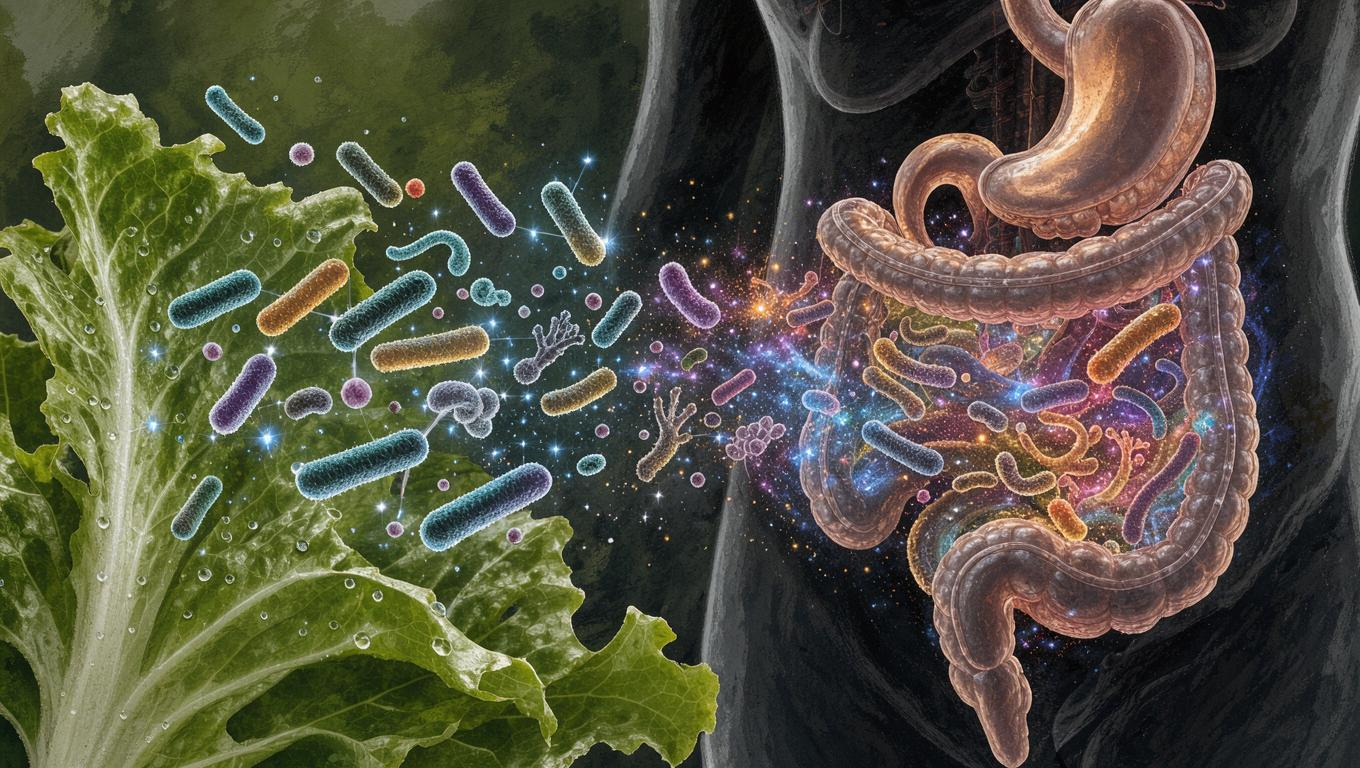
DNA-based detection overestimates live LAB. The review itself flags that HTS may detect DNA from dead/inactive cells and that amplicon methods yield only genus-level resolution — so the reported 90%+ genus-level taxonomic consistency between food and gut LAB (from the parallel lettuce study) does not establish viable, engrafting populations .
No demonstration of engraftment. Genomic presence of GI-survival traits (bsh in >90% of Lb. reuteri; urease in nearly all S. thermophilus; broad eps clusters) is circumstantial; trait presence does not equal in vivo function, and the review concedes bacteriocin in vitro activity often fails to align with in vivo efficacy .
Publication and reporting bias. The review was not systematic (no PRISMA-style protocol); trials listed use doses from 10^7 to 10^11 CFU/day with heterogeneous designs, and the probiotic literature skews toward positive results — a risk the authors acknowledge only partially .
Taxonomic churn undermines cross-study comparability. The Lactobacillus genus split into multiple genera complicates mapping between older food studies, gut MAGs, and clinical trials — a comparability problem the review notes but cannot solve.
Immune-benefit evidence is weaker than the framing suggests. Supporting human data (200 healthy elderly; yogurt vs heat-treated milk; IL-12/IgG1/NK outcomes) come from a single 12-week trial in healthy subjects with transient colonization requiring continuous intake — limited generalizability .
What would change these conclusions
Direct evidence of durable foodborne LAB engraftment (strain-tracked longitudinal shotgun data with viability assays), negative-result-transparent randomized trials, and standardized taxonomy across food/gut catalogs would either confirm or falsify the food-gut LAB transfer hypothesis. The review's own falsification criterion — showing LAB from fermented foods never durably engraft or translate to measurable health benefits in well-controlled trials — remains untested at scale. Confidence in this critique: moderate-to-high, limited by the narrative (non-systematic) nature of the source review and reliance on its own reported counts.
Feedback:
Updated: November 11, 2026
BGPT Paper Review
Study Novelty
80%
Among the first reviews to systematically bridge food microbiome databases (FoodMicrobionet), gut MAG catalogs, and LAB genomics into a unified food-gut axis framework; the framing was ahead of the 2026 lettuce-transmission literature it foreshadowed.
Scientific Quality
90%
Extensive (356 references), genome-grounded, with honest acknowledgment that engraftment is unproven; weaknesses are the narrative (non-systematic) design, no meta-analytic weighting, and unverifiable completeness of trial tables.
Study Generality
80%
Spans foods, gut, genomics, and clinical translation across many populations and matrices; limited mainly by LAB-specific rather than microbiome-general scope.
Study Usefulness
80%
Provides a practical roadmap (MAG workflows, strain-level tracking, trial design) still guiding food-gut transmission studies, including the 2026 lettuce phyllosphere work.
Study Reproducibility
60%
As a narrative review with no registered search protocol, its synthesis cannot be reproduced systematically; underlying databases (FoodMicrobionet, NCBI) are public, partially compensating.
We'll email you the results when your analysis is finished.
Hypothesis Graveyard
'Fermented-food LAB engraft durably and drive health benefits' — not falsified outright, but the review's mixed trial outcomes and transient-colonization data make durable-engraftment-unproven the better current explanation.
'Genomic presence of GI-survival genes (bsh, eps) predicts in vivo probiotic efficacy' — weakened by the review's observation that in vitro bacteriocin activity frequently fails to match in vivo efficacy.

 Explore by Goal
 Quick Answer
 Long Answer
 Top Data Sources
 Ask a Follow-Up
 Key Insight
 Keep Exploring
 Hypothesis Graveyard
 Potential Experiments
 Discussion
