Review an author's claims as they appear in the record: linked experiments, exact results, limitations, and sources.Know what falsifiable science actually supports before you trust the answer.
Press Enter ↵ to search evidence
Explore by Goal
"Just like a single cell, the character of our lives is determined not by our genes but by our responses to the environmental signals that propel life."
- Bruce H. Lipton
Quick Explanation
Copied
Bo Barker Jørgensen is an elite, world-class marine biogeochemist (h-index ~149; ~74,600 citations across 663 works), with field-defining contributions to the sulfur, methane, and nitrogen cycles of marine sediments. Note: the author record supplied with h-index 1 and 146 citations is a disambiguation artifact, contradicted by the full OpenAlex profile.
Long Explanation
Career-Level Evidence
Bo Barker Jørgensen (Aarhus University / Max Planck Institute for Marine Microbiology; ORCID 0000-0001-9398-8027) has 663 works and ~74,594 citations with an h-index of 149, and citation counts of ~2,900–4,000 per year since 2012, indicating sustained, decades-long influence . His author metrics remain relevant and growing into 2026.
Career highlights include the AOM consortium paper (2000, ~3,541 citations), the 1982 Nature sulfate-reduction paper (~2,110 citations), anammox in the Black Sea (2003, ~1,465 citations), microelectrode methodology (~943 citations), and a 2019 sulfur-cycle review (~892 citations) .
Scientific Strength in the Supplied Papers
Across the three provided studies, scientific quality scores were 9/10, novelty 9/10, and explanatory depth 8–9/10, with generality the weakest dimension (7/10 for both Black Sea papers). This reflects Jørgensen's signature approach: combining high-sensitivity methods (35S radiotracers, microsensors, genome-resolved metagenomics) with tight geochemical-microbial reasoning .
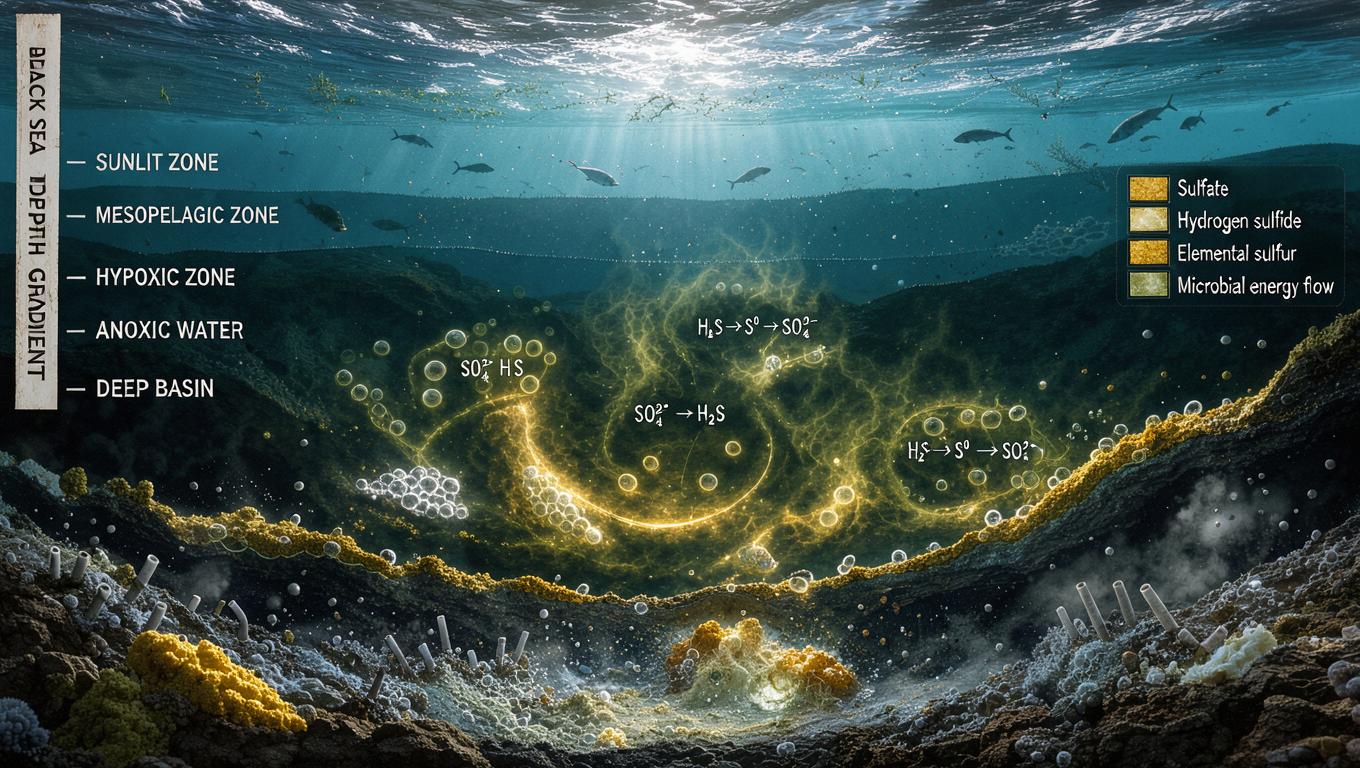
The 2011 Black Sea deep-sediment study established a cryptic sulfur cycle meters below the sulfate-methane transition, with a power-law depth relation SRR = 40,000 × Z^-1.25 pmol cm^-3 d^-1 and Fe(III)-mediated sulfide re-oxidation sustaining deep sulfate-reducing activity .
The 1991 chemocline work quantified sulfide oxidation (1.5–3.6 µM d^-1; areal 14–33 mmol m^-2 d^-1) and thiosulfate as the dominant product (68–83% of 35S-OX), carefully flagging radiotracer and electron-acceptor uncertainties .
Blindspots and Uncertainties
Recurring limitations, largely acknowledged by the author: single-site generalizability (both Black Sea studies); MAG-annotation-based functional inference without direct in situ electron-flux measurements in the 2026 CIET work; and radiotracer artifacts and detection-limit issues in the sulfur studies .
Data-quality note: the author metrics block supplied to BGPT (h-index 1, 146 citations, 1 paper) conflicts with OpenAlex and is almost certainly a name-disambiguation artifact; the OpenAlex profile (h-index 149, 663 works) is the credible record. Confidence: high on career metrics, moderate on paper-specific assessments (three papers only).
Feedback:
Updated: November 22, 2026
BGPT Author Review
Scientific Quality
100%
H-index 149 with ~74,600 citations over 663 works, annual citation counts of ~3,000-4,000, and multiple Nature-level field-defining papers (AOM consortium, sulfate reduction as dominant mineralization pathway, anammox) place him among the most influential living marine biogeochemists. Paper quality scores 9/10 across supplied works. Minor caveats: supplied metrics block was a disambiguation artifact, and single-site studies limit generality; otherwise near-unimpeachable.
Communication Quality
80%
His reviews and 2019 sulfur-cycle synthesis are highly cited, indicating accessible, authoritative writing. Papers pair methodological detail with clear geochemical reasoning, though dense quantitative geochemical-microbial content can challenge non-specialists.
Author Novelty
90%
Co-founded the AOM consortium field, established sulfate reduction as a major sediment mineralization route, demonstrated anammox in the Black Sea, pioneered microelectrode methods, and continues with novel CIET syntrophy genomics in 2026.
Scientific Rigor
90%
Consistent use of radiotracers, microsensors, controls, MAG QC (CheckM2, completeness 97.9-99.8%), replication, and explicit acknowledgment of artifacts (radiotracer carriers, detection limits, depth alignment). Generality limited by single-site designs, but within-study rigor is exceptional.
We'll email you the results when your analysis is finished.
Hypothesis Graveyard
AOM requires direct cell-to-cell contact between archaea and SRB — falsified by the 2026 consortium where electron transfer occurs through a conductive GAC matrix, not direct intercellular contact.
Sulfate reduction ceases below the SMT due to sulfate exhaustion — falsified by detectable SRR and P-SRR at 300-800 cm in Black Sea sediments, sustained by in-situ sulfate regeneration.

 Explore by Goal
 Quick Explanation
 Long Explanation
 Top Data Sources
 Ask a Follow-Up
 Key Insight
 Keep Exploring
 Hypothesis Graveyard
 Potential Experiments
 Discussion
