Check a paper's claims against linked experiments, exact results, stated scope, and limitations.Know what falsifiable science actually supports before you trust the answer.
Press Enter ↵ to search evidence
Explore by Goal
"Look deep into nature, and then you will understand everything better."
- Albert Einstein
Quick Explanation
Copied
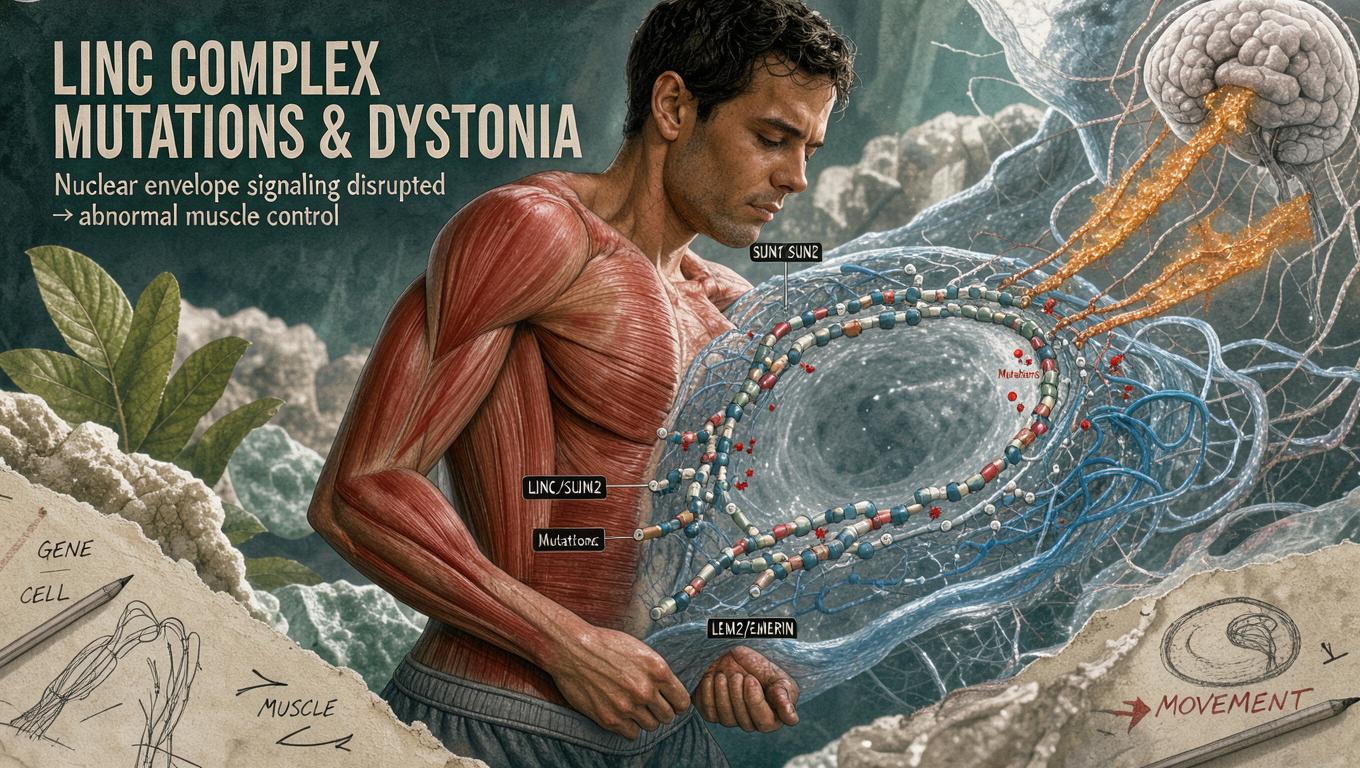
This 2016 review by Saunders and Gant Luxton (Cellular and Molecular Bioengineering, DOI: 10.1007/s12195-016-0432-0) synthesizes SUN-KASH crystal structures with torsinA cell biology, proposing that torsinA is a candidate LINC complex regulator within the perinuclear space whose dysfunction may contribute to DYT1 dystonia. The central mechanistic model remains speculative due to geometric constraints and lack of in vivo validation.
Long Explanation
Paper Overview and Synthesis
This review by Saunders and Gant Luxton (University of Minnesota) integrates two research streams: recent crystal structures of the SUN2-KASH interaction within the Linker of Nucleoskeleton and Cytoskeleton (LINC) complex, and cell biological evidence that torsinA—the AAA+ protein mutated in DYT1 dystonia—may regulate LINC complex assembly. The central hypothesis is that torsinA, activated by LAP1 and LULL1 through active site complementation, acts as a molecular chaperone controlling KASH-SUN heterohexamer formation within the perinuclear space, and that defective torsinA function disrupts nuclear-cytoskeletal coupling to produce dystonia .
Critical Analysis
The review's strength is its rigorous synthesis of structural biology (SUN2 trimers, KASH-lid, disulfide bonds) with cell biology (torsinA-nesprin interactions, LULL1-dependent INM targeting). However, the central proposal—that torsinA directly remodels KASH-SUN interactions—remains speculative. The review itself acknowledges a geometric paradox: torsinA is INM-localized, yet the KASH domains it supposedly regulates sit on the ONM across a ~30-50 nm perinuclear space, making direct access unclear . Conflicting reports on torsinA oligomerization across labs further complicate the model.
Downstream functional consequences of torsinA loss are better established in other contexts—altered Purkinje cell dendritic morphology in Dyt1 ΔGAG mice and sensorimotor integration deficits in DYT1 knock-in mice . Neither is directly attributable to LINC complex dysfunction, highlighting a gap between the torsinA-LINC model and established dystonia phenotypes. Striatal microstructural changes represent an alternative pathogenic mechanism the review does not integrate .
Overall Assessment
Best understood as a hypothesis-generating conceptual framework rather than a definitive mechanistic account. Its value lies in organizing structural biology, cell biology, and disease genetics into a coherent testable question: how does a luminal AAA+ ATPase regulate a force-transducing complex spanning two membranes? The answer remains unknown.
Feedback:
Updated: November 25, 2026
BGPT Paper Review
Study Novelty
70%
First to integrate SUN2-KASH structural data with torsinA cell biology and propose a specific regulatory mechanism linking LINC complex assembly to DYT1 dystonia; conceptual advance rather than new data.
Scientific Quality
70%
Well-referenced, logically structured, and honest about gaps; however, it is a hypothesis-generating review with no new experimental data, and the central model remains unvalidated in vivo.
Study Generality
70%
LINC complex regulation is broadly relevant to mechanotransduction, nuclear positioning, and multiple diseases; DYT1 framing narrows scope but the regulatory question is general.
Study Usefulness
70%
Provides a useful conceptual framework and testable predictions for cell biologists and dystonia researchers; limited immediate practical application without in vivo validation.
Study Reproducibility
60%
As a review, reproducibility applies to synthesis claims; it accurately reflects published data but includes speculative models that cannot be directly replicated without new experiments.
Explanatory Depth
80%
Deep mechanistic reasoning across multiple scales—from crystal structures to perinuclear space geometry to disease genetics—though ultimately stops short of a definitive mechanism.
We'll email you the results when your analysis is finished.
Hypothesis Graveyard
TorsinA is a conventional AAA+ unfoldase that directly pulls apart KASH-SUN bonds like ClpB—undermined by lack of substrate-binding domain and by LAP1/LULL1 acting as co-factors, not substrates.
DYT1 dystonia is purely gain-of-function toxic aggregation—undermined by knockout phenocopy studies showing loss-of-function mechanisms, though partial gain-of-function (e.g., abnormal SUN1 association) may coexist.

 Explore by Goal
 Quick Explanation
 Long Explanation
 Top Data Sources
 Ask a Follow-Up
 Key Insight
 Keep Exploring
 Hypothesis Graveyard
 Potential Experiments
 Discussion
