Check each claim against its linked experiments, results, and falsification criteria.Know what the science actually supports before you trust the answer.
Press Enter ↵ to check claims
Explore by Goal
"The most exciting phrase to hear in science, the one that heralds new discoveries, is not 'Eureka!' but 'That's funny...'"
- Isaac Asimov
Quick Explanation
Copied
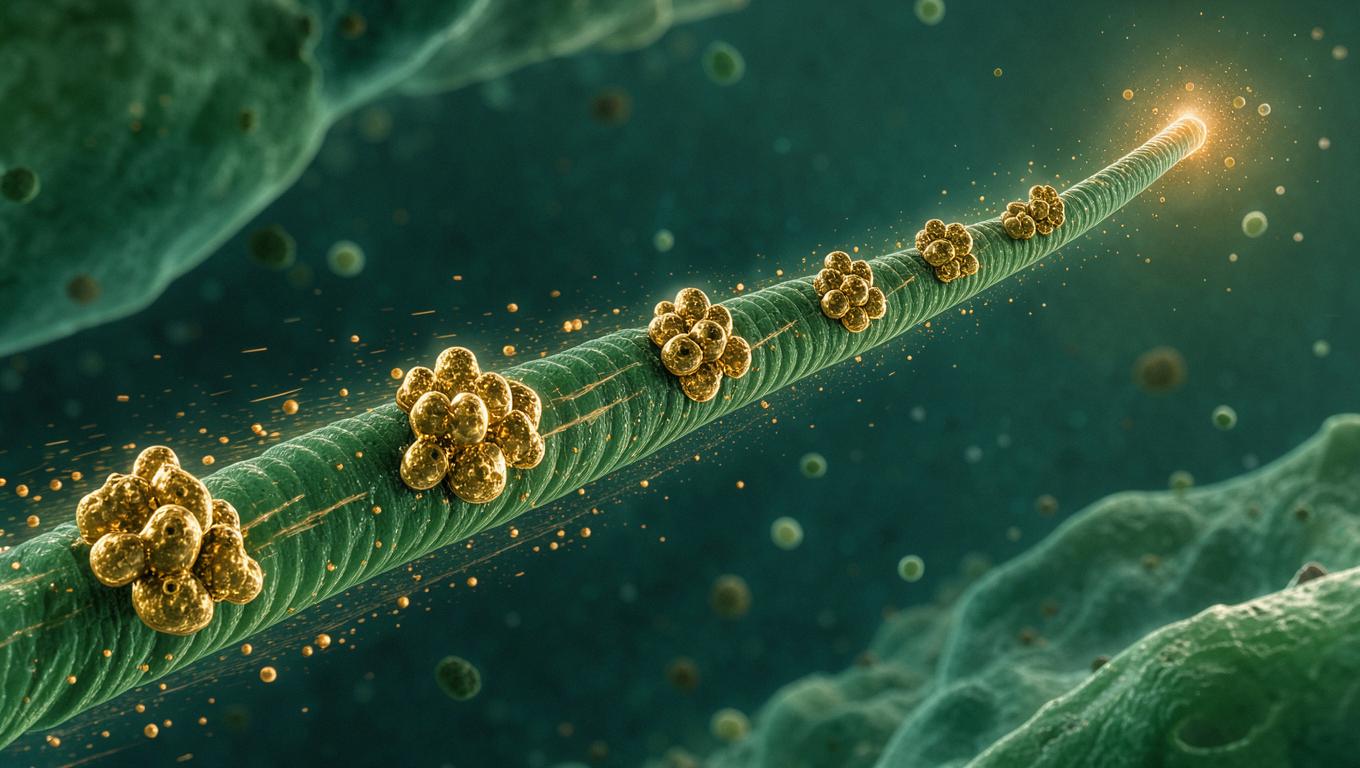
This 2005 Eukaryotic Cell paper identifies the cytoplasmic chaperone HSP70A as a genuine Chlamydomonas flagellar protein (~10% of the cellular pool), shows its mRNA is upregulated during flagellar regeneration, and demonstrates >90% colocalization with IFT kinesin FLA10, suggesting HSP70A travels as IFT cargo to assist flagellar protein folding and delivery.
Long Explanation
What the Paper Established
Building on the authors' 1995 discovery of a flagellar Hsp70, this study identifies the protein via ATP-agarose purification and MALDI-TOF mass spectrometry (9/11 peptide masses matched, 26.2% sequence coverage) as HSP70A, the major cytoplasmic isoform bearing the conserved EEVD motif. Approximately 10% of cellular HSP70A resides in flagella; the chloroplast isoform HSP70B is absent from flagella, supporting specificity. An HSP70A::HA epitope-tagged transformant recapitulates native localization without gross effects on growth or motility, strengthening the result against antibody-artifact concerns.
HSP70A mRNA rises 30 min after pH-shock deflagellation, paralleling tubulins — though HSP70B also rises, honestly signaling a possible whole-cell stress-response confound rather than flagellum-specific regulation. Within flagella, HSP70A shows a punctate distribution concentrating at tips, and >90% of FLA10 (IFT kinesin-II) signal colocalizes with HSP70A. Variable stoichiometry leads the authors to conclude HSP70A is IFT cargo, not integral machinery — supported by transparent reporting of failed direct-interaction assays (cofractionation, co-IP, cross-linking, immunoelectron microscopy).
Critical Assessment
Strengths: multiple orthogonal methods (biochemistry, mass spectrometry, RT-PCR, endogenous immunofluorescence, epitope tagging), honest negative results, isochronal RT-PCR controls (S14, CBLP unchanged), and independent corroboration by an unpublished flagellar proteome analysis (Pazour/Witman, cited in-text).
Limitations: colocalization does not prove cargo transport; no fla10 temperature-sensitive mutant test (loss of HSP70A flagellar entry upon IFT blockage would have been decisive); no functional perturbation showing HSP70A affects flagellar assembly; HSP70B co-upregulation weakens the transcription-specificity argument; single-organism scope. BGPT inference: the cargo hypothesis is an author interpretation from analogy to hsc70-kinesin release in axonal transport, not a demonstrated mechanism.
Falsification path: show HSP70A fails to enter flagella in IFT-defective mutants, or that HSP70A loss does not impair flagellar assembly/maintenance.
Feedback:
Updated: October 30, 2026
BGPT Paper Review
Study Novelty
60%
The 1995 predecessor paper had already reported a flagellar Hsp70; this work identifies the isoform, confirms localization rigorously, and links it to IFT — an incremental but meaningful identification.
Scientific Quality
70%
Multiple orthogonal methods, honest negative results, appropriate controls (S14/CBLP, HSP70B, no-primary-antibody). However, the central cargo hypothesis rests on colocalization alone; no fla10 mutant dependency test, no functional HSP70A perturbation, and HSP70B upregulation confounds the transcription claim. No conflicts declared.
Study Generality
60%
Findings concern one organism and one Hsp70 isoform, but the implication — cytosolic chaperones as IFT cargo — is relevant to ciliary biology broadly, pending cross-species confirmation.
Study Usefulness
70%
Provides the molecular identity and tools (antibodies, HA-tagged strain) enabling later functional studies of chaperone roles in ciliary assembly; no direct application demonstrated.
Study Reproducibility
70%
Detailed primers, strains (CC-1690, CC-3941, CC-2929), reagent sources, and standard methods allow replication; no data deposition and reliance on unpublished proteome corroboration reduce transparency.
Explanatory Depth
60%
Localization and regulation are well characterized, but mechanism remained unresolved — the authors explicitly failed to find interactors and frame cargo function as speculative analogy to axonal hsc70-kinesin release.
Comparing HSP70A/FLA10 colocalization claims against Chlamydomonas flagellar proteome datasets to evaluate whether Hsp70 behaves as IFT cargo versus a structural IFT component.
Get emailed when your analysis is done!
We'll email you the results when your analysis is finished.
Hypothesis Graveyard
HSP70A is an integral IFT particle component — rejected by variable stoichiometry with FLA10 and inconsistent cofractionation across interaction assays.
Flagellar HSP70A is a heat-shock contamination artifact of the deflagellation assay — weakened by steady-state presence in full-length flagella and independent proteomic confirmation, though stress-response regulation remains a caveat.

 Explore by Goal
 Quick Explanation
 Long Explanation
 Top Data Sources
 Ask a Follow-Up
 Key Insight
 Keep Exploring
 Analysis
 Hypothesis Graveyard
 Potential Experiments
 Discussion
