Why BGPT?
logo

Test Ideas Against Reported Evidence

Check your hypothesis against versioned claims, exact reported results, and stated falsification criteria.Know what falsifiable science actually supports before you trust the answer.

Press Enter ↵ to search evidence


     Quick Analysis Plan


    The supplied evidence contains no data on ants, temperature-gated attachment, or motor outputs; it only shows that fungal effector outcomes are host-context dependent (host genotype in maize–Ustilago maydis and microbiota in tomato–Verticillium) .


     Long Analysis Plan


    What the evidence supports — and what it does not

    The temperature-gating claim about manipulated ants cannot be evaluated: none of the supplied records address Ophiocordyceps, insect hosts, attachment persistence, or temperature–motor-output interactions. BGPT inference: what the sources do show is that a fungal effector's effect on host output is context-dependent — host genotype (six maize lines; 102 line-specific secreted effector DEGs, p=5.65e-30) and host microbiota (Vd424Y deletion reduces disease only when microbiota is present) . By analogy, temperature could conditionally modulate effector→motor mapping, but this is untested here. To plan the analysis, the missing inputs are: ant behavioral time-series across controlled temperature gradients, matched fungal transcriptomes (effector expression), and survival-attachment data — none of which are provided.


    Feedback:    

    Updated: November 21, 2026


     Top Data Sources ExportMCP


     Hypothesis Graveyard


    That the query's ant-temperature claim is established science from these records: it is not; no supplied source mentions ants or temperature.


    That effector context-dependence is purely genetic: Vd424Y microbiota-dependent virulence shows environmental mediation, but temperature specifically remains untested.

     Science Art


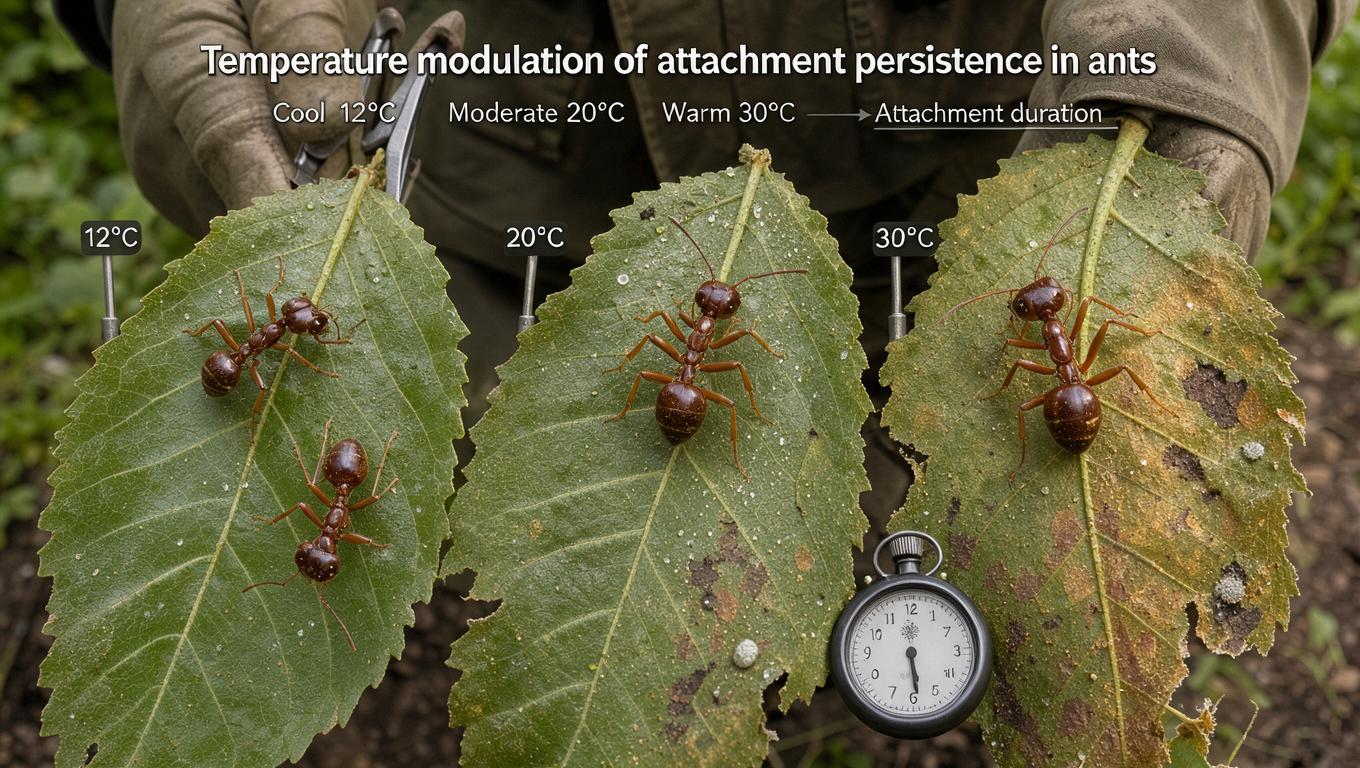
    Temperature acts as a gate that times when manipulated ants are exposed (attachment persistence) and also alters how fungal effectors map to host motor outputs (i.e., the same effector profile can produce immobility in cool microclimates but intermittent movement in warm ones), meaning parasite fitness and transmission windows are highly temperature conditional. Science Art

     Science Movie


    Make a narrated HD Science movie for this answer ($64 per minute)


     Discussion


    Stay current without chasing every paper.

    Know what changed, what holds up, and what remains uncertain. Every Friday. No ads.


    My BGPT