Review an author's claims as they appear in the record: linked experiments, exact results, limitations, and sources.Know what falsifiable science actually supports before you trust the answer.
Press Enter ↵ to search evidence
Explore by Goal
"Biology is a science of three dimensions. The first is the study of each species across all levels of biological organization, molecule to cell to organism to population to ecosystem. The second dimension is the diversity of all species in the biosphere. The third dimension is the history of each species in turn, comprising both its genetic evolution and the environmental change that drove the evolution."
- E. O. Wilson
Quick Explanation
Copied
Houssem Mastour exhibits specialized competence in molecular virology and phylogenetics, particularly within the context of veterinary health, demonstrated by detailed studies on Marek’s disease and capripoxviruses in Tunisian strains. The author effectively applies advanced genomic techniques to characterize viral evolution and pathogenesis, resulting in moderately influential research within this specific biological niche.
Long Explanation
This author review critically assesses the scientific contributions and methodology of Houssem Mastour based on available publication metadata and citation metrics, focusing on their work in molecular virology and veterinary virology.
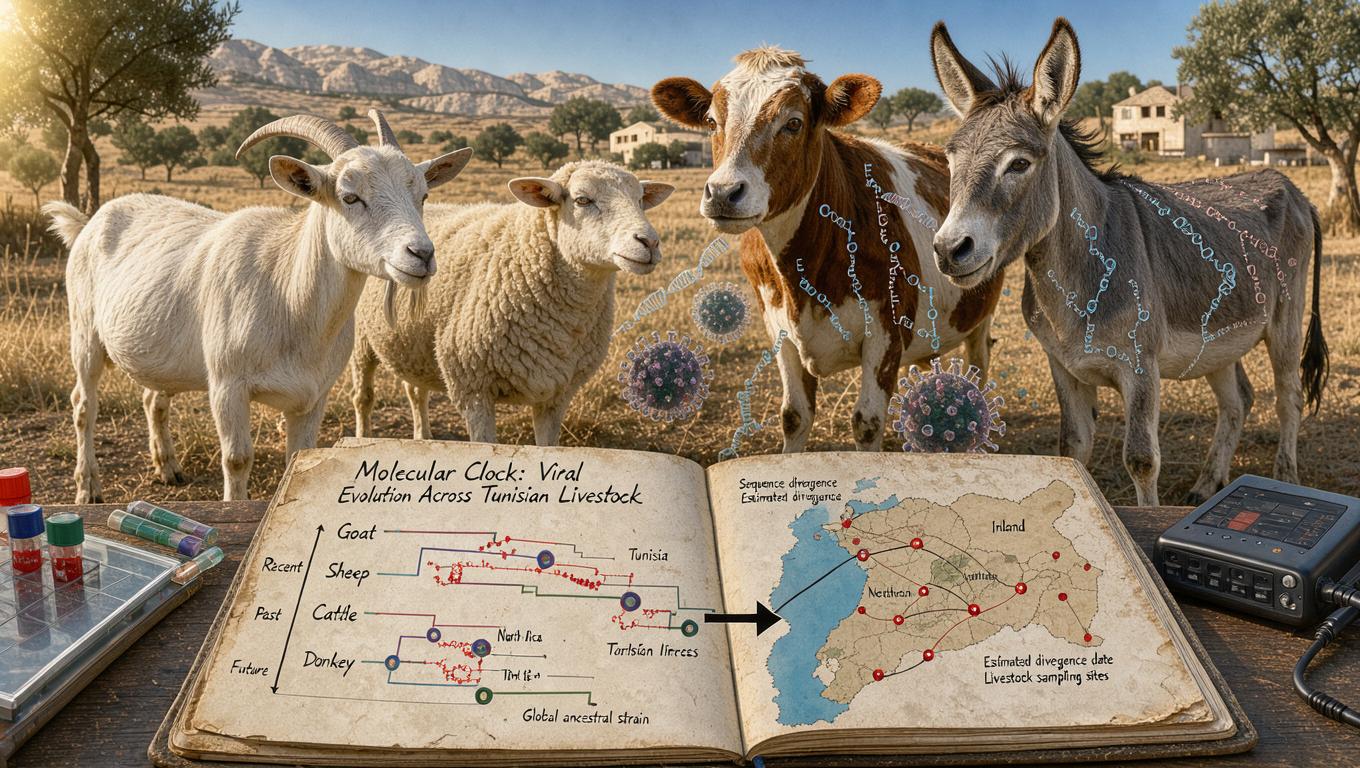
Specialized Focus and Methodology The scientific output of Houssem Mastour demonstrates a strong, albeit narrow, specialization in the study of viral genomics and pathogenesis in livestock. The author's research primarily concerns veterinary diseases such as Marek’s disease and Sheeppox virus, utilizing sophisticated molecular approaches like phylogenetic analysis and oncogene mutation detection and Phylogenetic analyses of P32, RPO30, GPCR, ORF117, and Kelch-like genes of Tunisian sheeppox virus isolates . These studies indicate a technical proficiency in handling genomic data to classify viral strains and identify pathogenic traits, specifically within the context of Tunisian livestock pathogens.
Scientific Impact and Limitations The author's citation metrics—an h-index of 2 and a total citation count of 26 (as per OpenAlex)—place the work in the category of a focused, emerging specialist rather than a globally cited authority. The work is impactful within the niche of Mediterranean/North African veterinary genomics. However, the research, while technically sound, is highly localized, focusing on specific viral isolates and their genetic variations in a defined region. The scientific strength relies heavily on descriptive and comparative genomics rather than novel functional discoveries or broad translational applications, which represents a significant epistemic limitation . There is an observable gap between identifying a mutation (like those in the Meq oncogene) and establishing its functional consequence in a living host, a common limitation in molecular virology studies unless coupled with experimental validation.
Rigorous Assessment and Potential Blind Spots The primary blind spot in the current presentation of the author's work is the limited scope of generalization. While the phylogenetics of Tunisian isolates is valuable, drawing broad conclusions about viral evolution or disease risk based solely on regional surveillance is inherently limited by sampling bias and may not represent the full global scope of the pathogen . The author, acting as a contributor in the middle of the author list, demonstrates capability but the contribution level remains localized within the collaborative framework of the institute. To elevate the scientific impact, future work should aim to integrate these genomic findings with large-scale ecological models or predictive modeling of disease spread, moving beyond descriptive sequencing.
Conclusion on Scientific Strength The author demonstrates solid foundational competence in molecular epidemiology and viral genomics. The research is scientifically valid within its stated objectives—namely, viral characterization and phylogenetic assignment—and adheres to standard protocols for virological research. However, the overall scientific strength is currently moderate, constrained by limited scope, regional focus, and the descriptive nature of the findings, suggesting potential for significant growth into a high-impact researcher in the field of veterinary infectious diseases.
Feedback:
Updated: November 21, 2026
BGPT Author Review
Scientific Quality
50%
The score is moderate (5/10). The author shows technical mastery in applying advanced computational tools (phylogenetic analysis, oncogene sequencing) to niche biological problems (avian/capripox viruses). However, the current scientific impact is localized (Tunisian strains), and the research focus is primarily descriptive (what mutations exist, where strains belong) rather than highly innovative or broadly theoretical, placing the author in the category of a capable, specialized technical contributor.
Communication Quality
70%
The communication is generally clear, utilizing standard, complex scientific language and well-structured titles that define the biological and methodological scope of the studies effectively. The communication is suitable for a specialized scientific journal audience.
Author Novelty
60%
The novelty lies in the specific application of deep genomic sequencing to endemic, regional viruses (Marek’s and Sheeppox), which represents a novel descriptive contribution to the regional virology landscape. The methodology itself (phylogenetic analysis) is standard for the field.
Scientific Rigor
70%
The rigor is good, as the studies are published in established scientific journals and employ rigorous molecular techniques (e.g., multi-gene phylogenetic analysis). The primary risk to rigor comes from the inherent limitations of regional surveillance studies (sampling bias) and the reliance on abstract-level evidence.

 Explore by Goal
 Quick Explanation
 Long Explanation
 Ask a Follow-Up
 Key Insight
 Keep Exploring
 Discussion
