Check each claim against its linked experiments, results, and falsification criteria.Know what the science actually supports before you trust the answer.
Press Enter ↵ to check claims
Explore by Goal
"The scientist is not a person who gives the right answers, he's one who asks the right questions."
- Claude Lévi-Strauss
Quick Answer
Copied
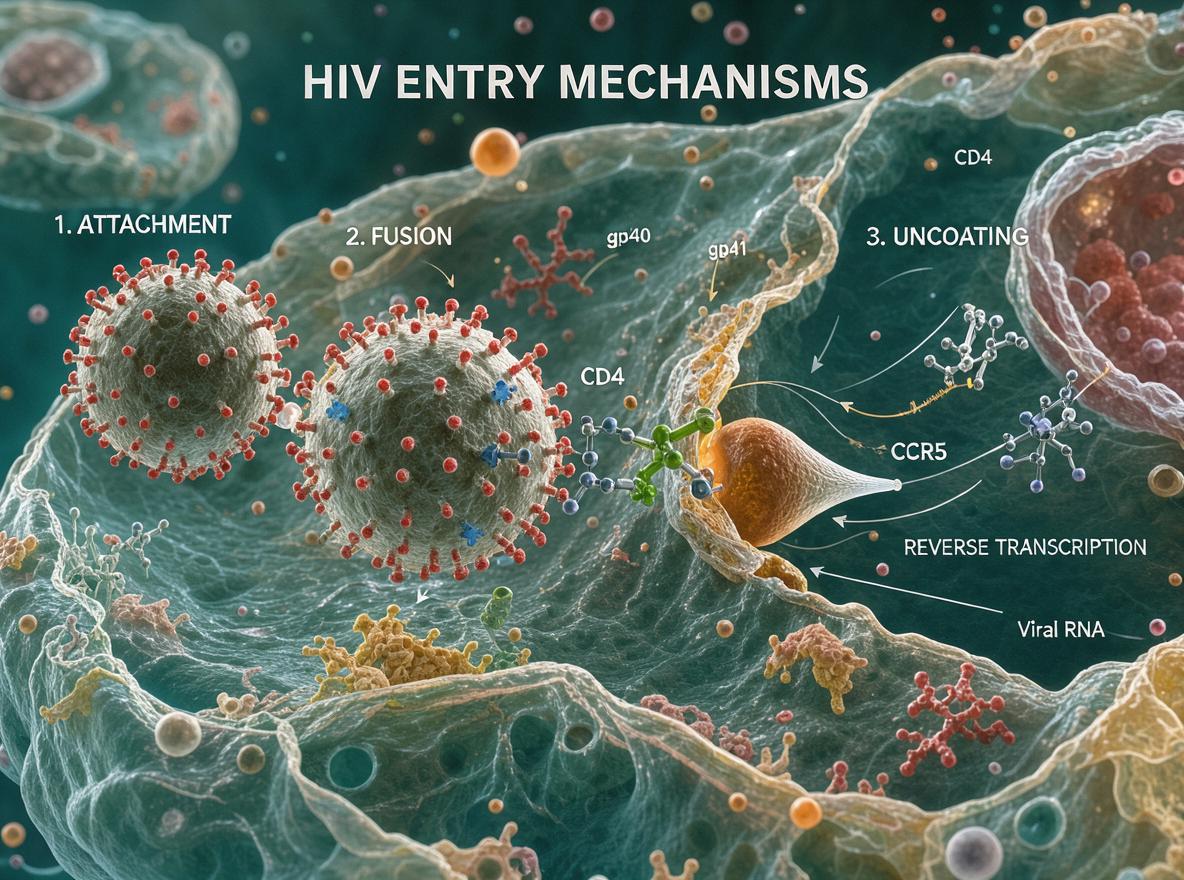
HIV entry is a multistep, coreceptor-dependent process: gp120 must engage CD4, then CCR5 or CXCR4, triggering gp41 fusion; coreceptor mobility, cholesterol-rich membrane domains, and cell-type-specific restrictions all modulate efficiency, and entry inhibitors (enfuvirtide, CCR5 antagonists) exploit these steps .
Long Answer
Coreceptor Complexity in HIV Entry: Evidence Synthesis
HIV-1 entry requires sequential engagement of CD4 and a chemokine coreceptor (CCR5 or CXCR4), triggering conformational changes in gp120/gp41 that drive membrane fusion. The reviewed literature converges on the view that coreceptor usage is not a simple binary switch but a dynamic process shaped by membrane biophysics, host-cell context, and viral evolution.
Coreceptor mobility is asymmetric and cholesterol-dependent. FRAP experiments show CCR5 recovers ~100% within 90 s while CD4 retains a ~20% immobile fraction; methyl-β-cyclodextrin depletion markedly reduces CCR5 mobility but leaves CD4 mobility unaffected, implying that cholesterol-dependent CCR5 recruitment to fusion sites is a rate-limiting step in entry . Caveat: overexpressed GFP/YFP fusions in non-primary cell lines may not reflect native receptor dynamics, and direct infectivity assays were not performed.
Entry inhibitors map onto this pathway. Enfuvirtide targets the gp41 six-helix bundle intermediate; CCR5 antagonists (e.g., maraviroc-class) block coreceptor engagement, with clinical evidence in treatment-experienced patients . Small molecules like BMS-806 block receptor-induced Env conformational changes without preventing CD4 binding , while antibodies to gp41 fusion intermediates inhibit entry preferentially at reduced temperatures, exposing kinetic vulnerabilities .
Alternative binding routes complicate the coreceptor model. Sperm glycolipids (SGalAAG, GalAAG) bind gp120 with sub-nanomolar affinity and could facilitate gp120-mediated fusion independent of canonical protein receptors . Broadly neutralizing antibody 2G12 neutralizes by reversibly binding gp120 glycans, slowing rather than blocking entry (titer drops from 1,700 to 21 FFU) .
Post-fusion complexity is equally significant. The HIV-1 capsid partitions into FG-repeat nuclear pore phases with coefficients ~1,000–2,000 (in:out), and CPSF6 extracts capsids to complete nuclear import—an entry mechanism as intricate as the receptor-binding stage . In dendritic cells, endocytosis-related host factors (FNBP1L, ARHGAP24, ATP6V1B1) restrict entry in a cell-type-specific manner .
Blindspots and Limitations
Most mechanistic data derive from immortalized cell lines with overexpressed fluorescent constructs; primary-cell validation is sparse.
FRAP provides ensemble averages, not single-molecule trajectories; the causal link between CCR5 mobility and fusion efficiency remains inferential.
Glycolipid gp120 binding is demonstrated in vitro on monolayers and sperm membranes—relevance to productive T-cell entry is unestablished.
Co-evolution analyses identify 424 coevolving Env residue pairs but lack direct structural validation of predicted contacts .
Confidence and Falsifiability
Confidence is high that CD4 plus a coreceptor (CCR5 or CXCR4) is necessary for productive HIV-1 entry in canonical T-cell infection, and moderate that cholesterol-dependent CCR5 mobility is a kinetic contributor. The conclusion would be revised if receptor-immobilization experiments or cholesterol manipulation failed to alter entry in primary cells, or if CCR5-independent entry routes proved broadly productive in vivo.
Feedback:
Updated: October 27, 2026
BGPT Paper Review
Study Novelty
50%
Coreceptor complexity (CD4/CCR5/CXCR4) is well-established; the review consolidates rather than introduces new mechanisms.
Scientific Quality
80%
Well-sourced synthesis spanning biophysics, pharmacology, and virology; no raw data or new experiments, limiting independent verification of claims.
Study Generality
70%
Principles of receptor-mediated entry and coreceptor switching generalize to other enveloped viruses, though depth is HIV-specific.
Study Usefulness
70%
Informs entry-inhibitor design (enfuvirtide, CCR5 antagonists, microbicides) and membrane-biophysics research directions.
Study Reproducibility
40%
As a review, it provides no primary data or protocols; reproducibility depends entirely on the primary studies cited.

 Explore by Goal
 Quick Answer
 Long Answer
 Top Data Sources
 Ask a Follow-Up
 Key Insight
 Keep Exploring
 Hypothesis Graveyard
 Discussion
