Ask questions across claims linked to experiments, exact results, limitations, and sources.Know what falsifiable science actually supports before you trust the answer.
Press Enter ↵ to search evidence
Explore by Goal
"The most exciting phrase to hear in science, the one that heralds new discoveries, is not 'Eureka!' but 'That's funny...'"
- Isaac Asimov
Quick Explanation
Copied
Korah, Boots and Wieder demonstrate that FGF-2 growth-arrests well-differentiated breast cancer cells, up-regulates integrin α5β1, and restricts survival of dormant clones to fibronectin via PI3K/Akt signaling — fibronectin-supported dormant clones reached 249–305% of plastic controls by day 15, and GRGDSP blockade reduced them by 50–64% (P<0.001) . The model is internally well-controlled but entirely in vitro with only two dormancy-competent lines, so clinical marrow dormancy relevance remains unproven.
Long Explanation
Core Finding and Evidence Base
Korah, Boots and Wieder reconstituted an in vitro paradigm of breast cancer dormancy in bone marrow: FGF-2 (10 ng/mL) completely suppressed clonogenic growth of well-differentiated MCF-7 and T-47D cells (EGF had no effect; MDA-MB-231 was unresponsive) yet spared small, spread-out dormant clones whose survival was selectively supported by fibronectin . Up to day 15, fibronectin-supported dormant clones reached 249% (MCF-7) and 305% (T-47D) of tissue-culture-plastic controls, versus 55%/57% on collagen I and 32%/99% on collagen IV — despite cells adhering to all three substrates. Function-blocking GRGDSP peptide against fibronectin reduced dormant clones by 63.6% (MCF-7) and 50.1% (T-47D; P<0.001), with TUNEL positivity showing deaths were apoptotic; the GRGESP control peptide was inert .
Mechanistically, FGF-2 up-regulated α5, β1, α2, β3 and β4 integrins at mRNA and protein levels within 3–5 days; an α5 antibody blocked fibronectin adhesion by ~75% in FGF-2-treated versus ~33% in untreated cells, while α2β1 blockade left fibronectin adhesion intact . Critically, MDA-MB-231 carries constitutively high α5 yet neither enters dormancy nor responds to FGF-2 — so α5 expression alone is insufficient, implicating differentiation state and ligation competence. Removing FGF-2 after day 3 converted dormant clones into growing colonies by day 9 on fibronectin (absent when FGF-2 was maintained), demonstrating dormancy is reversible and cells retain clonogenic capacity.
PI3K/Akt Dependence — and What the Inhibitors Do Not Do
FGF-2 sustained Akt phosphorylation on fibronectin in MCF-7/T-47D (strongest at 24 h, sustained ≥5 days) but not in MDA-MB-231. Akt inhibitor I reduced dormant clones dose-dependently with ED50 5 µM (matching the reported Kd), and LY294002 with ED50 ≈10 µM; neither eradicated dormant clones below the plastic-supported baseline . Two dissociations strengthen causality: Akt inhibition spared the characteristic spread dormant morphology whereas LY294002 survivors became small, dendritic and distressed (implying Akt-independent, PI3K-downstream pathways control cytoskeletal dormancy traits), and LY294002 inhibited growing clones more potently (~5 µM) while the Akt inhibitor largely spared them. In human marrow stromal cocultures, T-47D/MCF-7 growth was restricted to 4–8-cell clones while MDA-MB-231 proliferated; stromal FGF-2 was confirmed by Western blot; a fibronectin-blocking peptide reduced dormant clone survival on stroma without harming stromal cells, and LY294002 spared stromal monolayers .
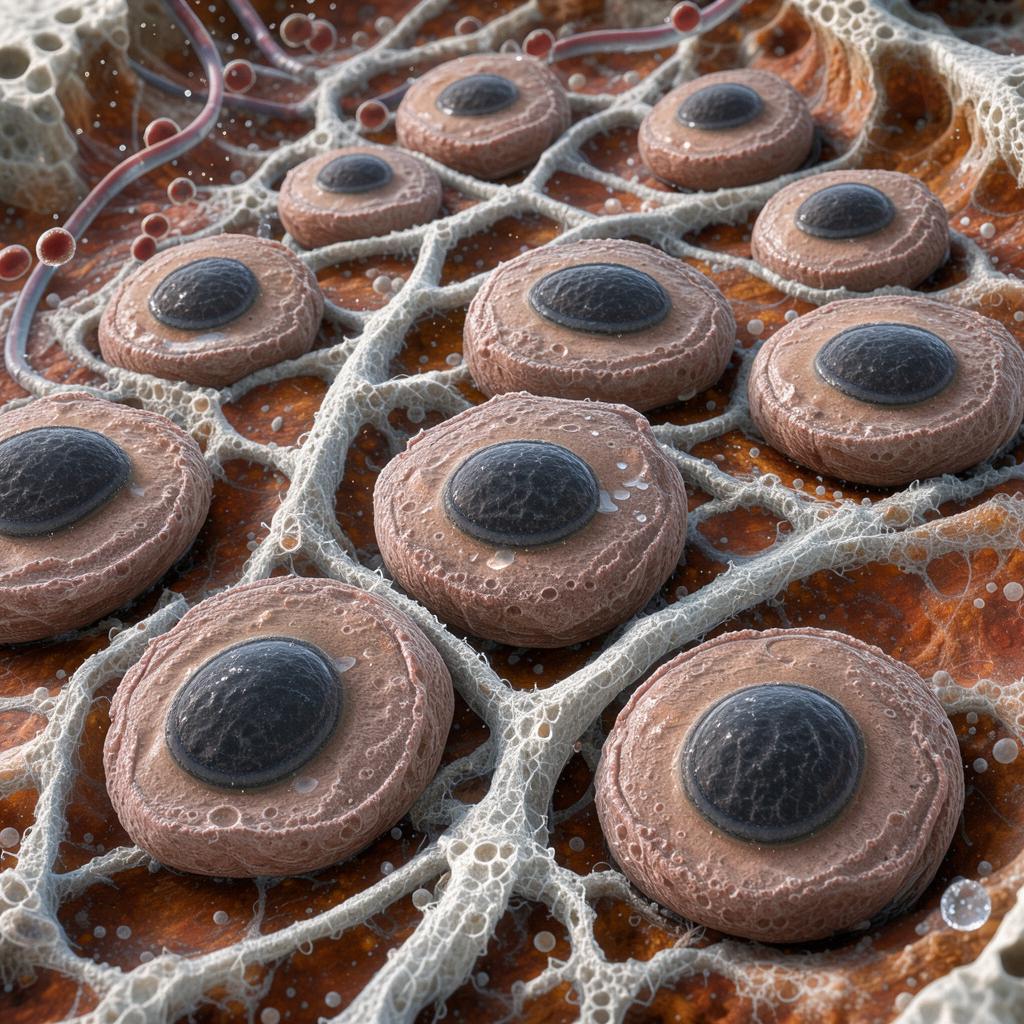
Mechanistic Model
Critical Appraisal
Strengths: inactive controls (GRGESP peptide, LY303511), quadruplicate plates repeated ≥2×, dose-concordance of the Akt inhibitor ED50 with its reported Kd, parallel adhesion-specificity antibody panels, and a human stromal coculture validation with a stromal-viability control .
Blind spots: the entire paradigm is in vitro with exogenous recombinant FGF-2; only two dormancy-competent lines, both ER+ luminal; no in vivo marrow model; the abstract's claim of survival "for many weeks" exceeds the 15-day data shown; dormant clones are operationally defined by colony-size thresholds rather than single-cell fate tracking; the microarray is a focused ECM/adhesion chip with densitometric normalization and no qPCR confirmation reported; and pharmacologic inhibitors/peptides may have off-target effects, only partially mitigated by inactive-analog controls.
Convergent literature: α5β1 has since emerged as a recurrent pathological signaling hub — CCL20 binds α5β1 (SPR-validated) to drive TGF-β/Smad fibroblast activation in pulmonary fibrosis, with ATN-161 blockade attenuating fibrosis in mice and human lung slices , and adipocyte Angiopoietin-2 engages endothelial α5β1 for CD36/FATP3-mediated fatty acid transport, with ITGβ1 deletion or ATN-161 cutting subcutaneous fatty-acid uptake by ~42–44% — supporting the plausibility of α5β1 as a druggable node, though these contexts are non-malignant.
What Would Change the Conclusion
The FGF-2–α5β1–fibronectin–PI3K/Akt axis would be falsified if blocking fibronectin ligation or PI3K/Akt failed to affect dormant clone survival, if dormancy occurred independently of fibronectin engagement, or if MDA-MB-231 entered dormancy under identical conditions. Confidence in the in vitro mechanism is moderate-to-high; confidence that it explains clinical marrow dormancy is low pending in vivo testing, and the era's reliance on LY294002-class inhibitors warrants modern genetic replication (ITGA5/ITGB1 CRISPR, Akt isoform-specific knockdown). This is BGPT's critical inference, not an author claim.
Feedback:
Updated: November 19, 2026
BGPT Paper Review
Study Novelty
80%
For 2004, proposing a defined microenvironmental mechanism (FGF-2-induced differentiation plus α5β1–fibronectin ligation–PI3K/Akt survival) for bone marrow dormancy was a genuine conceptual advance linking adhesion biology to metastatic quiescence; α5β1 later proved a recurring signaling hub, though the dormancy framing itself built on prior FGF-2 work.
Scientific Quality
70%
Rigorous internal controls (inactive peptide/analog, quadruplicate plates repeated ≥2×, ED50–Kd concordance, stromal coculture validation), but entirely in vitro, no qPCR validation of microarray, colony-size-based dormancy definitions, abstract overstates duration ('many weeks' vs 15-day data), and LY294002-class off-target confounds remain.
Study Generality
60%
The mechanistic concept generalizes to microenvironment-gated dormancy, but the data are limited to two ER+ luminal lines on coated plastic; MDA-MB-231's constitutively high α5 without dormancy shows the model does not extend to de-differentiated states.
Study Usefulness
70%
Identifies a concrete, testable therapeutic axis (α5β1–fibronectin–PI3K/Akt) for eradicating dormant micrometastases and explains chemoresistance of quiescent cells; direct clinical utility remains unestablished without in vivo validation.
Study Reproducibility
60%
Methods are detailed with defined cell densities, doses, timing, and repeat counts, but no data deposition, densitometry-based quantification without raw blots, and inhibitor off-target effects hinder exact independent replication.
Explanatory Depth
70%
The axis is mapped from FGF-2 through α5β1 induction, ligation specificity, and sustained Akt/GSK-3 phosphorylation, with morphology-based dissociation of PI3K vs Akt roles; upstream transcription of integrin induction, Akt-independent cytoskeletal pathways, and p38/ERK dormancy ratios remain unresolved (acknowledged by authors).
Simulating dormancy-survival dynamics of FGF-2-arrested breast cancer clones across fibronectin, collagen, and plastic substrates to visualize the reported survival ratios and blocker effects under defined assumptions.
Get emailed when your analysis is done!
We'll email you the results when your analysis is finished.
Hypothesis Graveyard
α5 integrin overexpression alone drives dormancy survival — falsified within the paper: MDA-MB-231 expresses constitutively high α5 yet neither enters dormancy nor shows FGF-2-induced Akt phosphorylation; differentiation state plus ligation competence is required.
EGF, another abundant marrow growth factor, could substitute for FGF-2 in initiating dormancy — excluded: EGF had no effect on the clonogenic potential of dormancy-competent MCF-7 and T-47D cells.

 Explore by Goal
 Quick Explanation
 Long Explanation
 Top Data Sources
 Ask a Follow-Up
 Key Insight
 Keep Exploring
 Analysis
 Hypothesis Graveyard
 Potential Experiments
 Discussion
