Examine the evidence base and provenance of specific claims made by authors or groups.Know what the science actually supports before you trust the answer.
Press Enter ↵ to review
Explore by Goal
"The molecules of life are like letters of the alphabet. You can't tell what a word says by knowing the number of letters in it."
- Matt Ridley
Quick Explanation
Copied
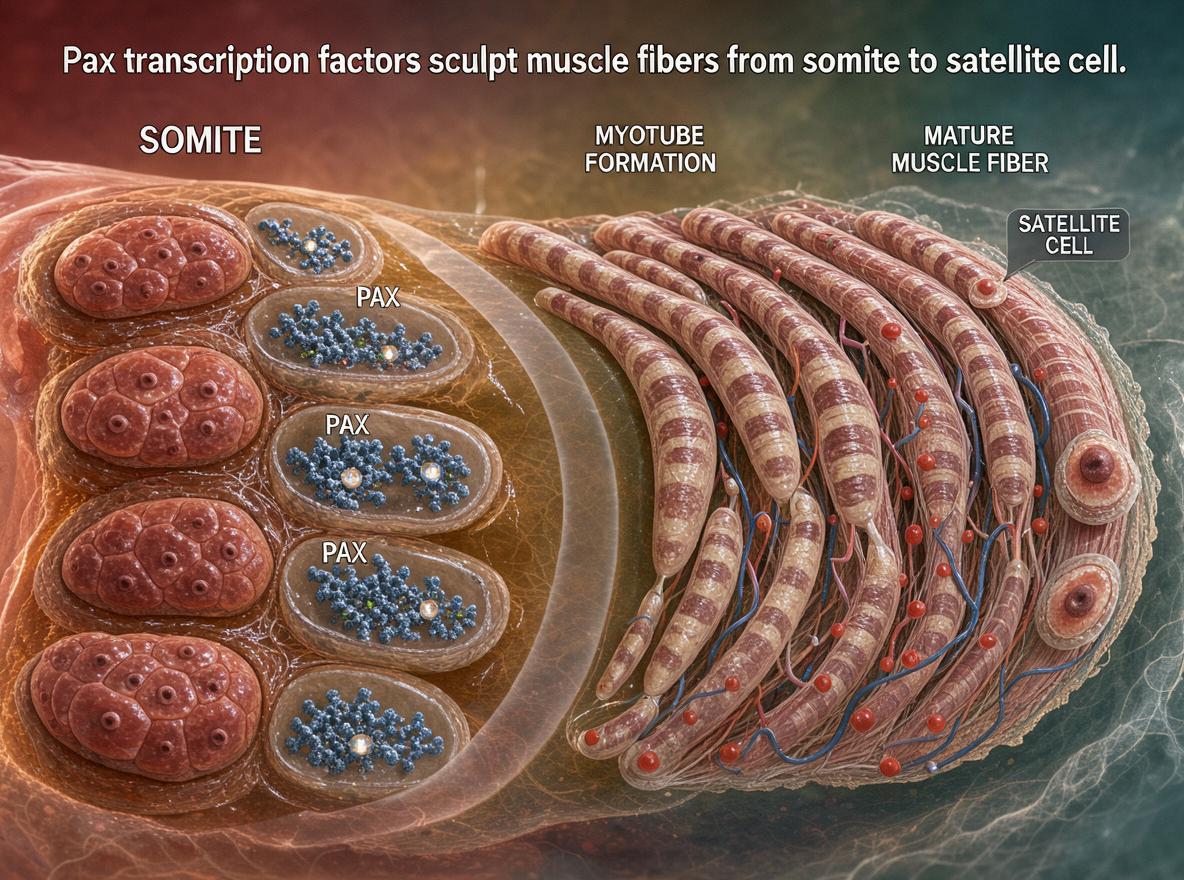
Frédéric Relaix is a world-class developmental and muscle stem-cell biologist (280 works, h-index 61, ~15,700 citations per OpenAlex), best known for defining Pax3/Pax7-dependent muscle progenitors and satellite cell biology, with recent rigorous expansion into DMD preclinical models, transposable elements, and PAX3-driven neuroepithelial mechanics.
Long Explanation
Scientific Trajectory and Impact
OpenAlex records 280 works, ~15,676 citations, and an h-index of 61 for Frédéric Relaix, with sustained productivity (33 works in 2025, 13 by October 2026) and rising annual citation counts (>1,100/year since 2021). His foundational first-author Nature paper defining a Pax3/Pax7-dependent muscle progenitor population (1,167 citations) and co-authored Science work on direct isolation of satellite cells via Pax3-GFP (1,100 citations) reshaped the muscle stem cell field .
Mechanistic Depth: Pax3/Pax7 Regulatory Networks
His mechanistic work is exceptionally strong. The 2004 Genes & Development allele-swap study (quality 9/10, novelty 9/10 in supplied extraction) genetically replaced Pax3 with Pax7, showing Pax7 rescues neural tube, neural crest, and somite development but fails to support limb muscle progenitor delamination and c-met signaling . Reviews consolidate targets (Myf5 enhancers, Six1/4, chromatin modifiers) while honestly flagging limitations: incomplete functional validation of binding sites, ChIP reliance on cell lines, and context dependence .
Translational and Model-System Breadth
Relaix extends mechanistic findings into translational platforms: a 2025 Skeletal Muscle review systematizes DMD rat models (mdx rat median survival ~13 months; R-DMDdel52 ~11–12 months) as intermediates between mouse and large animals ; a longitudinal GRMD dog Holter study found VLF heart-rate variability at 4 months strongly predicts later LV function (R = 0.929, 8 dogs) ; and a 2026 preprint couples PAX3 to glycolysis/mannose-dependent glycosylation controlling neuroepithelial mechanics, with multi-modal evidence (laser ablation, Vin-TS FRET, metabolomics, mannose rescue) .
Critical Assessment and Blindspots
Strengths: mechanistic rigor (isogenic CRISPR lines, FRET, CUT&Tag, metabolomics), cross-species breadth (mouse, rat, dog, human organoids), and transparent limitations. Weaknesses: several recent pieces are reviews (reproducibility scored 5–6/10 in supplied extractions); key dog correlations rest on n=8 without multivariate adjustment; organoid phenotypes may exaggerate in vivo junctional defects; some works lack full OpenAlex affiliation metadata. Confidence: high for citation metrics and Pax3/Pax7 impact; moderate for translational claims, which require independent replication.
Feedback:
Updated: October 30, 2026
BGPT Author Review
Scientific Quality
90%
h-index 61 with 280 works and field-defining first-author Nature/Science papers on Pax3/Pax7 progenitors and satellite cell isolation. Sustained high output through 2026, expansion into metabolism-mechanics coupling and translational DMD models. Minor deduction because recent output includes narrative reviews and one preprint with incomplete journal provenance.
Communication Quality
80%
Reviews (PAX3/7 myogenesis, TE repression, DMD rat models) are organized, comprehensive, and explicitly state limitations and future directions. Primary papers use dense genetic nomenclature that limits accessibility to non-specialists.
Author Novelty
80%
The Pax3/Pax7 allele-swap and satellite-cell isolation work was groundbreaking and paradigm-setting. The 2026 PAX3-metabolism-mechanics link and dual PAX3/7 spinal fate encoding show continued conceptual novelty, though several reviews consolidate existing knowledge.
Scientific Rigor
80%
Strong genetic controls, isogenic iPSC lines, quantitative biomechanics (FRET, laser ablation), and data deposition (GEO, MassIVE, GitHub). Deductions for n=8 dog correlations without multivariate adjustment, organoid-topology confounds, and narrative reviews lacking primary data.
We'll email you the results when your analysis is finished.
Hypothesis Graveyard
Satellite cells were dormant myoblasts of unclear necessity: falsified by Pax7 ablation and Pax3-GFP isolation experiments demonstrating their essential, regenerative role.
Pax3 and Pax7 are fully interchangeable paralogs: disproven by the allele-swap forelimb-muscle failure phenotype.

 Explore by Goal
 Quick Explanation
 Long Explanation
 Top Data Sources
 Ask a Follow-Up
 Key Insight
 Keep Exploring
 Hypothesis Graveyard
 Potential Experiments
 Discussion
