Check each claim against its linked experiments, results, and falsification criteria.Know what the science actually supports before you trust the answer.
Press Enter ↵ to check claims
Explore by Goal
"The scientific man does not aim at an immediate result. He does not expect that his advanced ideas will be readily taken up. His work is like that of the planter - for the future. His duty is to lay the foundation for those who are to come, and point the way."
- Nikola Tesla
Quick Explanation
Copied
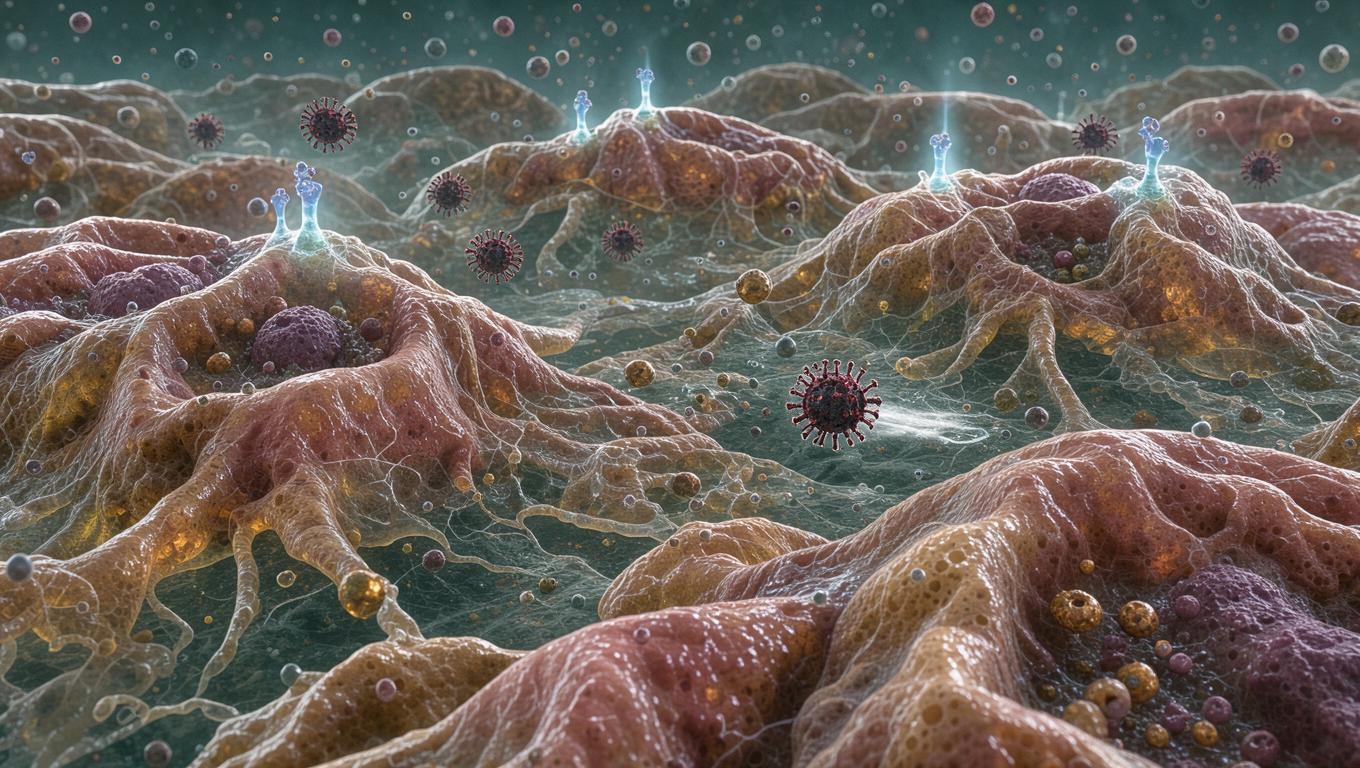
Mori, Rosenzweig and Desrosiers (J Virol 2000) show that SIVmac239 replication in rhesus alveolar macrophages is blocked at the cell-population level because >99% of these cells express undetectable surface CD4, while the Env-variant SIVmac239/316E spreads efficiently, likely via CD4-independent or ultra-low-CD4 entry into CCR5+ cells. The mechanistic inference is strong but built on only two donor animals and in vitro cultures, so human tissue-reservoir predictions remain hypothesis-generating rather than proven.
Long Explanation
Core Mechanistic Finding
The paper identifies the nature of the replication block of SIVmac239 in rhesus alveolar macrophages (AM). Viral DNA is synthesized at comparable levels for both SIVmac239 and the Env-variant SIVmac239/316E within 24 h, but SIVmac239 DNA then decays (140 copies/100 cells at day 1 falling to 11 by day 5 in experiment A), whereas 316E DNA rises exponentially with spreading infection. Infectious-center assays show only a tiny susceptible fraction for SIVmac239 (0.4–3.1% infected, declining over 3 days) versus near-complete spread by 316E in donor A (25% at day 1, 100% at day 3) .
The critical correlate: >99% of BAL macrophages lack detectable surface CD4 by flow cytometry (CD4+ frequency 0.24% ± 0.2%), yet a CCR5+ CD4− population is present and is selectively depleted after 316E infection — identifying CCR5+ CD4− cells as the principal early 316E targets. Anti-CD4 antibody (19thy5D7) delays but does not block 316E replication, supporting entry that is CD4-independent or dependent on CD4 densities below flow-cytometric detection .
Critical Appraisal and Blind Spots
Strengths: The design cleanly separates entry (normal early DNA) from spread (divergent kinetics) using re-exposure experiments, RT-inhibitor controls, and matched virus stocks normalized for p27 content. Mechanistic logic is multi-layered and internally consistent.
Limitations the paper acknowledges: decay of SIVmac239 DNA may reflect death of the rare infected cells rather than DNA instability; intracellular blocks beyond CD4 density cannot be excluded; the susceptible minority was not directly phenotyped.
Limitations BGPT adds: only two donor macaques underpin the central tables, with donor-to-donor variability acknowledged (donor B showed high initial 239 susceptibility — 25% infected at day 1 — before decline); the entire study is in vitro BAL culture, which may not reproduce in vivo alveolar conditions; the extrapolation to human HIV-1 lung/brain CD4-independence is a prediction, not demonstrated in humans. A related follow-up showed macrophage tropism per se does not predict in vivo pathogenicity in SHIV models, cautioning against over-reading tropism-to-disease links .
Falsification route: If AMs engineered to raise surface CD4 still resist SIVmac239, or if CD4 blockade fully abrogates 316E replication, the CD4-density/CD4-independence model collapses.
Confidence: High for the in vitro observations; moderate for the CD4-independence interpretation (two non-mutually-exclusive mechanisms offered); low-moderate for human extrapolation.
Explore Further
Feedback:
Updated: October 29, 2026
BGPT Paper Review
Study Novelty
80%
First mechanistic demonstration that macrophage restriction of SIVmac239 is a population-level CD4-density barrier rather than an entry or post-entry block, linking Env adaptation to CD4-independent infection of CCR5+ macrophages.
Scientific Quality
80%
Rigorous multi-assay design with controls (RTIs, re-exposure, DNase-treated stocks, matched p27 normalization), but only two donor animals, in vitro-only system, and partial data for some donor/virus combinations reduce statistical weight.
Study Generality
70%
Findings generalize to primate lentivirus tissue-macrophage tropism and predict HIV-1 lung/brain reservoir biology, but are anchored to one SIV strain pair and rhesus AMs.
Study Usefulness
80%
Directly informs understanding of macrophage HIV reservoirs, Env determinants of tropism, and receptor-density thresholds; useful for neuroAIDS and pulmonary HIV research design.
Study Reproducibility
70%
Methods are detailed (primers, antibody clones, doses, gating strategies), but BAL donor availability and inter-donor variability limit independent replication fidelity.
Explanatory Depth
70%
Distinguishes entry from spread with clear kinetic evidence and proposes two candidate mechanisms (CD4-independence vs ultra-low-CD4 dependence), but does not definitively discriminate between them or rule out intracellular blocks.
We'll email you the results when your analysis is finished.
Hypothesis Graveyard
SIVmac239 restriction is a post-entry intracellular block in macrophages — falsified by normal early reverse transcription and equivalent early DNA/RNA levels between the two viruses.
Restriction is due to defective viral entry into all macrophages — falsified by infectious-center assays showing a small, real susceptible population.

 Explore by Goal
 Quick Explanation
 Long Explanation
 Top Data Sources
 Ask a Follow-Up
 Key Insight
 Keep Exploring
 Hypothesis Graveyard
 Potential Experiments
 Discussion
