Check a paper's claims against linked experiments, exact results, stated scope, and limitations.Know what falsifiable science actually supports before you trust the answer.
Press Enter ↵ to search evidence
Explore by Goal
"Mood reflects the biology of the brain. How you feel is affected by the chemicals in the brain, and these are the same chemicals that form the basis of mood-altering drugs."
- Liz Miller
Quick Explanation
Copied
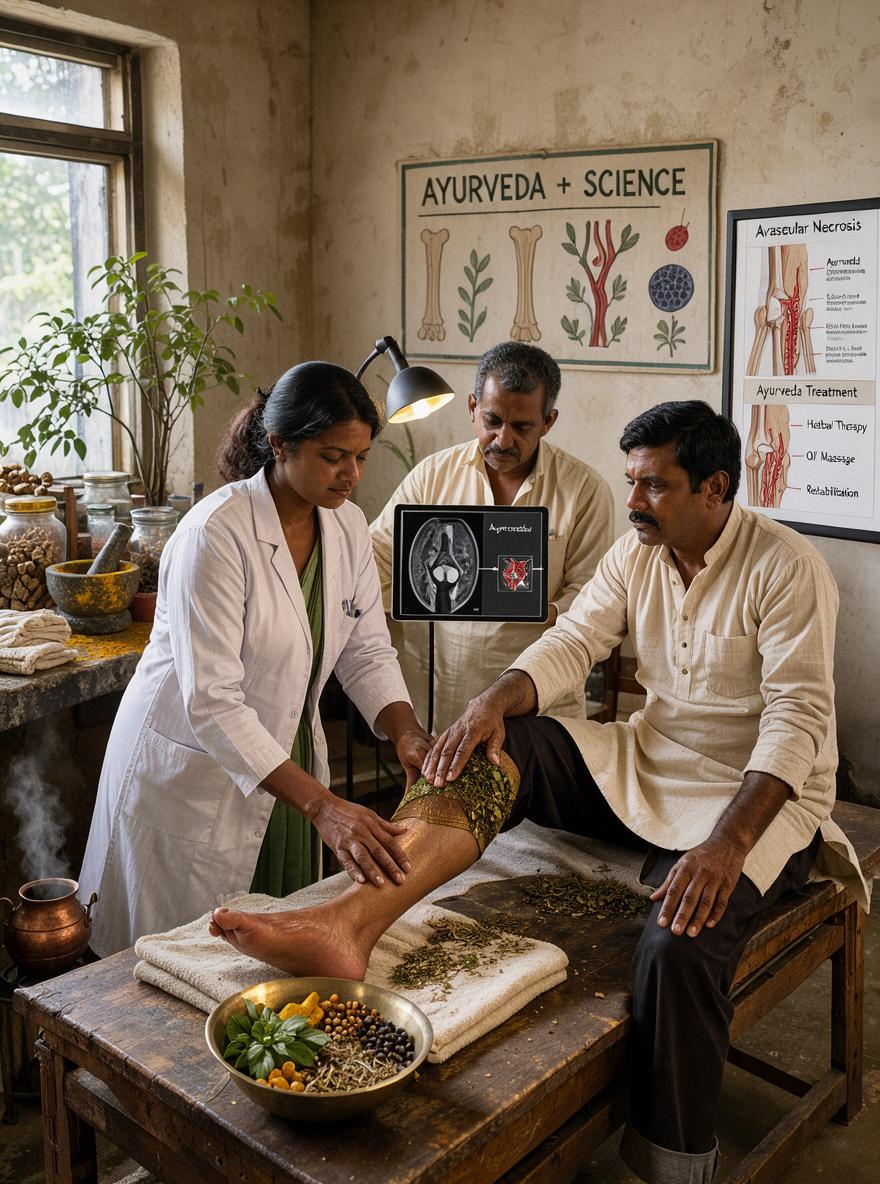
This Ayushdhara narrative review proposes that Ayurvedic Panchakarma and Shamana therapies may relieve AVN symptoms, but it reports no original patient data, no systematic methods, and no safety or comparative-effectiveness evidence, so its therapeutic claims remain untested hypotheses rather than demonstrated efficacy .
Long Explanation
What the paper actually establishes
This is a conceptual narrative review, not a clinical study. It maps AVN onto Ayurvedic frameworks (Asthi Majjakshaya, Asthi Majjagata Vata, Vatarakta), describes standard orthopedic staging (Steinberg, Ficat-Arlet), and outlines a Panchakarma treatment logic: Nidana Parivarjana, Snehana, Swedana, Virechana, Basti, and Jalaukavcharana . No patient sample, inclusion criteria, outcome measures, or safety data appear anywhere in the text.
Key critical gaps
No empirical evidence: claims of "promising results" in pain, tenderness, stiffness, and gait improvement are asserted in the abstract without any reported data or cited trial in this paper .
No critical appraisal: it is not a systematic review; no PRISMA-style search, risk-of-bias assessment, or effect-size synthesis, in contrast to properly structured orthopedic reviews of the same disease .
Angiogenesis mechanism overstated: the review asserts leech therapy stimulates angiogenesis and restores femoral head perfusion; this mechanistic leap is untested. By comparison, a rabbit VEGF gene-therapy study needed direct histological endpoint measurement to claim angiogenesis effects .
Conventional-management framing is accurate: the authors correctly note surgical limitations; a systematic review found only 29% satisfactory outcomes after core decompression for post-collapse hips, and classification systems like Ficat remain contested .
Comparative evidence quality
How to falsify the paper's central claim: a randomized controlled trial in early-stage AVN showing no greater improvement in pain, stiffness, gait, or radiographic progression with Panchakarma/Shamana than standard care or placebo would refute the proposed efficacy. BGPT inference: given zero original data here, the review functions as a hypothesis-generating document only, and its safety framing ("safe approach") is unsupported assertion.
Feedback:
Updated: November 24, 2026
BGPT Paper Review
Study Novelty
20%
The Ayurvedic correlation of AVN with Asthi Majjakshaya and Panchakarma protocols was previously published (the review cites a 2018 IJRAP review of the same topic); no new concept, data, or framework is introduced.
Scientific Quality
20%
Narrative review with no original data, no systematic search, no appraisal of cited evidence, no safety analysis, and an abstract implying results ('promising results... significant enhancements') that the body never substantiates. Reference handling is sloppy (e.g., Harrison's textbook dated '1098'). The staging descriptions are accurate, which is the paper's main redeeming quality.
Study Generality
20%
The Dosha-based pathophysiology framework is disease-specific and not testable or generalizable to broader bone biology; it does not advance understanding beyond classical Ayurvedic descriptions.
Study Usefulness
30%
Modest value as a practitioner-oriented synthesis of treatment principles and staging; but it offers no actionable, evidence-graded guidance, no doses, durations, or outcome benchmarks for clinicians or researchers.
Study Reproducibility
20%
No protocols, no participant selection, no intervention regimens with doses or schedules, no outcome instruments; replication of any empirical claim is impossible from this text.
Explanatory Depth
30%
Describes classical Ayurvedic constructs (Vriddhi/Kshaya, Ashraya-Ashrayi Bhava, Samprapti) coherently but offers no mechanistic, molecular, or hemodynamic analysis of how therapies would reverse osteonecrosis; the angiogenesis claim is speculative.
We'll email you the results when your analysis is finished.
Hypothesis Graveyard
'Panchakarma restores blood flow to the femoral head via Margavrodha removal' - unsupported; no perfusion imaging (MRI, angiography) was performed or cited.
'Ayurveda provides a safe, comprehensive alternative to surgery' - no safety surveillance data exist in this review; safety cannot be asserted without adverse-event reporting.

 Explore by Goal
 Quick Explanation
 Long Explanation
 Top Data Sources
 Ask a Follow-Up
 Key Insight
 Keep Exploring
 Hypothesis Graveyard
 Potential Experiments
 Discussion
