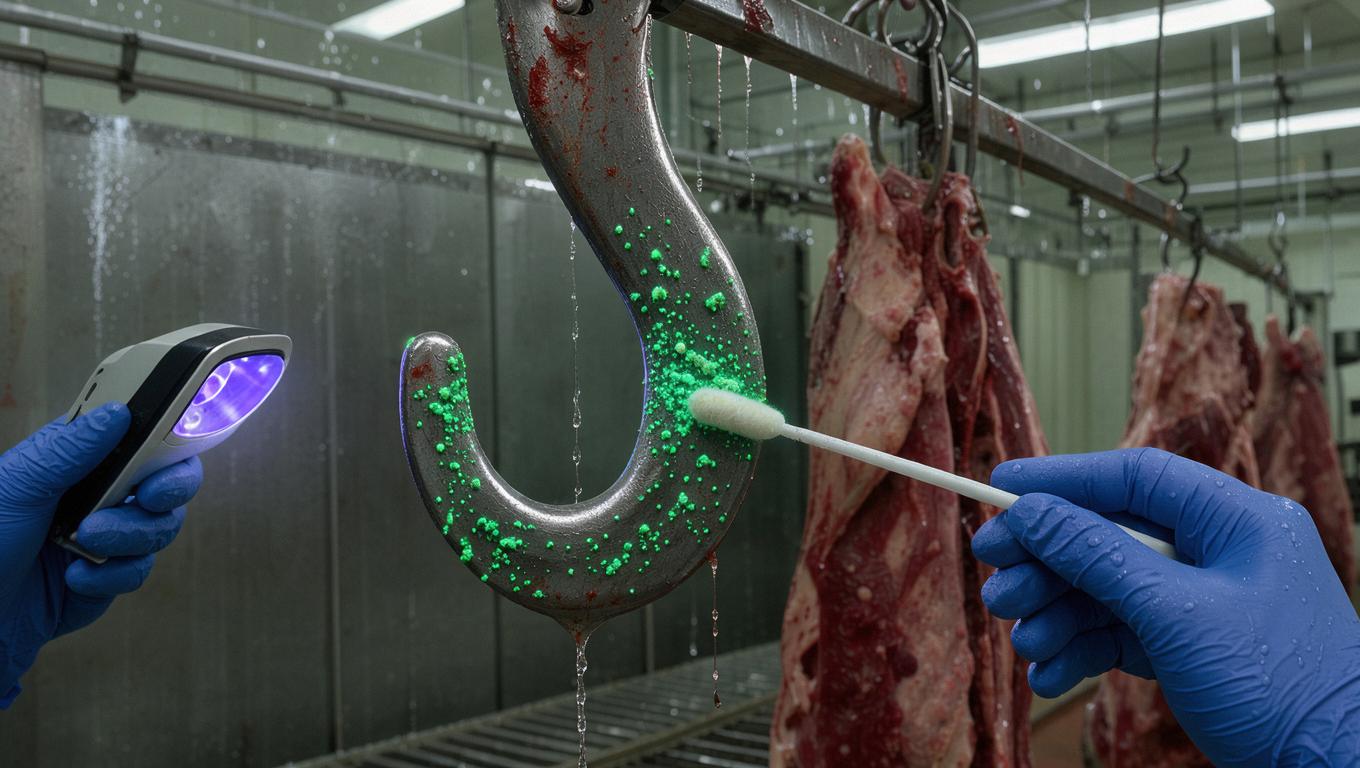
Core findings: In four Calabrian slaughterhouses (1 slaughter session each), multiplex PCR detected Mycobacterium spp. DNA in 21/65 (32%) carcasses of tuberculin-positive cattle, with M. bovis confirmed in 14/21; contamination rose as butchery progressed within each session. M. bovis DNA was found in 50% (2/4) of wastewater samples, none of 13 air filters, and on the hands of 1/11 (9.1%) workers; 81.8% of workers carried Mycobacterium spp. DNA. Crucially, 7/12 (58%) carcasses of healthy cattle slaughtered the next day tested PCR-positive for M. bovis, indicating inadequate disinfection between sessions. All culture attempts failed, so viability was never confirmed and PCR signal may reflect non-viable organisms .
Critical interpretation: The authors' inference of occupational and consumer risk rests entirely on DNA detection without viable isolates or epidemiological endpoints. Cross-sectional design (one session per plant), regional focus, tiny worker sample (n=11, with no TB screening of workers), and unstandardized PPE assessment limit causal claims about infection risk. The next-day carcass finding is the strongest signal, but small n=12. The systematic review context supports that abattoir workers are a high-risk group, though data remain scarce . Environmental persistence is biologically plausible given demonstrated soil survival of M. bovis under moist, cool conditions .
Falsification test: If multi-site studies with validated viability assays (e.g., propidium monoazide-qPCR or culture on optimized media) show no infectious M. bovis in these matrices after standardized disinfection, the inferred occupational hazard would be substantially weakened.
Know what changed, what holds up, and what remains uncertain. Every Friday. No ads.