Evaluate a paper by its claims, linked experiments, reported metrics, limitations, and provenance — not just a summary.Know what the science actually supports before you trust the answer.
Press Enter ↵ to start review
Explore by Goal
"An expert is a person who has made all the mistakes that can be made in a very narrow field."
- Niels Bohr
Quick Explanation
Copied
This preprint reports that LTP stimuli recruit IRSp53 to drive Arc capsid assembly and EV release from dendritic filopodia, and that transferred Arc mRNA reduces surface AMPARs in neighboring neurons, proposing a novel intercellular form of synaptic plasticity .
The authors propose that monomeric Arc is autoinhibited by intramolecular CC–Gag contacts, and that IRSp53 binding via its SH3 domain to Arc's N-terminal proline-rich region releases this inhibition, exposing Gag residues for capsid assembly. This is supported by AlphaFold3/MD simulations, GST-pulldown, SEC, and negative-stain TEM showing increased capsid formation when Arc and IRSp53 are co-incubated .
Note: exact quantitative values for capsid counts are not reported in the text; the bar heights above are a schematic representation of the reported qualitative increase and serve to illustrate the expected pattern rather than reproduce precise published data.
IRSp53-Dependent Trafficking and EV Release
cLTP, but not cLTD, increases Arc–IRSp53 proximity ligation puncta (n=31/28/33 neurons for basal/cLTP/cLTD) and drives anterograde Arc trafficking into dendrites from the soma. IRSp53 shRNA or Cre-mediated knockout abrogates this dendritic accumulation and blocks cLTP-induced Arc EV release (n=3 independent cultures) . Notably, Arc release is not blocked by dominant-negative VPS4a and Arc does not co-IP with Alix, arguing against canonical ESCRT-dependent exosome biogenesis .
Intercellular Synaptic Plasticity
WT EVs, but not Arc KO EVs, reduce surface GluA1 and mEPSC amplitude in Arc KO recipient neurons (n=15 neurons/group). Arc-shRNA in recipients blocks the GluA1 loss, supporting a requirement for mRNA delivery and local translation . Sparse ESARE-Arc expression in Arc KO neurons similarly blocks cLTP-induced surface GluA1 increases in neighboring dendrites within ~400 µm, establishing spatially restricted, non-cell-autonomous AMPAR regulation (n=20 neurons/group) .
Context: Prior Arc Capsid Work
These findings extend the foundational report that Arc is a repurposed retrotransposon Gag protein forming capsids released in EVs that transfer RNA intercellularly .
Blind Spots and Open Questions
No in vivo functional demonstration: all plasticity data come from cultured neurons; whether intercellular Arc transfer occurs in intact circuits is untested.
Live imaging lacks capsid-level resolution; the reported "release events" are inferred from abrupt loss of Arc fluorescence at filopodia, not direct visualization of EV budding.
In vivo Arc EV uptake specificity and the identity of receptors mediating uptake remain unknown.
The authors note Arc release may occur via different routes in different cell types (e.g., MVB pathway in HEK293 overexpression), introducing context-dependence uncertainty.
Whether the conformational switch model (closed→open) holds for Arc oligomers in vivo, where postsynaptic density interactions may prevent capsid assembly, is uncertain.
Implications and Hypotheses
If confirmed in vivo, this mechanism implies that active neurons actively suppress neighboring dendritic AMPARs, potentially sharpening memory engram circuits by reducing "noise" from non-engram synapses. The IRSp53 I403P mutant retains capsid assembly but not release, dissociating two functions: SH3-domain-mediated actin coupling is dispensable for capsid formation but essential for EV budding, suggesting these are separable druggable steps.
Feedback:
Updated: September 07, 2026
BGPT Paper Review
Study Novelty
90%
First to identify IRSp53 as a direct Arc capsid assembly factor and to demonstrate intercellular, EV-mediated AMPAR suppression as a mechanistically defined form of synaptic plasticity.
Scientific Quality
80%
Multiple orthogonal approaches (biochemistry, EM, live imaging, electrophysiology, genetics) with appropriate controls; primary limitation is absence of in vivo functional validation.
Study Generality
60%
Findings are demonstrated in cultured rodent neurons; relevance to intact brain circuits and human cognition remains inferred.
Study Usefulness
80%
Identifies a new EV biogenesis pathway and a druggable protein interaction relevant to both normal memory and tau spread in neurodegeneration.
Study Reproducibility
60%
Methods are detailed and orthogonal, but live-imaging release events are low-frequency and require specialized imaging; quantitative values for capsid counts and some fluorescence data are not fully reported.
Explanatory Depth
80%
Provides a coherent mechanistic chain from conformational switch to trafficking to functional AMPAR suppression, supported by structural modeling and loss-of-function genetics.
We'll email you the results when your analysis is finished.
Hypothesis Graveyard
Arc EVs arise from MVB/exosome pathway: contradicted by ESCRT-independence, lack of Arc-Alix interaction, and filopodial release morphology observed here.
Arc transfer to neighbors is a general EV uptake phenomenon independent of Arc: contradicted by Arc KO EVs failing to suppress AMPARs and by the requirement for Arc mRNA translation in recipients.

 Explore by Goal
 Quick Explanation
 Long Explanation
 Top Data Sources
 Ask a Follow-Up
 Key Insight
 Keep Exploring
 Hypothesis Graveyard
 Potential Experiments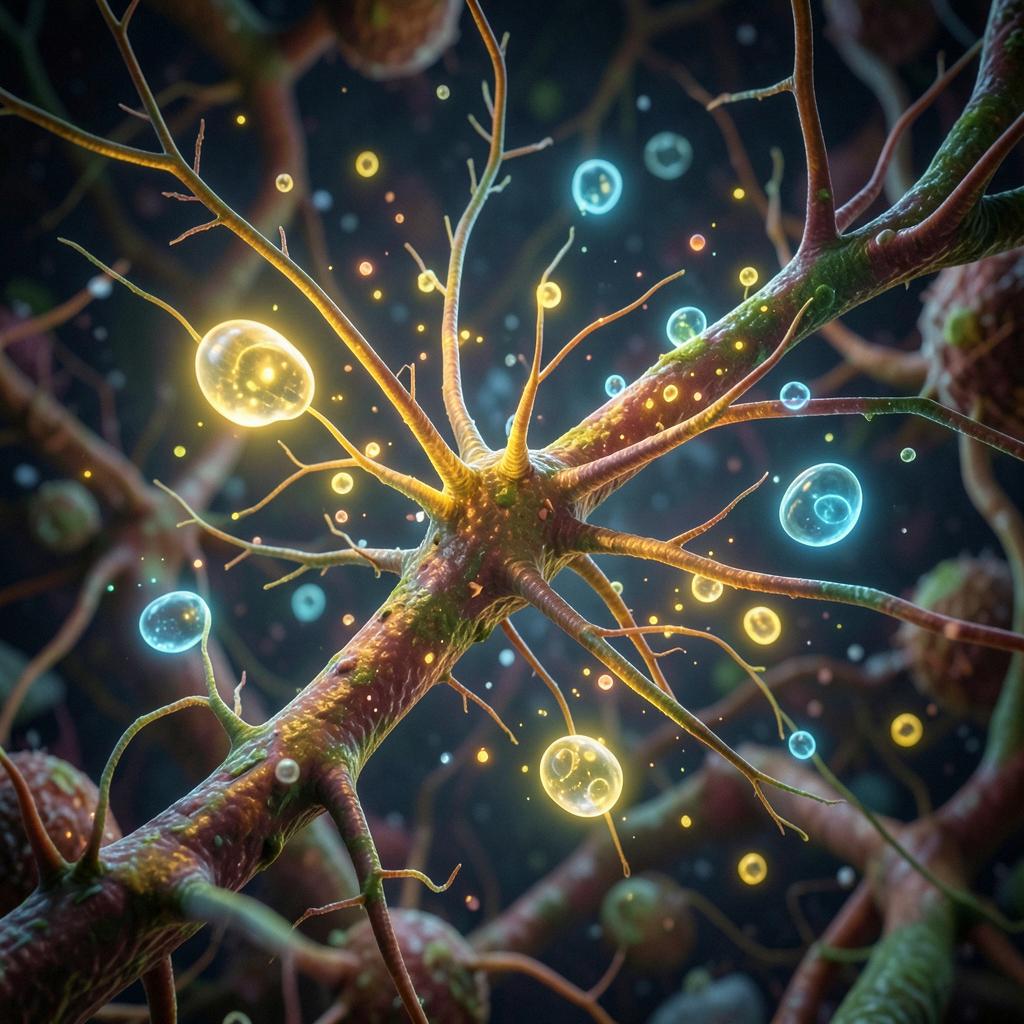
 Discussion