Examine the evidence base and provenance of specific claims made by authors or groups.Know what the science actually supports before you trust the answer.
Press Enter ↵ to review
Explore by Goal
"The biology of mind bridges the sciences – concerned with the natural world – and the humanities – concerned with the meaning of human experience."
- Eric Kandel
Quick Explanation
Copied
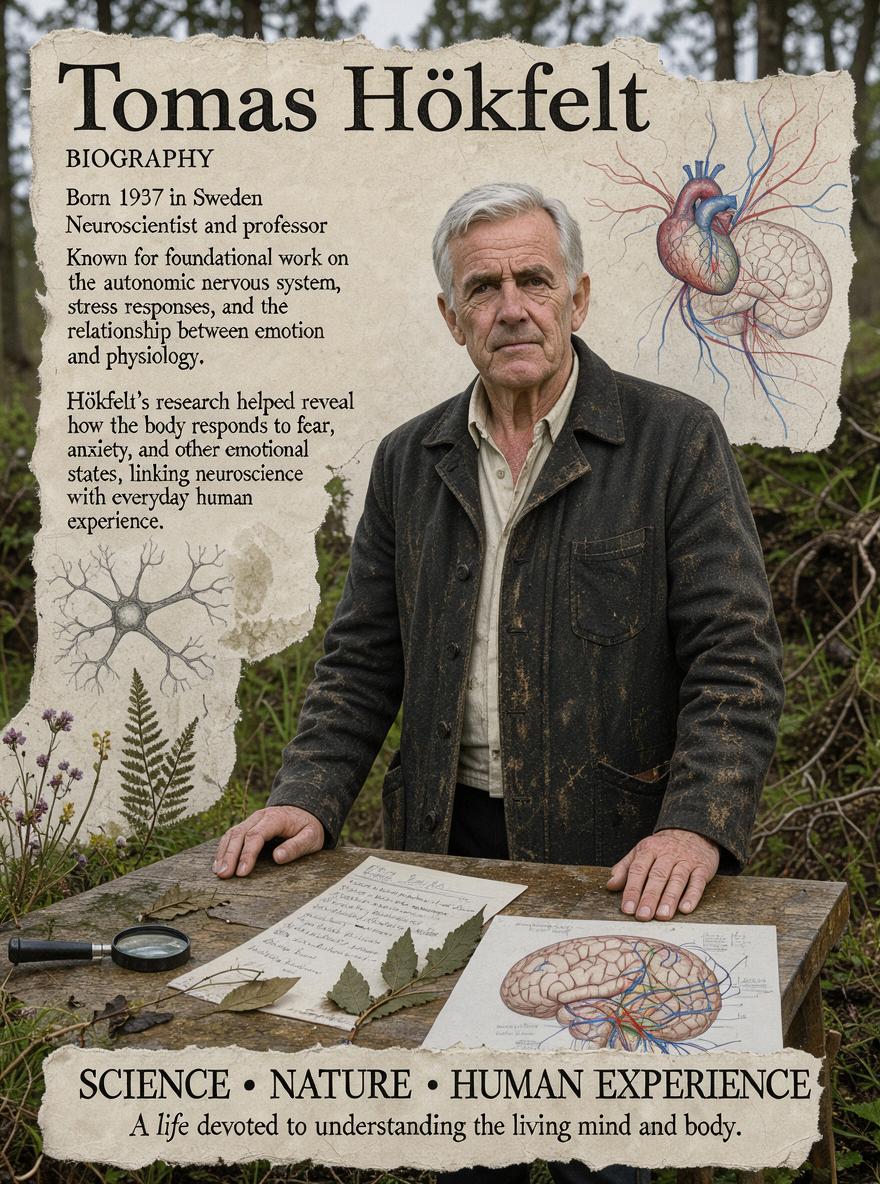
Tomas Hökfelt is among the most influential neuroscientists alive: OpenAlex records ~1,237 works, ~104,219 citations, and an h-index of 164 . His work pioneered peptide co-transmission (substance P, NPY, galanin) and continues with current-day translational studies. Note: the supplied Author Citation fragment (h=14, 2,445 citations) contradicts OpenAlex and almost certainly reflects a truncated, name-disambiguated sub-profile rather than the canonical scientist.
Long Explanation
Career Arc and Bibliometric Weight
Tomas G. M. Hökfelt (Karolinska Institutet; ORCID 0000-0002-3587-0116) presents one of the most sustained publication records in neuroscience: OpenAlex lists 1,237 works with ~104,219 citations and h-index 164, with active output every decade from 1965 through 2026 . Separate smaller OpenAlex name-variant profiles (h=28 and h=23) exist, and the supplied "Author Citation" fragment (h=14, 2,445 citations) is inconsistent with the canonical record — a classic author-disambiguation artifact that should be treated with skepticism, not evidence of a small career.
Note: pre-2012 citation counts are not recorded in the supplied data (open-access index zero but citations unknown), so the red series understates his historical citation flow. This is a data gap, not a career gap.
Seminal Contributions: Quantified Influence
His most cited works established the field of neuropeptide co-transmission. The 1980 Nature review "Peptidergic neurones" (~1,552 citations) synthesized the concept; the 1975 Science substance P localization paper (~1,024) and 1978 rat CNS mapping (~1,432) supplied the anatomical foundation . An early quantitative masterpiece was the 1966 nigro-neostriatal study combining biochemistry and histochemistry: ~3,500 DA cell bodies/side, ~500,000 varicosities per neuron, terminal arbor 55–77 cm, and DA concentrations ~40× higher in varicosities (~8,000 pg/g) than cell bodies (~200 pg/g) — with honest acknowledgment that reserpine-recovery assumptions made cell-body estimates uncertain (0.8 vs 2.5 pg) . This early explicit treatment of estimate uncertainty is a hallmark of his scientific character.
Continuity Into Current-Day Science
Unusually for a scientist of his generation, Hökfelt appears on active 2026 work: a translational review in methamphetamine-induced neuropeptide remodeling (galanin, CCK, somatostatin, NPY) with age-specific mouse data and rigorous FISH/qPCR validation , and an anorexia nervosa study linking patient iPSC-microglia and anx/anx mouse hypothalamic microglial synapse uptake to GLP-1 signaling . Both are preprints with acknowledged limitations (small samples, acute-only timepoints, no causal manipulation in the AN study), which he co-authors transparently rather than overclaiming — a positive rigor signal.
Translation and Blind Spots
His 2003 Lancet Neurology review of neuropeptides as drug targets (157 references) remains a touchstone, openly declaring no conflicts and noting that peptide drugs face degradation and BBB-delivery barriers . Blind spots across the corpus: (1) the classic quantitative work relied on bulk-tissue arithmetic, not single-neuron measurement; (2) review-era selection favored well-tooled peptide systems, underweighting negative results; (3) recent preprints use small, all-female or single-strain cohorts with limited statistical power. None rise to integrity concerns; all are disclosed or structurally inherent to the era's methods.
Verdict basis: The evidence for world-class stature is bibliometrically and mechanistically overwhelming; the main uncertainties are bibliometric (name disambiguation, partial historical citation capture). What would change the conclusion: demonstration that the canonical OpenAlex profile aggregates papers of a different person, or systematic irreproducibility of his peptide-anatomy findings — neither is suggested by the supplied record.
Feedback:
Updated: October 31, 2026
BGPT Author Review
Scientific Quality
100%
Hökfelt is a field-founding neuroscientist: co-discovery of peptide co-transmission, quantitative mapping of monoamine systems (1966), substance P/NPY/galanin anatomy, microglial neuroprotection, and continued 2026 output. h-index 164 and >100k citations place him in the top percentile of all neuroscientists. Early work honestly quantified its own uncertainty (reserpine-recovery assumptions). Weaknesses: era-typical reliance on bulk-tissue inference and small recent preprint cohorts; no evidence of fabrication or integrity issues in the supplied records.
Communication Quality
80%
His 1980 Nature review and 2003 Lancet Neurology synthesis are celebrated for clarity and breadth, organizing an entire emerging field for broad audiences. Primary papers are dense and quantitative, typical of 1960s–80s histochemistry; recent preprints are methodologically explicit but terse. Deduction for era-typical jargon density and for limitations sometimes relegated to figure legends.
Author Novelty
90%
He effectively created the co-transmission/peptide-neuron paradigm (substance P, NPY, galanin mapping) that reshaped neuropharmacology, and pursued genuinely new questions (microglia in anorexia, developmental psychostimulant neuropeptide remodeling) into his ninth decade. Deduction because the core paradigm work is now over 40 years old and recent preprints extend rather than overturn frameworks.
Scientific Rigor
90%
Exemplary for its era: the 1966 study combined independent biochemical and histochemical methods, applied double-count corrections, and explicitly propagated uncertainty (0.8 vs 2.5 pg DA per cell body). Recent work uses validated molecular assays (Smart-seq3, GeoMx DSP, HCR-FISH) with declared conflicts, deposited data, and candid limitations. Deduction: small recent sample sizes (n=3–5 per condition) and lack of causal manipulation linking microglial engulfment to behavior in the AN preprint.
We'll email you the results when your analysis is finished.
Hypothesis Graveyard
'Dopamine neurons are a small, compact system where somatic DA content dominates function' — falsified by his own 1966 finding that terminals hold 50–150× more DA than cell bodies, establishing volume transmission via a massive divergent varicosity plexus.
'Neuropeptides are modulatory afterthoughts without therapeutic tractability' — falsified by the cumulative GLP-1, NK1, and NPY pharmacology his 2003 review anticipated, though its optimism about non-peptide BBB-penetrant mimetics for many systems remains only partially realized.

 Explore by Goal
 Quick Explanation
 Long Explanation
 Top Data Sources
 Ask a Follow-Up
 Key Insight
 Keep Exploring
 Hypothesis Graveyard
 Potential Experiments
 Discussion
