Check whether claims match experiments, exact reported results, and stated limitations.Know what the science actually supports before you trust the answer.
Press Enter ↵ to review paper
Explore by Goal
"Mood reflects the biology of the brain. How you feel is affected by the chemicals in the brain, and these are the same chemicals that form the basis of mood-altering drugs."
- Liz Miller
Quick Answer
Copied
Schoener's 1968 Bimini anole study is a landmark, still-valid demonstration that four syntopic Anolis species partition a tiny island by perch height, perch diameter, leaf use, and prey size/taxa, with classes that overlap most in habitat overlapping least in prey size — a foundational niche-partitioning result . Its main weaknesses are unbalanced samples (n=164 sagrei vs n=32 angusticeps diet specimens), category-boundary arbitrariness the author himself flags, and purely observational inference of foraging habitat.
Long Answer
Core Evidence: A Saturated Fauna Carved Into Niche Space
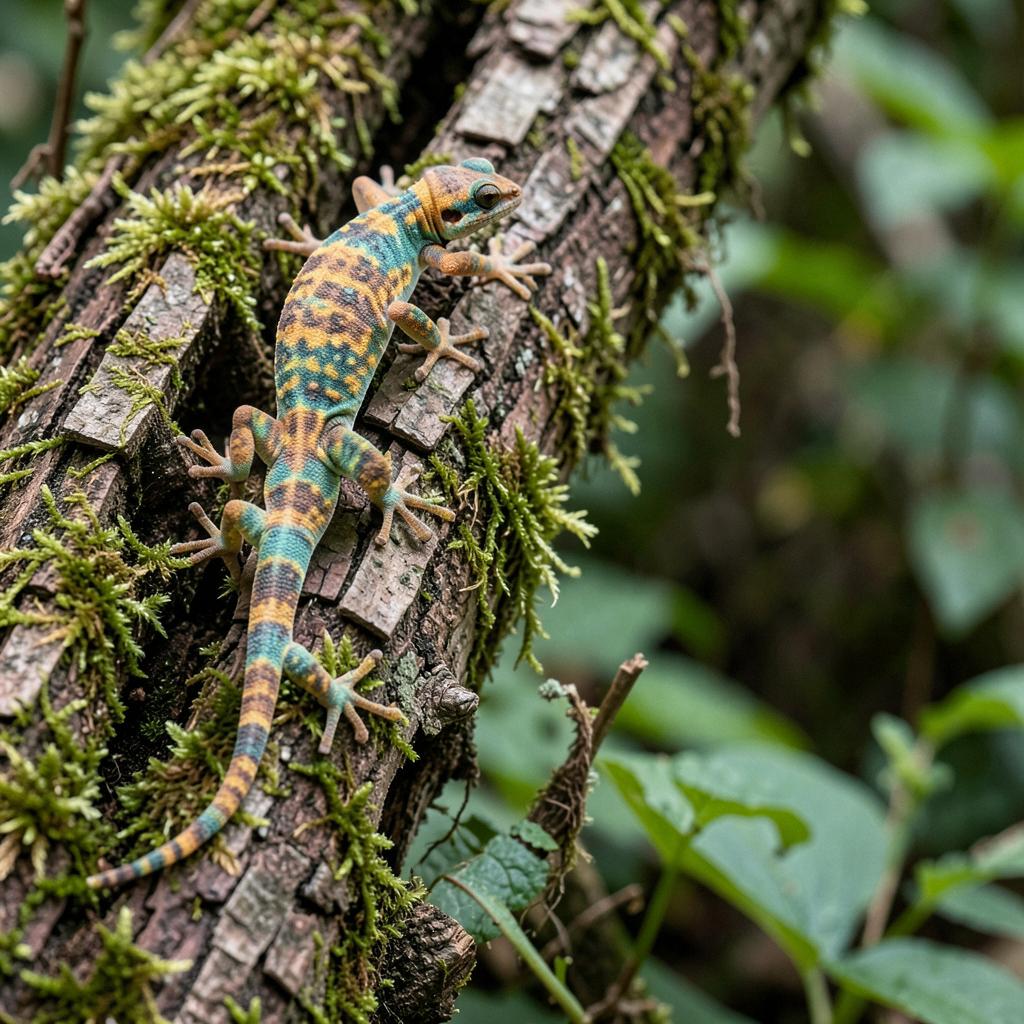
The paper documents that 4 Anolis species coexist syntopically on the ~5-square-mile South Bimini — a species count rivaled in the West Indies only on much larger islands — and attributes this to fine-grained resource partitioning rather than coarse vegetation separation: sagrei is partly terrestrial on low perches, distichus occupies trunks of large trees, angusticeps inhabits high thin twigs, and carolinensis perches largely on leaves . The pivotal quantitative finding: interspecific pairs overlapping most in structural habitat show the lowest prey-size overlap — "the greater the overlap values in habitat, the lower the maximum overlap value in prey size" — and using prey volume instead of item counts accentuates this pattern . Diet divergence is dramatic: 75.5–91.3% of distichus prey items are ants, while ants are negligible for twig/crown-dwelling angusticeps and carolinensis, which eat flying insects .
This size stagger is mechanistically tied to head morphology: sagrei and angusticeps males have nearly equal head lengths (~14.4 vs 15.7 mm largest-third) yet sagrei has far wider and deeper heads and takes larger prey . A second structural result is the inverse relation between interspecific habitat overlap and sexual size dimorphism: distichus, the class most "boxed in" by other species, shows the least dimorphism, which the author interprets as a constraint on faunal assembly — small, nondimorphic species insinuate into complex faunas while dimorphic species colonize empty ones .
Quantitative Backbone and Its Skew
The 5.1-fold spread in diet sample sizes matters: angusticeps conclusions rest on 32 specimens (only 4 juveniles), which the author concedes made prey-size significance "probably too small to be conclusive" .
Skeptical Appraisal
Genuine strengths: the paper is unusually self-critical for its era — the author explicitly evaluates overlap-measure arbitrariness (category number/boundaries can shift values from ~0 to ~1), demonstrates that range-based "specialization" is an artifact of sample size (ranking species by observation frequency), and shows that arithmetic vs log perch-diameter variance reverses which species appears more specialized (SD 4.11 in vs 0.786 in log-space for sagrei males) .
Remaining blindspots: (1) Observational, single-season snapshot — diet collections were concentrated in November with inactive gonads, so the subadult-male/female prey-size reversal is explained post hoc via growth vs reproduction energy demands (HARKing risk the author partially acknowledges by unifying Grenada and Bimini results under one hypothesis). (2) Structural ≠ foraging habitat — the author admits no way to test whether perched position equals feeding location without longer study, yet prey-taxa conclusions partly depend on it. (3) No prey-availability data — diet differences cannot be distinguished from resource availability differences; the proposed "density specialization" projects were future work. (4) Observer effects — cryptic angusticeps was likely undercounted, and the carolinensis height data are flagged as possible detection artifacts. A related later development shows how such Bimini data need correction: raw tail-injury frequencies in Bahamian A. sagrei (Abaco, Andros, Bimini) misrepresent predation intensity unless adjusted for survival and alternative mortality — a caution that applies equally to uncorrected overlap indices here.
What would change this conclusion: demonstration that habitat-overlapping pairs do not diverge in prey size when prey availability is measured; long-term data showing class niche positions shift seasonally; or modern resurveys showing the assemblage is not at equilibrium. Notably, the exclusion-rule claim ("no more than 5 syntopic Anolis") rests on an unpublished manuscript (Williams and Rand, in prep.) — an unverifiable citation from the 1968 text. The TEI header lists three authors, but the acknowledgments and narrative are first-person singular by Schoener; the two additional names appear to be a parsing artifact, so the author-review link covers the sole substantive author.
Feedback:
Updated: October 25, 2026
BGPT Paper Review
Study Novelty
90%
In 1968, quantitative class-by-class niche-overlap matrices across habitat, prey size, and prey taxa were groundbreaking; the habitat-prey-size trade-off and dimorphism-overlap assembly rule became canonical niche theory.
Scientific Quality
90%
Extensive statistical testing (chi-square, Kolmogorov-Smirnov where valid), explicit metric self-critique, and transparent small-n caveats. Deductions: single-season snapshot, unverifiable 'in prep.' citations, no prey-availability control, and possible observer detection bias for cryptic species.
Study Generality
70%
Results generalize strongly to Caribbean Anolis radiations and niche theory broadly, but many assembly claims are system-specific to flat, topographically uniform Bahamian islands where syntopic segregation is forced.
Study Usefulness
90%
Founded quantitative niche-overlap methodology and ecomorph thinking; the log-scale specialization critique still informs how ecologists must justify niche-breadth measures.
Study Reproducibility
70%
Methods, category definitions, and per-class sample sizes are fully reported in tables, enabling recomputation; but no raw data repository exists and some class assignments (e.g., subadult males) required field judgment.
Explanatory Depth
80%
Mechanistic links from head girth to gape to prey size, and energy-demand reasoning for sex differences, are genuinely explanatory; yet several causal claims (foraging-habitat equivalence, saturation) are inference, not measurement.
We'll email you the results when your analysis is finished.
Hypothesis Graveyard
'Vegetation type alone explains anole coexistence' — directly falsified: all four species are syntopic within blackland forest, forcing partitioning onto structural and trophic axes instead.
'Range-based specialization ranks predict colonizing ability' — falsified within the paper itself: the specialization ranking was an artifact of observation frequency, requiring evenness (H') or variance-based measures instead.

 Explore by Goal
 Quick Answer
 Long Answer
 Top Data Sources
 Ask a Follow-Up
 Key Insight
 Keep Exploring
 Hypothesis Graveyard
 Potential Experiments
 Discussion
