Check whether claims match experiments, exact reported results, and stated limitations.Know what the science actually supports before you trust the answer.
Press Enter ↵ to review paper
Explore by Goal
"I was taught that the way of progress was neither swift nor easy."
- Marie Curie
Quick Answer
Copied
This single-patient report documents immediate anaphylaxis within 3 minutes of a first BNT162b2 dose that was attributed to a severe cholinergic urticaria flare after negative PEG, polysorbate, and vaccine skin testing plus a positive exercise provocation challenge; the patient then tolerated a supervised, unmedicated second dose . The non-IgE attribution is a plausible but undemonstrated inference because acute tryptase and histamine were never measured during the reaction, so the case supports allergist referral and individualized rechallenge rather than proving mechanism .
Long Answer
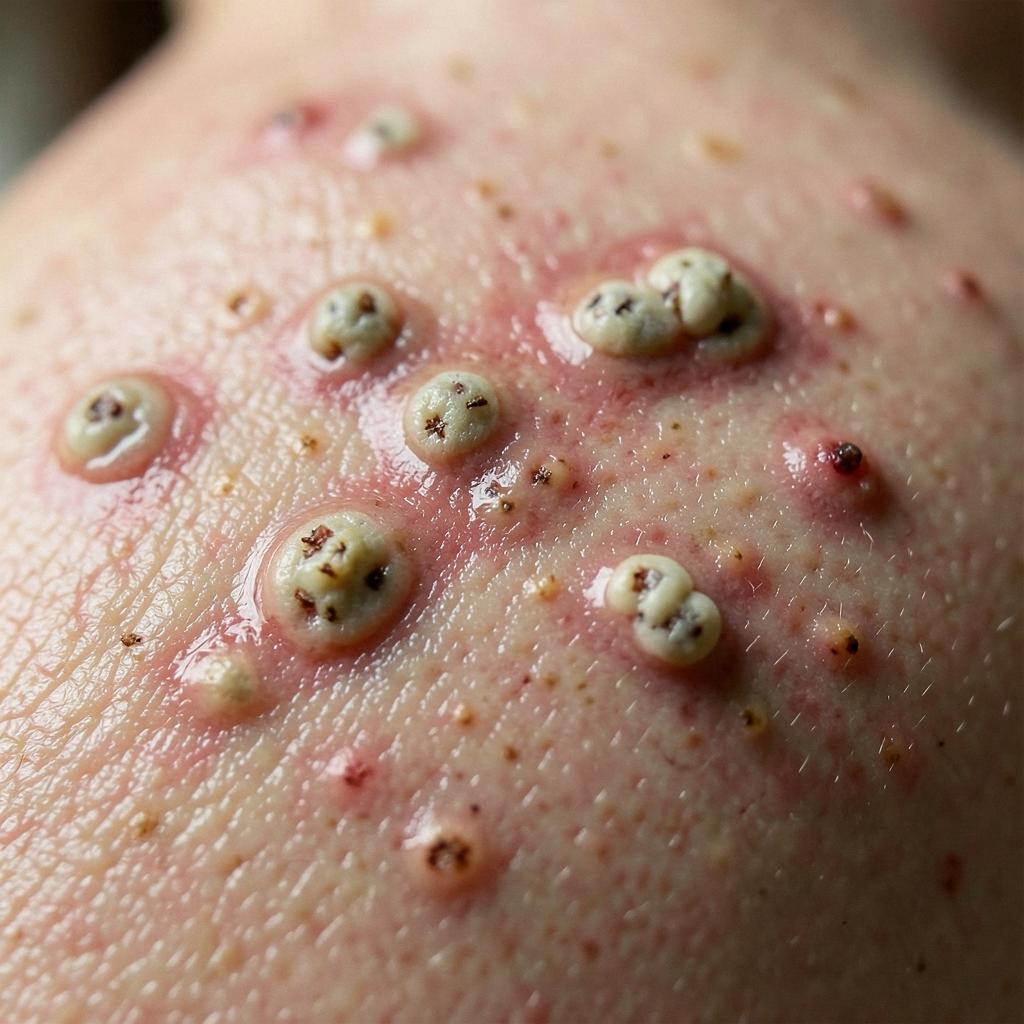
What was reported: A 34-year-old healthcare worker experienced flushing, generalized urticaria, tongue swelling, nausea, and dyspnea within 3 minutes of her first BNT162b2 dose, treated with intramuscular epinephrine and diphenhydramine with rapid relief . Crucially, she had been subjectively overheated while queueing, had a >10-year history of sweating-triggered hives, and prior large local reactions to influenza vaccines — the pivotal context the authors argue was initially overlooked .
No premedication; cool room; breastfeeding avoided antihistamines
Serum Tryptase: The Missing Acute Measurement
Diagnostic Reasoning Pathway
Critical Appraisal
Strengths: Unusually complete case workup — standardized exercise challenge, TPSAB1 genotyping, graded vaccine/PEG intradermal testing — and an ethical informed rechallenge; the core clinical message (refer immediate-reaction patients to allergists rather than categorically denying vaccination) is supported by later reviews showing allergist-managed vaccination is feasible .
Missing mechanistic proof: No acute tryptase or histamine was drawn during the reaction; the non-IgE attribution rests on history and later normal values, so vasovagal, idiopathic mast-cell, or other etiologies were not directly excluded .
Guideline tension: CDC guidance at the time stated an immediate allergic reaction should preclude a second dose; the authors implicitly challenge this blanket rule, anticipating later risk-stratification frameworks .
Confounded success: The tolerated second dose could reflect thermal-environment control, chance, or reaction threshold variability — though independent perioperative cases show strict temperature control prevented ChU episodes in similar patients .
Generalizability: n=1, healthcare worker, military tertiary center, possible recall and selection bias; ChU mechanisms are heterogeneous, complicating extrapolation to other patients .
Bottom line (confidence: moderate): The case is a well-documented existence proof that immediate post-mRNA-vaccine anaphylaxis is not always IgE-mediated vaccine allergy and that allergist-led evaluation can enable safe rechallenge; what would change this conclusion is any cohort data showing IgE sensitization to PEG or vaccine components in similar reactors, or a rechallenge reaction under the same cool-room protocol.
Author Reviews
Feedback:
Updated: October 25, 2026
BGPT Paper Review
Study Novelty
60%
First documented pairing of confirmed cholinergic urticaria with post-BNT162b2 anaphylaxis and a successful supervised rechallenge, but the underlying concepts (ChU-associated anaphylaxis, allergist referral after vaccine reactions) were already established in prior literature cited by the authors.
Scientific Quality
70%
Rigorous, standardized workup (pulse-controlled exercise challenge, TPSAB1 genotyping, graded intradermal testing) for a case report, but n=1, no acute tryptase or histamine during the reaction, and the causal attribution is interpretive; authors appropriately acknowledge skin-testing limitations themselves.
Study Generality
40%
A single patient limits formal generality, but the diagnostic pathway and the critique of blanket no-second-dose rules transfer to the broader class of immediate vaccine reactions.
Study Usefulness
70%
Directly actionable for clinicians: the case supports allergist referral, environmental thermal control, and unmedicated supervised rechallenge rather than automatic permanent contraindication; later reviews corroborate this management direction.
Study Reproducibility
60%
Methods reference standardized published protocols (skin testing, exercise challenge) and report quantitative values, but replication is inherently limited to single cases and no raw data are shared.
Explanatory Depth
60%
The authors propose a coherent non-IgE mast-cell mechanism consistent with their data, yet never directly demonstrate mast-cell activation acutely; the explanation is plausible inference, not demonstrated mechanism.
We'll email you the results when your analysis is finished.
Hypothesis Graveyard
IgE-mediated PEG allergy as the default explanation for immediate mRNA vaccine reactions — weakened here by negative epicutaneous and intradermal PEG, polysorbate, and vaccine testing plus tolerated rechallenge, consistent with commentary noting PEG causality remains unconfirmed.
Antihistamine premedication is necessary for safe rechallenge in prior reactors — undermined by this case's successful unmedicated rechallenge, where the authors deliberately avoided masking an IgE reaction.

 Explore by Goal
 Quick Answer
 Long Answer
 Top Data Sources
 Ask a Follow-Up
 Key Insight
 Keep Exploring
 Hypothesis Graveyard
 Potential Experiments
 Discussion
