Check a paper's claims against linked experiments, exact results, stated scope, and limitations.Know what falsifiable science actually supports before you trust the answer.
Press Enter ↵ to search evidence
Explore by Goal
"Science is organized knowledge. Wisdom is organized life."
- Immanuel Kant
Quick Explanation
Copied
This narrative review by Paroli and Sirinian (2025) synthesizes evidence that neuroimmune crosstalk—glial activation, small-fiber neuropathy, central sensitization, and autonomic dysfunction—explains symptom burden in SARDs that peripheral inflammation alone cannot, concluding that pain phenotyping and multimodal management should enter rheumatology practice; its synthesis is coherent and well-sourced (156 refs) but remains hypothesis-generating, with no systematic search and largely preclinical/indirect human evidence .
Long Explanation
What the paper claims and how well the evidence supports it
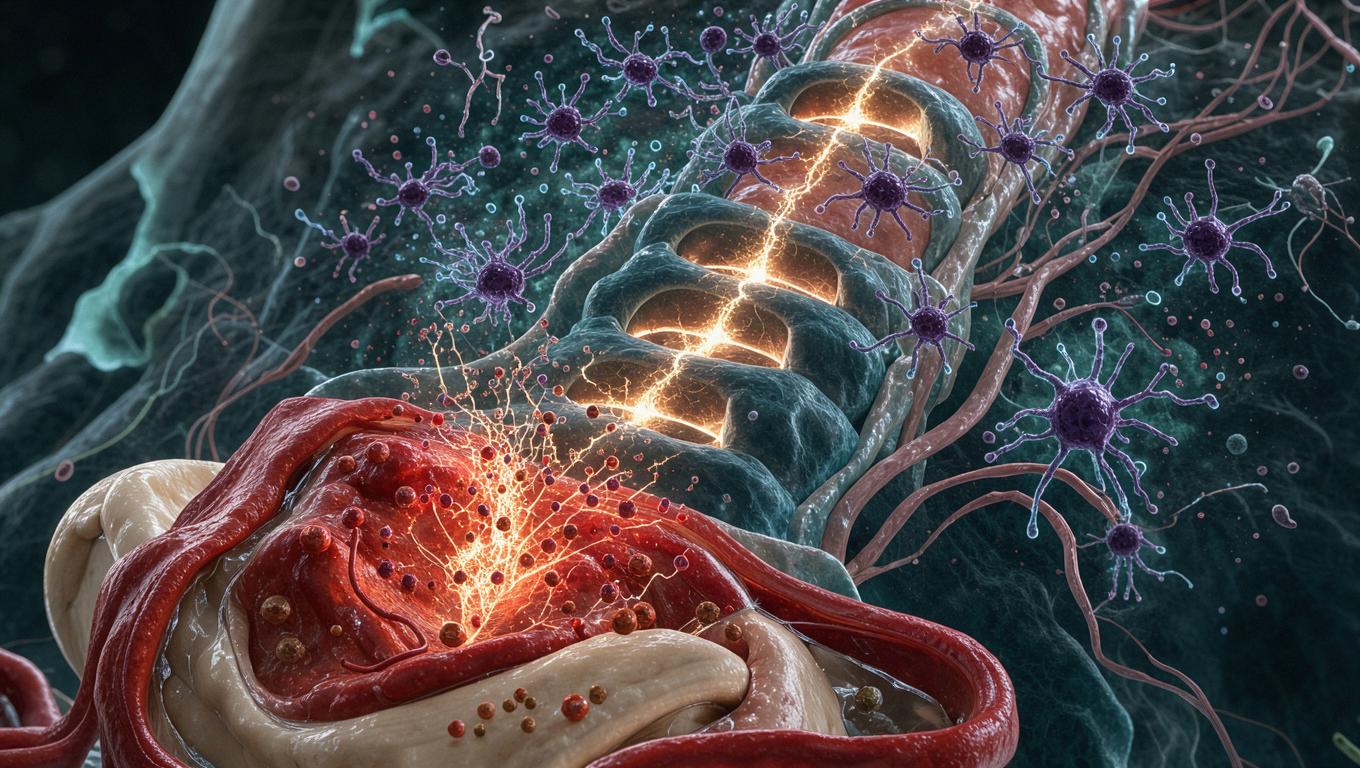
Paroli and Sirinian (Sapienza University of Rome) propose a "glial-cytokine-pain" framework: systemic inflammation in SARDs (RA, SLE, Sjögren's) feeds forward through peripheral cytokines (TNF-α, IL-6, IL-17), BBB compromise, microglial/astrocytic activation, and SFN-driven afferent injury, producing central sensitization and dysautonomia that persist even when synovitis is controlled .
Strongest evidentiary pillars in the paper: (1) TSPO-PET imaging showing glial activation in fibromyalgia and SLE cohorts ; (2) biopsy-confirmed SFN in ~49% of fibromyalgia patients across eight studies ; (3) passive transfer of IgG from fibromyalgia patients producing sensory hypersensitivity in mice ; (4) the vagal "inflammatory reflex" .
Critical caveats BGPT flags: The authors honestly concede the framework is "fragmentary" and a unifying model is lacking; the central sensitization→residual pain link in SARDs is explicitly framed as a hypothesis. Much support comes from murine arthritis/lupus models (e.g., collagen-induced arthritis, lupus microglial stripping) whose human translation is unproven, and TSPO-PET ligand specificity and SFN diagnostic heterogeneity (non-standardized IENFD criteria across small studies) remain unresolved. As a narrative review with no systematic search or quality appraisal, selection and citation bias cannot be excluded. The related RHD literature shows that retrospective, small-cohort rheumatology evidence frequently overstates confidence .
Visual assessment of the review's evidence architecture
Bar lengths are BGPT's qualitative tiering of evidence class cited in the review—not measured quantities.
Bottom line
The review succeeds as an integrative, well-referenced (156 refs) roadmap that reframes residual pain/fatigue in SARDs as biologically grounded neuroimmune phenomena and pushes pain phenotyping (inflammatory vs neuropathic vs nociplastic) plus COMPASS-31/CSI screening into rheumatology. It does not yet prove causality; validating claims requires prospective human cohorts combining IENFD biopsy, TSPO-PET, QST, HRV, and outcome-linked biomarkers. Falsification would entail demonstrating central sensitization/autonomic dysfunction independent of, or symptom burden fully explained by, peripheral inflammation .
Feedback:
Updated: October 28, 2026
BGPT Paper Review
Study Novelty
70%
Synthesizes recent (2021-2025) mechanistic work (meningeal Tregs, fibromyalgia IgG transfer, TSPO-PET in SARDs) into a unified PNS-CNS crosstalk framework, but the individual concepts (central sensitization, SFN, cholinergic anti-inflammatory reflex) are established; the integration is incremental rather than paradigm-breaking.
Scientific Quality
70%
Coherent, well-organized, transparently self-critical, no funding or COI. Weaknesses: narrative (non-systematic) methodology, no PRISMA flow, no quality appraisal of included studies, heavy reliance on murine models and small human studies, and some citation formatting errors in the reference list.
Study Generality
70%
Framework spans RA, SLE, Sjögren's, psoriatic arthritis, and spondyloarthritis with translatable concepts to other inflammatory conditions, though mechanistic specificity varies by disease and fibromyalgia overlap complicates generalization.
Study Usefulness
80%
Practically valuable for rheumatologists: promotes pain phenotyping, CSI/COMPASS-31 screening, skin biopsy consideration, avoidance of reflexive immunosuppression escalation, and multidisciplinary care—all actionable today.
Study Reproducibility
50%
As a narrative review there are no methods to reproduce; no systematic search string, inclusion criteria, or protocol. Reproducibility of the underlying studies cited varies (some single-center murine work).
Explanatory Depth
80%
Deep mechanistic layering from molecular mediators (cytokines, neuropeptides, miRNAs, P2X7/TLR signaling) through cellular actors (microglia, astrocytes, satellite glia) to systems physiology (BBB, vagal reflex), though several links are asserted rather than demonstrated in humans.
Mining GWAS and single-cell datasets to prioritize candidate autoantibody and miRNA biomarkers linking small-fiber neuropathy with central sensitization phenotypes in SARDs.
Get emailed when your analysis is done!
We'll email you the results when your analysis is finished.
Hypothesis Graveyard
"Fibromyalgia in SARDs is purely psychological/somatization" — falsified by biopsy-confirmed SFN in ~49% of fibromyalgia patients and murine IgG passive-transfer experiments showing antibody-mediated sensitization.
"Residual pain in RA equals uncontrolled inflammation" — weakened by documented dissociation between DAS28 remission and symptom burden; persistent pain persists in objectively controlled disease.

 Explore by Goal
 Quick Explanation
 Long Explanation
 Top Data Sources
 Ask a Follow-Up
 Key Insight
 Keep Exploring
 Analysis
 Hypothesis Graveyard
 Potential Experiments
 Discussion
