Analyze how experimental results and claims are presented, scoped, and limited in a paper.Know what the science actually supports before you trust the answer.
Press Enter ↵ to analyze
Explore by Goal
"The finding of the double helix thus brought us not only joy but great relief. It was unbelievably interesting and immediately allowed us to make a serious proposal for the mechanism of gene duplication."
- James Watson
Quick Explanation
Copied
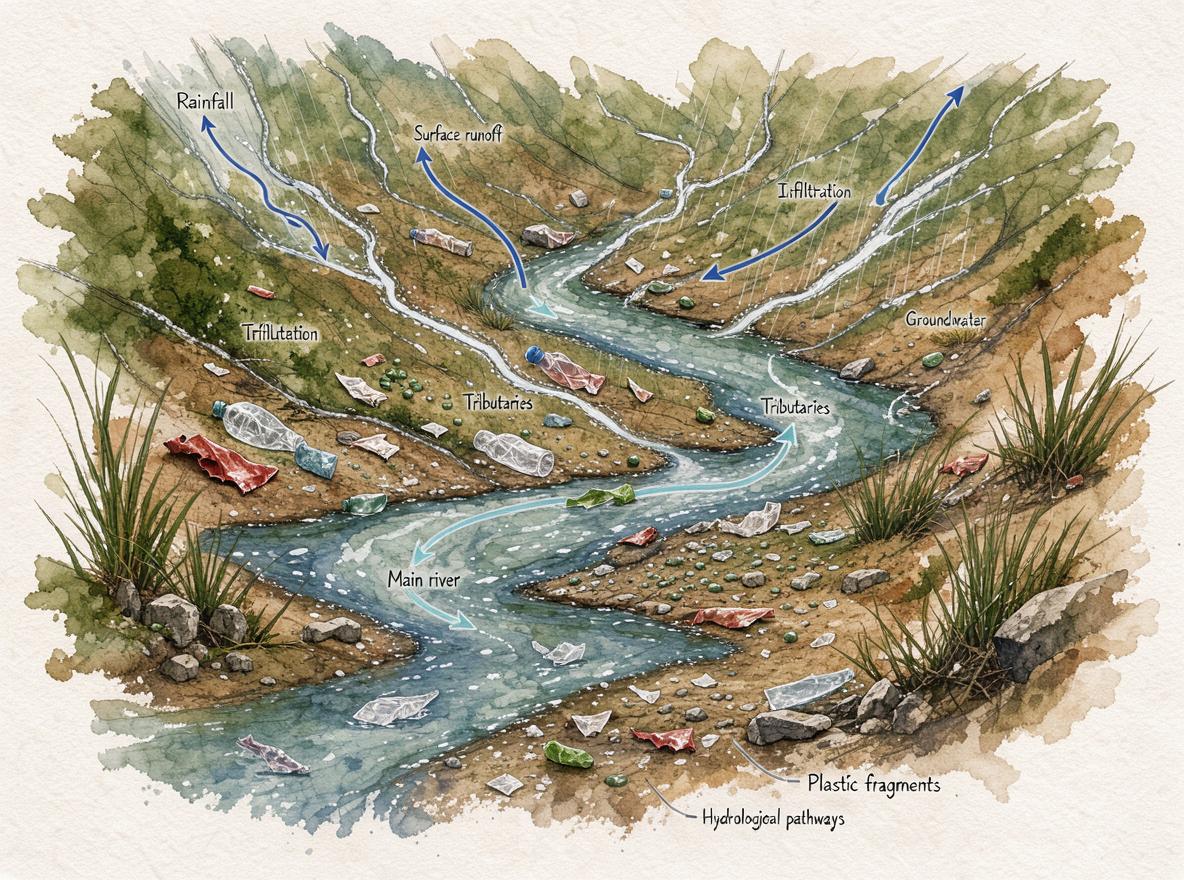
Windsor et al. (2019) provide an influential conceptual review arguing that hydrological catchments are the correct integrating scale for studying plastic pollution from terrestrial sources through freshwater conduits to marine sinks . Its synthesis is conceptually strong but, by design, mostly theoretical: empirical flux data remain sparse, and the authors themselves state models cannot yet be parameterized or validated.
Long Explanation
What the paper establishes
This peer-reviewed synthesis in Global Change Biology reframes plastic pollution as a catchment-scale problem: plastics follow hydrological pathways determined by topography and land use, making river basins the natural unit for quantifying sources, fluxes and sinks . Key quantitative anchors reported in the review: ~6,300 Mt of plastic waste produced with ~79% landfilled or leaked to the environment ; 4.8–12.7 MT/year entering oceans ; and river networks transferring 1.15–2.41 MT/year — an estimate the authors flag as likely underestimated because it counts only surface transport .
Freshwaters emerge as hotspots: Lake Erie near densely populated shores holds ~43,000 MP/km² versus 6,541–12,645 MP/km² in less populated Great Lakes , and a single flood event removed 0.85 ± 0.27 tonnes of microplastic from one UK river catchment, demonstrating episodic sedimentary mobilization . Under-represented compartments — cryosphere, groundwater, riparian zones — are correctly flagged: Arctic sea ice stores 40–250 MP/L of melted ice, with 7.2–8.7 × 10²⁰ particles (0.011–5 mm) released by net melting 2011–2016 .
Critical assessment
Strengths: The catchment framing was genuinely integrative in 2019, moving beyond the marine-centric literature; the biological cycling section (faecal-pellet aggregation, earthworm burrowing, mosquito-mediated aerial transference) is mechanistically rich. Weaknesses: The authors candidly state there is "insufficient data to accurately parameterize and validate empirical transport models" and that unique particle heterogeneity limits model utility . Nearly all dose-response evidence cited involves concentrations exceeding environmental relevance, and individual-level effects rarely scale to populations — the review acknowledges this rather than resolving it . The vector-effect treatment is appropriately balanced, noting recent evidence that microplastics may be negligible chemical vectors relative to natural organic matter . Blind spots: no quantitative synthesis methodology stated (narrative review), geographic over-representation of European/North American studies, and the number of flux estimates is small enough that catchment-scale mass balances cannot yet be closed — all conditions the authors transparently declare rather than conceal. Confidence: moderate-high that the paper's own framing and self-declared gaps are accurately represented here.
Feedback:
Updated: November 01, 2026
BGPT Paper Review
Study Novelty
60%
The catchment-scale framing was a fresh synthesis angle in 2019, but the component data (river flux, marine inputs, ecotoxicology) were already published; novelty lies in integration, not new findings.
Scientific Quality
70%
Well-cited, transparently self-critical narrative review with balanced treatment of the vector-effect controversy; but no systematic methodology, no formal PRISMA-style inclusion criteria, and heavy reliance on theoretical models.
Study Generality
80%
Applicable across all ecosystem types, taxa, and global catchments; the framework generalizes to any particulate pollutant following hydrological pathways.
Study Usefulness
90%
Provided a research-agenda-setting framework widely used to structure subsequent catchment plastic studies, monitoring design, and source-apportionment research.
Study Reproducibility
50%
As a narrative review, synthesis steps are not reproducible systematically; the quantitative claims it reports are traceable to primary sources, but selection criteria are undocumented.
Explanatory Depth
60%
Strong conceptual mechanisms (biological cycling, size-ratio effect framework) but mechanistic dose-response understanding is explicitly declared incomplete.
We'll email you the results when your analysis is finished.
Hypothesis Graveyard
Oceans as terminal one-way sinks: falsified in principle by documented marine-to-terrestrial/atmospheric return fluxes (wave redeposition, aerosolization) recognized in this very review.
Microplastics as dominant chemical vectors: substantially weakened by model-supported reinterpretations showing negligible transfer relative to natural organic matter.

 Explore by Goal
 Quick Explanation
 Long Explanation
 Top Data Sources
 Ask a Follow-Up
 Key Insight
 Keep Exploring
 Hypothesis Graveyard
 Potential Experiments
 Discussion
