Check a paper's claims against linked experiments, exact results, stated scope, and limitations.Know what falsifiable science actually supports before you trust the answer.
Press Enter ↵ to search evidence
Explore by Goal
"The only way to discover the limits of the possible is to go beyond them into the impossible."
- Arthur C. Clarke
Quick Explanation
Copied
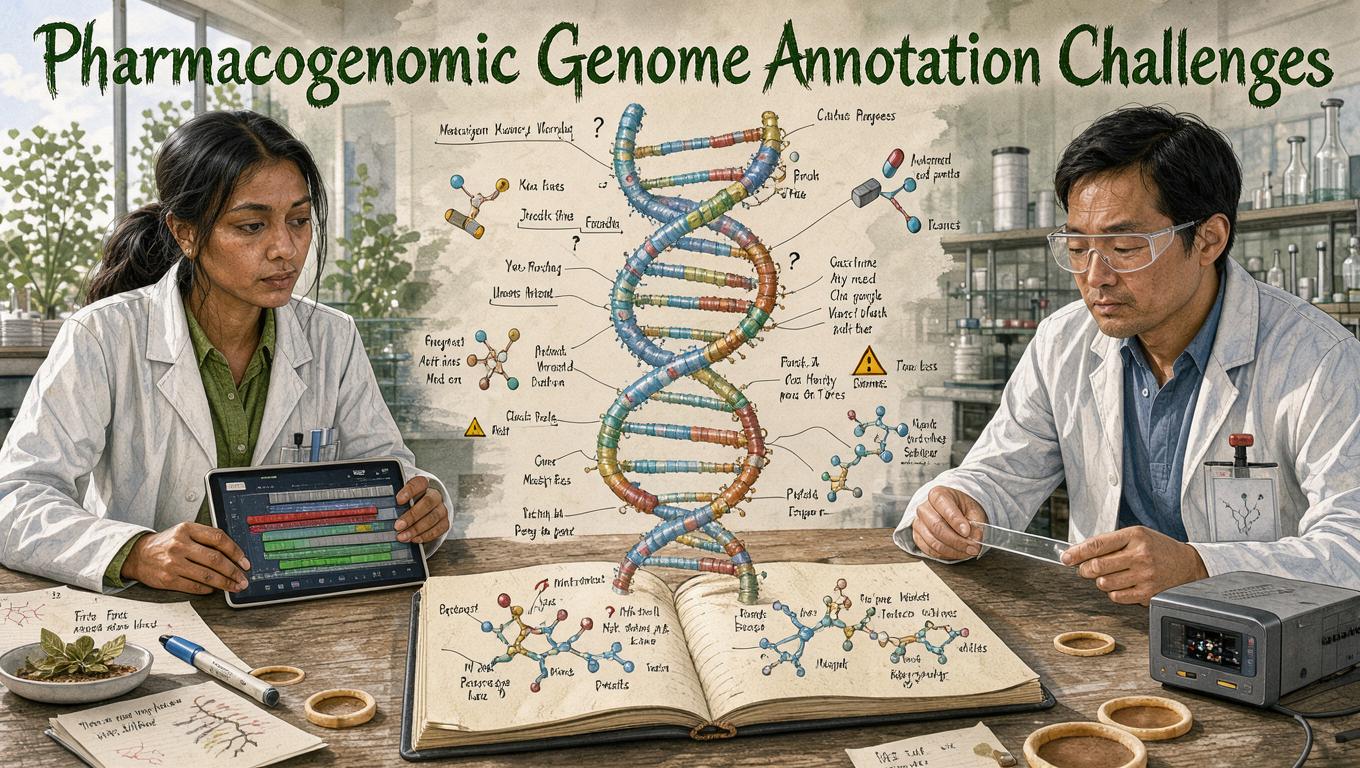
This 2013 perspective by Altman, Whirl-Carrillo, and Klein distills three whole-genome pharmacogenomic annotation exercises into ten enduring challenges—sequencing accuracy in GC-rich/CNV/pseudogene regions, rare-variant interpretation, unambiguous allele reporting, phasing, and combining variant effects—many of which remain unresolved today, though the paper presents no new primary data and its patient-facing observations rest on three individuals.
Long Explanation
What the Paper Reports
The authors, who curate PharmGKB, participated in three genome-annotation exercises: a 40-year-old asymptomatic man ( yielding clinical annotations for nearly 100 drugs, including CYP2C19*2 carrier status affecting clopidogrel response and warfarin insensitivity), a family quartet emphasizing haplotype inheritance, and a longitudinal multi-omics individual. From these they extract ten challenges spanning technical, interpretive, and human factors .
Critical Assessment
Strengths: The challenge list was prescient. Phasing, CNV calling in CYP2D6, pseudogene confounding, and multi-variant integration remain active problems. The identified ambiguity in risk-allele reporting in the literature is a real curation bottleneck.
Blind spots and limitations: All human observations derive from three consenting, counselled individuals—clearly non-generalizable; the 'consumer discounting unused drug information' findings are anecdotal, not systematic. The paper predates ENCODE publication, so regulatory-variant claims are speculative. Population bias is implicit: genotyping arrays cited as discovery tools 'typically focus on European populations', a limitation the paper notes but does not resolve . Notably, R.B. Altman discloses founder/consultant roles at Personalis (clinical genomics NGS company)—a financial conflict that partially aligns with the paper's push for better clinical-grade sequencing.
Contextual Evidence: How Much Genomic Drug Information Reached Patients
An independent 2008 claims-database analysis quantified actual exposure: 24.3% of 36.1 million patients used drugs whose labels carried pharmacogenomic information, dominated by CYP2D6 (13.6%) and CYP2C19 (10.9%) biomarkers, while rarer actionable markers (UGT1A1, TPMT, G6PD) affected under 0.5% of users . This supports the paper's point that clinical guideline coverage was then the bottleneck, not label content.
Figure: User prevalence of pharmacogenomic biomarker-labeled drugs (sourced from the 2008 FDA label analysis, not from the reviewed perspective).
How the Field Could Disprove the Framework
The paper's own falsification criterion is sound: if real-world data later showed that whole-genome annotation adds no incremental value over targeted panels, or that a small variant set suffices across populations, the agenda collapses. Subsequent population-specific work (e.g., Indian scoping reviews finding 24 genes affecting 57 essential drugs) partially validates the rare-variant and population-diversity concerns while leaving multi-variant combination methods unsolved. Confidence in the historical reading is moderate; the perspective lacks quantitative primary evidence by design.
Feedback:
Updated: November 25, 2026
BGPT Paper Review
Study Novelty
70%
For 2013, framing whole-genome PGx annotation as a discrete ten-challenge research agenda was forward-looking, but each individual challenge (CNV calling, phasing, rare variants) was already recognized; the synthesis, not the parts, is novel.
Scientific Quality
80%
Well-reasoned expert perspective with disclosed COI (Altman/Personalis) and NIH funding; however, no primary data, small anecdotal basis for patient observations, and no systematic literature methodology.
Study Generality
70%
Challenges apply broadly to clinical genomics beyond pharmacogenomics, but the agenda is anchored to drug-response phenotypes and PharmGKB-specific workflows.
Study Usefulness
80%
Directly shaped research priorities (CPIC expansion, phasing tools, rare-variant interpretation); useful roadmap still partially relevant in 2026 for multi-variant integration.
Study Reproducibility
60%
As a perspective, it presents no reproducible experiments; the three cited genome-annotation exercises are separately published and partially reproducible.
Explanatory Depth
70%
Mechanistically concrete on technical challenges (GC-rich regions, pseudogenes, CYP2C19 cis/trans phasing example), but the patient-behavior observations lack any explanatory model or data.
Analyzing PharmGKB drug-gene annotation coverage across populations, comparing CPIC guideline counts from 2013 versus current, and mapping which of the ten 2013 challenges remain unresolved using extracted claim data.
Get emailed when your analysis is done!
We'll email you the results when your analysis is finished.
Hypothesis Graveyard
Whole-genome PGx annotation was assumed necessary for clinical value; targeted panel approaches later captured most actionable signal for common metabolizer genes, weakening the necessity claim—though rare-variant and CNV cases still favor WGS.

 Explore by Goal
 Quick Explanation
 Long Explanation
 Top Data Sources
 Ask a Follow-Up
 Key Insight
 Keep Exploring
 Analysis
 Hypothesis Graveyard
 Potential Experiments
 Discussion
