Analyze how experimental results and claims are presented, scoped, and limited in a paper.Know what the science actually supports before you trust the answer.
Press Enter ↵ to analyze
Explore by Goal
"Biology sees right and wrong as the same color in different light."
- Delia Owens
Quick Explanation
Copied
This first population-based prospective study of primary cardiac tumors (Grosseto, Italy, 1998–2011) found an incidence of 1.38 per 100,000/year across 42 cases, 90.5% benign and myxoma-predominant, with malignancy, age >70, and non-surgical management independently predicting mortality. It is a landmark but small, single-county study with incomplete screening and seven imaging-only diagnoses, so estimates carry non-trivial uncertainty.
Long Explanation
Key Findings and What They Mean
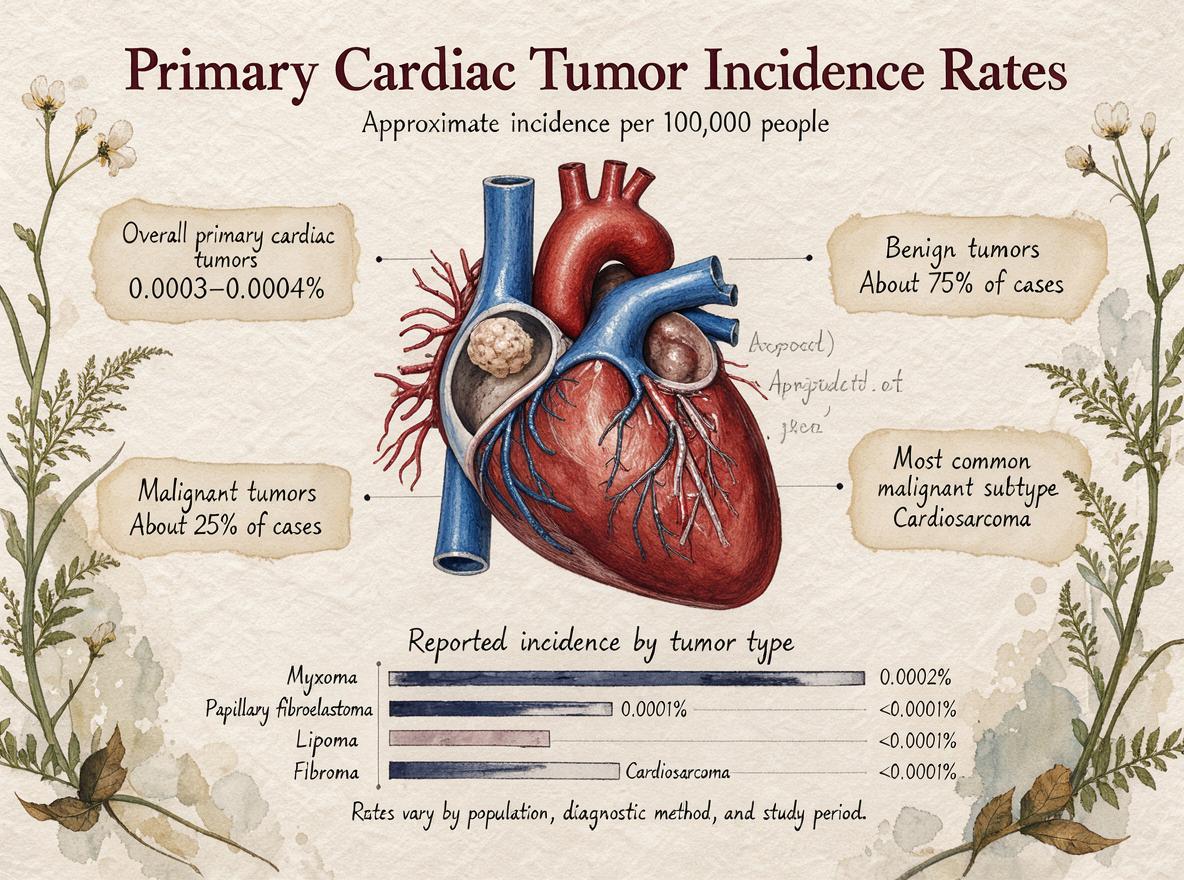
Cresti et al. prospectively captured all 42 primary cardiac tumors (PCTs) among residents of Grosseto county (average population 217,778) over 14 years by merging a prospective institutional database with an ICD-9 interrogation (codes 212.7/164.1) of the county health system, yielding an overall incidence of 1.38 per 100,000/year (benign 1.24; malignant 0.24 per 100,000/year). This contrasts with the classic pooled autopsy estimate of ~0.02% (~200 per million autopsies, ~75% benign), supporting the authors' claim that referral/autopsy-based figures underestimate live-population incidence.
Strengths and Independent Critique
The dual-database capture (catching 3 patients operated elsewhere and 8 never-hospitalized cases), prospective enrollment, multimodality imaging (TEE in 55%, MRI 29%, CT 17%, PET 12%), and comparison with ISTAT life-tables are genuine methodological strengths for a rare-disease design. However, BGPT's skeptical read flags real concerns: (1) only 42 events, so histotype-specific rates (e.g., hemangiopericytoma 0.03/100,000) have enormous Poisson uncertainty and no confidence intervals were reported; (2) seven diagnoses (17%) rested on imaging alone without histology, which could inflate benign counts if atypical mimics occurred; (3) the survival advantage of operated benign tumors (P=0.0127) is confounded by indication — unoperated patients were older with severe comorbidities, which the authors acknowledge but cannot statistically resolve with n=42; (4) 99.8% Caucasian single-county population limits external validity; (5) screening only reached people who underwent diagnostic exams, so asymptomatic prevalence may be underestimated — the authors state incidence "may be even higher."
Bottom line: a credible, first-of-its-kind population estimate (~1.4/100,000/year) whose headline number is reasonably robust, but whose surgical-indication inference and rare-histotype rates are underpowered. Replication in an independent registry with reported CIs would be decisive; a substantially different rate or survival equivalence after confounder adjustment would falsify the central claims.
Feedback:
Updated: October 30, 2026
BGPT Paper Review
Study Novelty
80%
First population-based prospective incidence study of PCTs; prior estimates derived solely from autopsy or echo registries, making this a genuinely new epidemiological datum.
Scientific Quality
70%
Sound rare-disease methodology and dual-ascertainment, but no confidence intervals on incidence rates, small n per histotype, unaddressed residual confounding in the surgery-survival comparison, and 17% imaging-only diagnoses.
Study Generality
60%
Defines a baseline incidence for a rare disease class, but a single 99.8% Caucasian Tuscan county with era-specific imaging limits generalizability across populations and time.
Study Usefulness
70%
Provides the first defensible population denominator for PCT incidence, useful for clinical suspicion thresholds, epidemiologic modeling, and comparing future registry studies.
Study Reproducibility
60%
Methods are clearly described (databases, ICD-9 codes, imaging, statistics) and conceptually replicable, but raw data are not available and no software or CIs are reported.
Explanatory Depth
50%
Descriptive epidemiology with survival analysis, but mechanistic explanation of why unoperated patients fared worse or why incidence exceeds autopsy estimates is limited to plausibility arguments.
We'll email you the results when your analysis is finished.
Hypothesis Graveyard
'Registry studies are equivalent to case-series for estimating rare disease incidence' — falsified here: the Icelandic myxoma registry reported 0.11/100,000 vs 0.65/100,000 in this prospective series, showing registries miss never-hospitalized cases.
'Autopsy frequency (~0.02%) approximates true population incidence' — falsified because autopsy selection bias and era-specific imaging make postmortem rates non-comparable to live-population rates.

 Explore by Goal
 Quick Explanation
 Long Explanation
 Top Data Sources
 Ask a Follow-Up
 Key Insight
 Keep Exploring
 Hypothesis Graveyard
 Potential Experiments
 Discussion
