Analyze how experimental results and claims are presented, scoped, and limited in a paper.Know what the science actually supports before you trust the answer.
Press Enter ↵ to analyze
Explore by Goal
"The finding of the double helix thus brought us not only joy but great relief. It was unbelievably interesting and immediately allowed us to make a serious proposal for the mechanism of gene duplication."
- James Watson
Quick Explanation
Copied
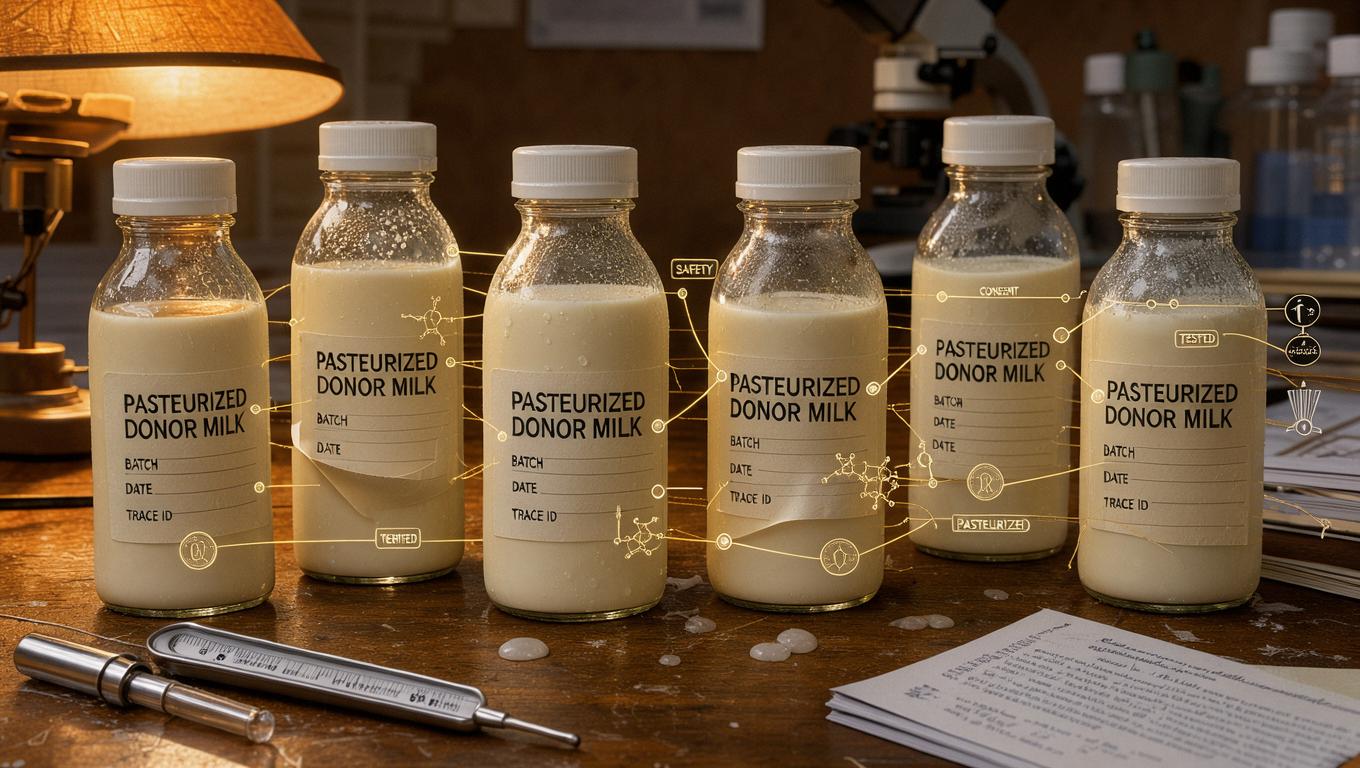
This is a timely but non-systematic legal-policy review correctly identifying that Article 290 of Ukraine's Civil Code omits breast milk from donation objects, and recommending SoHO-style classification plus a dedicated milk-bank law aligned with EU Regulation 2024/1938 . Its clinical motivation (donor milk halves necrotizing enterocolitis risk in very preterm infants, high-certainty Cochrane evidence) is well grounded , but the review provides no primary Ukrainian data and uses non-transparent source selection.
Long Explanation
What the paper establishes
This 2026 review from Uzhhorod National University makes one verifiable legal claim: Ukrainian law contains no definition of breast milk donation — Article 290 of the Civil Code lists donation objects without breast milk, and the draft new Civil Code (Article 312) leaves the gap unaddressed . The clinical rationale is solid: donor milk reduces necrotizing enterocolitis risk roughly two-fold versus formula in very preterm/very-low-birth-weight infants, with high-certainty evidence from 12 randomized trials , and >20 million low-birth-weight infants are born annually per WHO .
Note: counts differ in kind (donors, banks, risk findings); plotted on a log scale to make all anchors visible, not to enable direct comparison.
Comparative models — the paper's core contribution
The comparative analysis is the strongest section: US milk is regulated as food (21 CFR Part 117), leaving room for commercial processors like Prolacta; Brazil treats milk under sanitary-supervision logic with mandatory batch-by-batch post-pasteurization testing (ANVISA RDC 918/2024); France restricts milk banking to state-authorized non-profit lactariums under the Code de la Santé Publique; Poland built ~16 hospital banks despite a legal vacuum ; and EU Regulation 2024/1938 classifies processed donor milk as a substance of human origin (SoHO) with compliance required by August 7, 2027 . The paper's policy conclusion — classify milk as SoHO, amend Article 290, enact a special law, fund via NHSU packages, and assign Ministry of Health oversight — follows logically from the EU candidate-country obligation and is consistent with EMBA consensus recommendations on donor screening, Holder pasteurization and traceability .
Critical gaps and blind spots
Reported risk evidence for informal milk sharing is real but thin: a US scoping review found bacterial contamination and handling problems in online exchanges, yet explicitly noted insufficient evidence of direct clinical outcomes in infants — a nuance the Ukrainian review partially preserves. Blind spots: no PRISMA protocol or search-quality reporting despite claiming priority for systematic reviews and RCTs; no primary data on actual Ukrainian milk-bank volumes, contamination rates, or informal-sharing prevalence; the Italian donor increase (1,336→1,520) is presented without denominators or significance testing ; and the recommendation to exclude commercial circulation is asserted normatively rather than derived from comparative outcome data. Falsification would require showing Ukraine's final Civil Code already covers breast milk, or that existing general medical licensing adequately controls the Kyiv bank.
Verdict
Confidence: moderate. The legal-gap claim is specific, checkable, and almost certainly correct; the policy prescription is reasonable but normatively driven. As a law/policy paper, not a clinical study, it succeeds at problem-setting but offers no implementation evidence, cost analysis, or Ukrainian empirical baseline.
Feedback:
Updated: November 03, 2026
BGPT Paper Review
Study Novelty
40%
The comparative regulatory mapping (US food-model vs Brazilian sanitary model vs French public-health model vs EU SoHO 2024/1938) is competently assembled but the underlying comparisons exist in prior literature (Klotz 2022, EMBA); the Ukraine-specific gap analysis is the novel element but is straightforward doctrinal checking.
Scientific Quality
40%
No systematic review protocol despite claiming priority for RCTs and systematic reviews; no primary data; normative conclusions asserted rather than derived; mixed-units quantitative claims (donor counts, ~2-fold NEC reduction) used loosely. Offsetting strengths: accurate legal citations, correct use of a high-certainty Cochrane review, and a falsifiable central legal claim.
Study Generality
40%
Findings are Ukraine- and EU-accession-specific, though the comparative model taxonomy (food vs SoHO vs sanitary supervision) is transferable to other post-Soviet or candidate states.
Study Usefulness
50%
Directly actionable for Ukrainian legislators and the Ministry of Health given the 2026 MoH roadmap and the August 2027 SoHO deadline; limited for international researchers beyond policy context.
Study Reproducibility
30%
No search strings beyond keywords, no inclusion/exclusion criteria, no PRISMA flow, no screening or quality-appraisal documentation; a reader could not replicate the source selection.
Explanatory Depth
30%
Describes regulatory architectures accurately but does not analyze causal mechanisms — e.g., why Brazil's model reduces informal sharing, or cost-effectiveness of SoHO compliance for a wartime health system.
We'll email you the results when your analysis is finished.
Hypothesis Graveyard
The assumption that US food-classification of donor milk is uniformly weaker: FDA's 21 CFR Part 117 GMP requirements still impose enforceable manufacturing standards, so 'food model = lax' is an oversimplification the paper relies on rhetorically.

 Explore by Goal
 Quick Explanation
 Long Explanation
 Top Data Sources
 Ask a Follow-Up
 Key Insight
 Keep Exploring
 Hypothesis Graveyard
 Potential Experiments
 Discussion
