Check a paper's claims against linked experiments, exact results, stated scope, and limitations.Know what falsifiable science actually supports before you trust the answer.
Press Enter ↵ to search evidence
Explore by Goal
"The goal of science is not to open the door to infinite wisdom, but to set a limit to infinite error."
- Bertolt Brecht
Quick Explanation
Copied
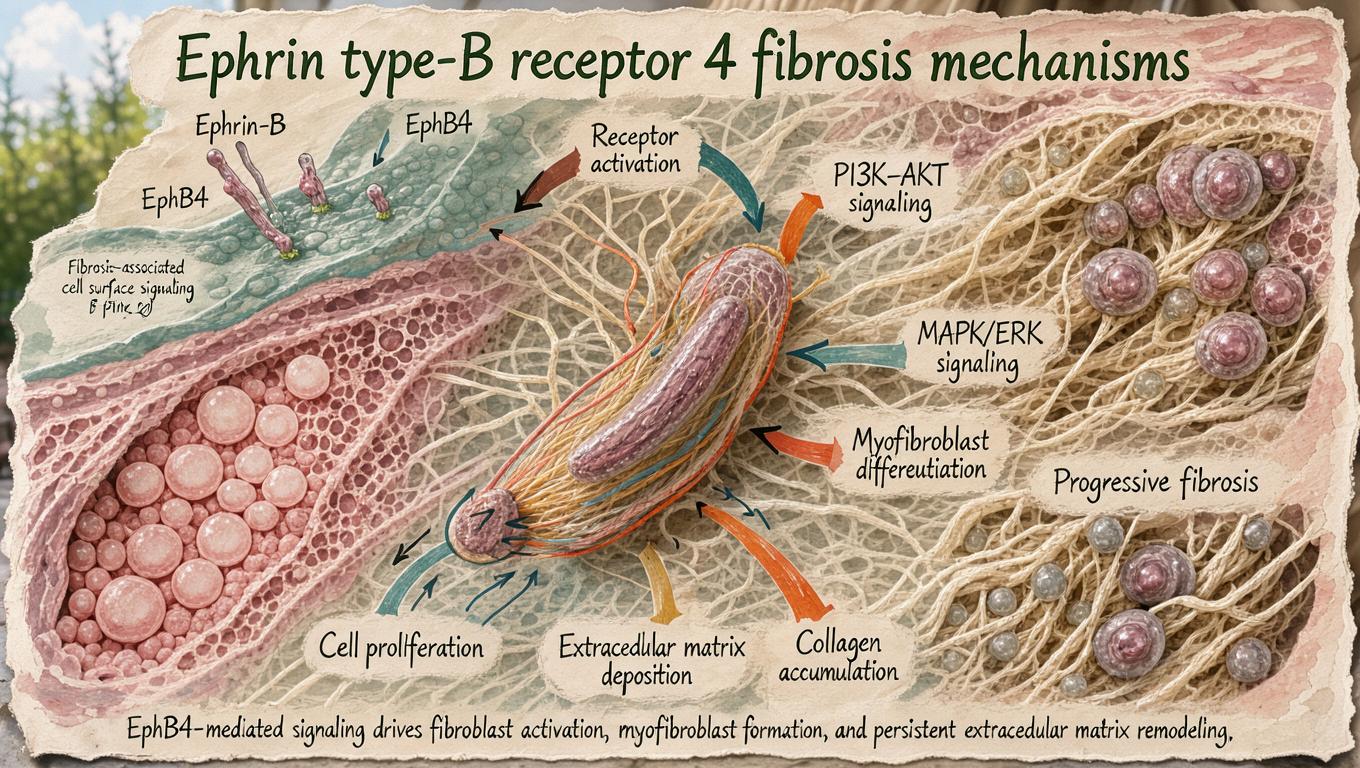
This JCI Insight study (Dec 22, 2025) provides converging genetic, pharmacologic, and transcriptomic evidence that EphB4 drives pulmonary fibrosis, with elastin (ELN) identified as a key downstream partner; the main caveats are reliance on the bleomycin model, tissue-context specificity (no skin protection), and small human donor cohorts.
Long Explanation
Evidence Converging on an EphB4–ELN Fibrosis Axis
The study combines a Col1a2-CreERT conditional Ephb4 knockout (Ephb4-CKO), the EphB4 inhibitor NVP-BHG712, bulk RNA-Seq, snRNA-Seq (39,611 nuclei), NanoString, and human IPF fibroblast assays. Genetic deletion in Col1a2-expressing cells and pharmacologic inhibition both markedly reduced bleomycin-induced pulmonary fibrosis (PF): Ashcroft scores fell from 4.05 ± 0.61 (vehicle) to 2.48 ± 0.55, and lung collagen content from 49.7% ± 8.8% to 37.81% ± 6.8% in NVP-BHG712-treated mice . RNA-Seq of Ephb4-CKO fibroblasts under bleomycin challenge identified 317 DEGs (214 downregulated), enriched for ECM organization, protein trafficking, and ER cargo concentration; only 4 DEGs overlapped between mouse CKO and human IPF fibroblasts treated with NVP-BHG712, with ELN the sole consistently responsive ECM gene across mouse genetic/pharmacologic and human pharmacologic datasets .
Notably, EPHB4 silencing did not reduce TGF-β1-induced SMAD2/3 phosphorylation, implying EphB4 acts non-canonically relative to canonical TGF-β signaling .
Critical Limitations and Blind Spots
Model dependency: The bleomycin model has an acute inflammatory phase absent in human IPF; the authors acknowledge this and note no protection was observed in a bleomycin skin fibrosis model, indicating tissue-context specificity .
Off-target pharmacology: NVP-BHG712 inhibits VEGF-driven angiogenesis and has documented off-targets; inhibitor findings are best interpreted alongside the genetic CKO data .
Small human cohort: Only n=4 IPF and n=5 control donor fibroblast lines; ELN findings require larger, tissue-level validation. The preprint version corroborates the published findings with identical GEO data .
Mechanistic gap: How EphB4 signaling regulates ELN transcription remains unresolved; the paper explicitly defers this and flags EphB4's essential angiogenic and cardiovascular roles as barriers to systemic therapeutic targeting .
Bottom line: A rigorously controlled, internally consistent study establishing EphB4 as a fibrosis mediator (reproducible in GEO: GSE205612/205613/273467), with ELN as the strongest candidate effector — but the 4-gene human-mouse overlap cautions against over-generalizing ELN as the singular mechanism. Disconfirming evidence would be failure of EphB4 targeting in non-bleomycin fibrosis models or failure of EphB4 deletion to reduce ELN-driven ECM remodeling in human lung tissue.
Feedback:
Updated: November 24, 2026
BGPT Paper Review
Study Novelty
80%
First in vivo demonstration of EphB4's role in pulmonary fibrosis, building on prior in vitro Ephrin-B2/EphB4 fibroblast work; ELN as the effector is a novel but specific advance.
Scientific Quality
80%
Strong convergent design (genetic + pharmacologic + transcriptomic + human validation), public GEO data, both sexes included; limited by small human n, potential NVP-BHG712 off-targets, and semi-quantitative histology scoring.
Study Generality
60%
The paper itself shows tissue-context specificity (no skin fibrosis protection), and the 4-gene mouse-human overlap is narrow, limiting generalizability beyond lung fibroblast biology.
Study Usefulness
80%
Identifies a druggable kinase and ELN as an effector gene with deposited datasets, directly informing IPF therapeutic exploration and biomarker work despite translational safety caveats.
Study Reproducibility
80%
Complete methods (doses, software versions, primer tables) and full GEO deposition (GSE273468 super-series) with Supporting Data Values enable independent reanalysis.
Explanatory Depth
70%
Establishes correlation across modalities and excludes canonical SMAD2/3 mediation, but the EphB4-to-ELN mechanistic pathway remains explicitly unresolved by the authors.
We'll email you the results when your analysis is finished.
Hypothesis Graveyard
EphB4 inhibition protects via canonical TGF-β/SMAD suppression — falsified: EPHB4 siRNA did not reduce SMAD2/3 phosphorylation despite reducing ELN.
EphB4 broadly mediates all tissue fibrosis — weakened: Ephb4-CKO did not protect against bleomycin-induced skin fibrosis, indicating tissue-context dependency.

 Explore by Goal
 Quick Explanation
 Long Explanation
 Top Data Sources
 Ask a Follow-Up
 Key Insight
 Keep Exploring
 Hypothesis Graveyard
 Potential Experiments
 Discussion
