Ask questions across claims linked to experiments, exact results, limitations, and sources.Know what the science actually supports before you trust the answer.
Press Enter ↵ to search evidence
Explore by Goal
"I was taught that the way of progress was neither swift nor easy."
- Marie Curie
Quick Explanation
Copied
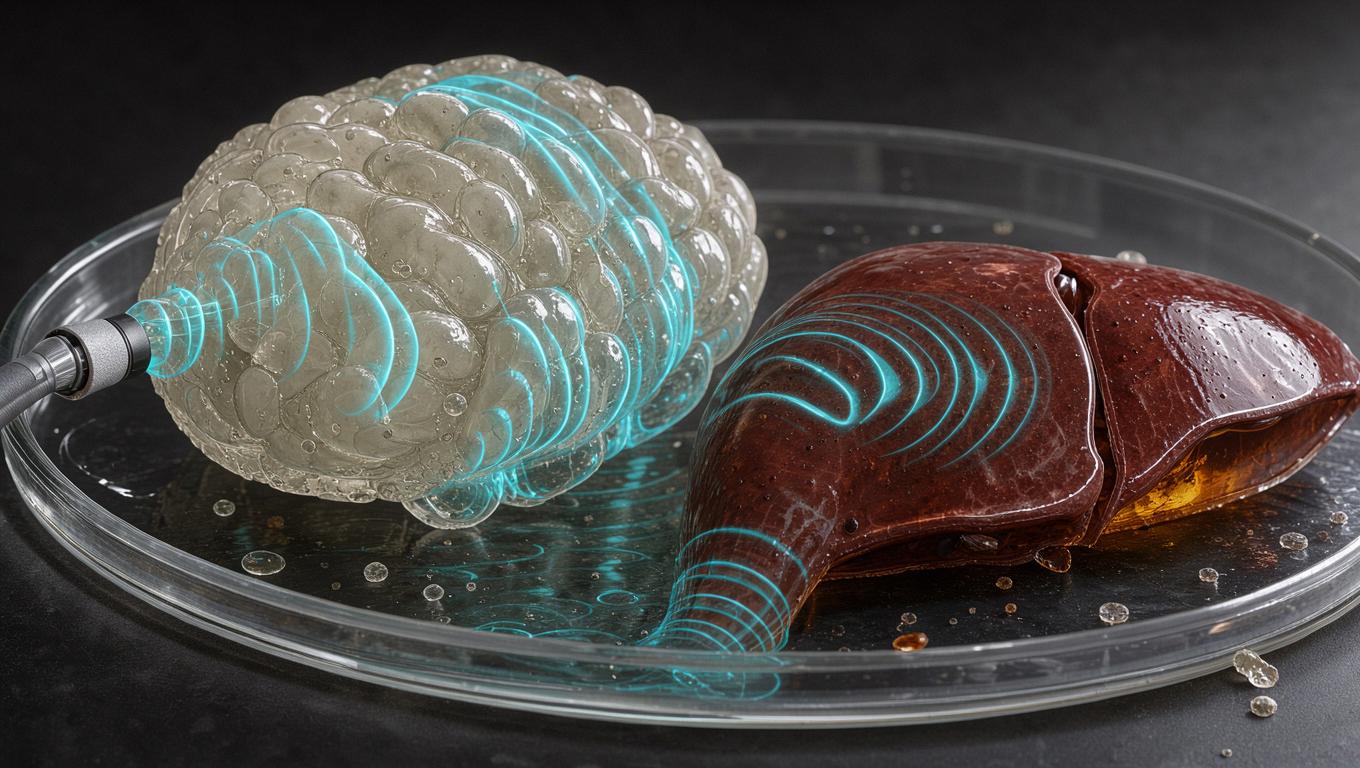
This Scientific Data descriptor openly releases high-quality 3T MRE wavefield datasets (agar phantom with two inclusions, healthy 27-y male brain, healthy 25-y male liver) plus the TWENN inversion pipeline, with strong reported quality metrics (DNR 22.02/17.55/15.86 dB). The main weakness is the pilot scale: one sample per category.
Long Explanation
What the paper delivers
This data descriptor publishes raw wrapped phase, displacement fields, magnitude images, and TWENN-derived complex shear-modulus maps (.mat format) for three categories: an agar phantom (17×12×14 cm box, background 1% agar, inclusions 0.75% and 1.5%, each 3.5 cm diameter × 10 cm), a healthy 27-year-old male brain, and a healthy 25-year-old male liver, all acquired at 30–60 Hz on a 3T uMR790 with SE-EPI readout. The companion TWENN inversion software (Dual-DC phase unwrapping + physics-informed complex-valued network) and a demo script are also shared.
Liver DNR (15.86 dB) sits within the typical clinical range of 13–17 reported for liver MRE, and spatial sampling (9.09±2.77 voxels/wavelength for liver) is documented.
Critical assessment
Strengths: raw wrapped phase (not just processed maps) is released, enabling head-to-head inversion-algorithm benchmarking against the 2D/3D, multi-frequency reference results; the phantom provides ground truth for validation against mechanical testing. Authors transparently disclose that the 2 mm liver slice gap may compromise 3D inversion accuracy.
Limitations and blind spots: only one sample per category (healthy males only), single scanner/vendor (UIH 3T), no diseased tissue, and no external cross-platform validation — generalizability to patient populations or other scanners is untested. Context: brain MRE literature shows large cross-center variability in stiffness (global brain 0.62–2.99 kPa at ~50 Hz) largely driven by protocol differences, underscoring both the value of shared datasets and the caveat that one phantom/subject cannot resolve standardization gaps. DNR is reported but modulus-accuracy uncertainty (e.g., confidence intervals on G′/G″) is not, so users cannot yet gauge inversion precision on in vivo data.
What would change this assessment: multi-subject, multi-scanner releases with diseased cohorts and per-voxel modulus uncertainty maps would elevate this from a useful pilot resource to a true community benchmark.
Feedback:
Updated: November 13, 2026
BGPT Paper Review
Study Novelty
50%
A data descriptor, not a methods breakthrough; novelty lies in bundling raw multi-frequency 3T wavefields with a physics-informed NN inversion, but BioQIC already offers comparable shared MRE data, and TWENN itself was published in 2023.
Scientific Quality
80%
Well-documented acquisition parameters, IRB approval, honest disclosure of the liver slice-gap limitation, and clear DNR/sampling metrics; quality limited by single-subject scope and absence of modulus-accuracy uncertainty reporting.
Study Generality
60%
Covers the two canonical MRE organs (liver, brain) plus a phantom, but single healthy male subjects per category and one scanner/vendor constrain cross-domain generalizability.
Study Usefulness
80%
Directly useful for inversion-algorithm developers who lack MRE hardware: raw phase data plus reference TWENN results and runnable software enable immediate benchmarking.
Study Reproducibility
80%
Full parameter tables, actuator efficiencies, ethics approvals, public data (sciencedb) and code links make reprocessing feasible; reproducibility of acquisition requires the same proprietary 3T uMR790 system and actuators.
Explanatory Depth
60%
As a data descriptor it documents what was measured and how, but does not develop theory; mechanistic depth resides in the companion TWENN paper rather than this descriptor.
Computing and charting DNR benchmarks and voxel-per-wavelength sampling statistics for the phantom, brain, and liver MRE releases to assess data quality against published clinical ranges.
Get emailed when your analysis is done!
We'll email you the results when your analysis is finished.
Hypothesis Graveyard
Assuming phantom-only validation suffices for in vivo algorithm trust: the phantom's agar rheology differs from living tissue poroelasticity, so phantom-validated algorithms still require in vivo benchmarks — which is why this descriptor includes liver/brain data.
Assuming public data sharing is novel for MRE: BioQIC (Charité) has long hosted MRE datasets, so novelty must rest on the TWENN bundle and raw-phase completeness, not openness per se.

 Explore by Goal
 Quick Explanation
 Long Explanation
 Top Data Sources
 Ask a Follow-Up
 Key Insight
 Keep Exploring
 Analysis
 Hypothesis Graveyard
 Potential Experiments
 Discussion
