Check your hypothesis against versioned claims, exact reported results, and stated falsification criteria.Know what falsifiable science actually supports before you trust the answer.
Press Enter ↵ to search evidence
Explore by Goal
"The most beautiful experience we can have is the mysterious. It is the fundamental emotion that stands at the cradle of true art and true science."
- Albert Einstein
BGPT Odds of True
60%
80% Confidence
The first clause (constraint-dominated torque space) is consistent with reported coefficient-insensitivity and low torque dimensionality, but the second clause (PC alignment with the equilibrium subspace) is untested and unvalidated experimentally, so a moderate estimate with wide uncertainty is appropriate.
Hypothesis Novelty
70%
Framing torque-space dimensionality as a constraint/equilibrium problem rather than an optimization outcome is a fresh, testable reframing of the yoga biomechanics results, though subspace-alignment methods are standard in motor-control literature.
Quick Analysis Plan
Copied
Partially supported. The yoga-pose model reports low-dimensional torque kinetics (first three torque PCs >90% variance) despite high-dimensional kinematics, and torque rankings were robust to randomized metabolic cost coefficients—an indirect clue that equilibrium/contact constraints, not energy weights, dominate . However, the direct claim—that top torque PCs align with the equilibrium subspace—was never tested, and no experimental validation exists, so the hypothesis remains unproven.
Long Analysis Plan
What the evidence actually shows
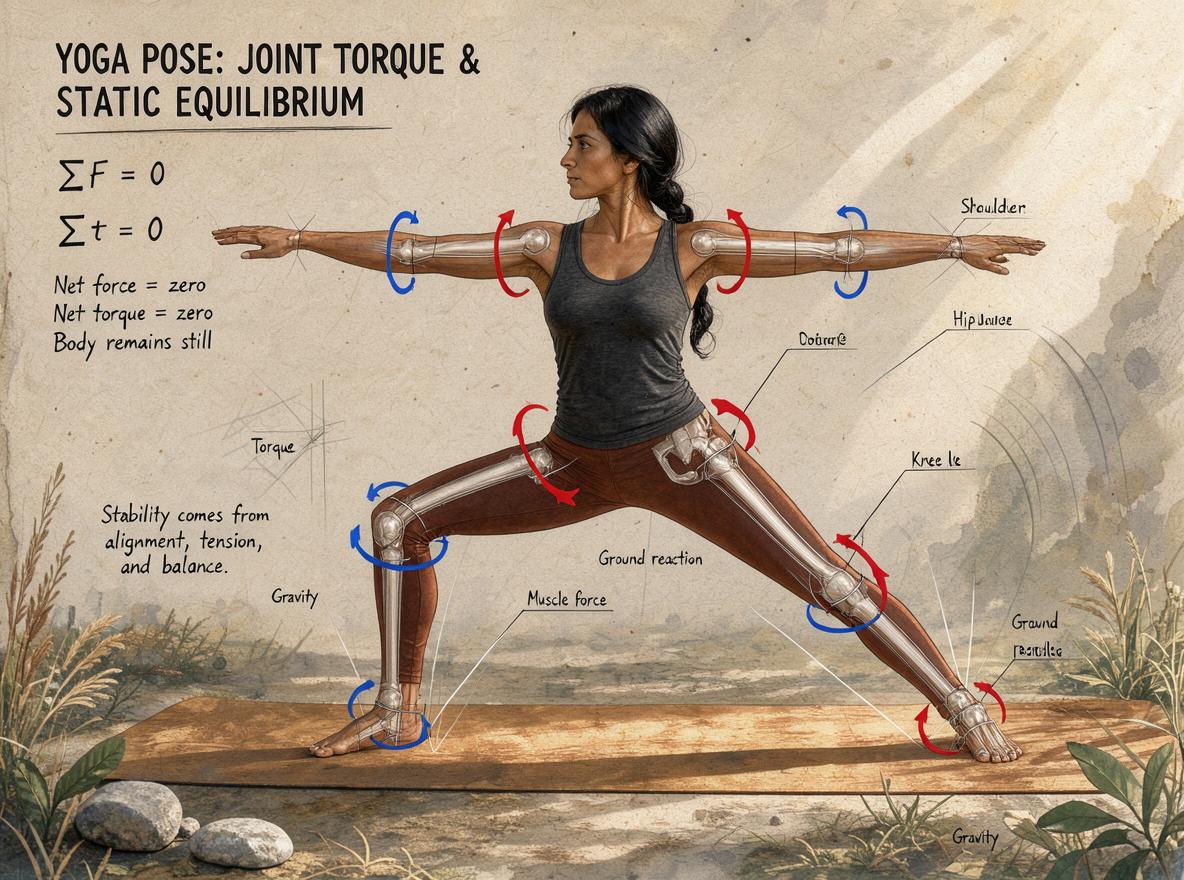
The single directly relevant source is a 2026 2D MuJoCo study of 55 sagittally symmetric poses from Light on Yoga, which found that joint angles required nearly all ten kinematic dimensions (PC1 = 30% variance, subsequent PCs 5–10% each), whereas the first three joint-torque PCs captured over 90% of torque variance . This kinetic/kinematic dimensionality mismatch is consistent with torque structure being imposed by hard constraints (static equilibrium, contact geometry) rather than by the freely chosen pose shape.
Indirect evidence for the constraint-dominance view
When the authors repeated the optimization 50 times with randomly generated joint-specific metabolic cost coefficients, 10 poses showed identical torque rankings and all remaining poses retained at least 50% similarity . BGPT inference: if perturbing the metabolic objective barely changes the torque solution, the binding constraints (equilibrium + contact) plausibly determine most of the solution—but this is inference, not a demonstrated decomposition.
What is missing, and why the hypothesis is not yet testable from these data
The second clause is untested. No reported analysis projects torque PCs onto the equilibrium subspace, computes principal angles between subspaces, or compares equilibrium-only solutions against energy-minimized ones. The predicted torques were never experimentally validated, the model omits passive muscle/ligament forces and body–body contacts, and 2D sagittal symmetry excludes the arm–leg asymmetries central to many real poses . A decisive test would re-run the same 55 poses with (a) pure equilibrium/contact-constraint satisfaction without any energy objective and (b) alternative objectives (torque-norm, effort-distribution), then measure subspace alignment (e.g., principal angles, subspace overlap) of torque PCs across all three.
Tangentially, energy-minimization frameworks do successfully predict structure in legged locomotion and manipulation design contexts , so metabolic minimization is not vacuous—it may simply matter less in quasi-static, multi-contact postures than in cyclic locomotion.
Verdict (moderate confidence in the first clause, low in the second): the existing evidence is consistent with constraint-dominated, low-dimensional torque space, but the specific PC–equilibrium-subspace alignment claim requires new analysis and human experimental validation before it can be accepted.
Metabolic energy minimization fully determines pose torque structure: contradicted by the reported insensitivity of torque rankings to randomized metabolic coefficients in the 55-pose dataset.
Kinematics determine kinetics in static postures: contradicted by the observed dissociation between ~10-dimensional kinematics and 3-dimensional torque space.

 Explore by Goal

 Hypothesis Novelty
 Quick Analysis Plan
 Long Analysis Plan
 Top Data Sources
 Ask a Follow-Up
 Key Insight
 Keep Exploring
 Potential Hypothesis
 Hypothesis Graveyard
 Potential Experiments
 Discussion
