Ask questions across claims linked to experiments, exact results, limitations, and sources.Know what falsifiable science actually supports before you trust the answer.
Press Enter ↵ to search evidence
Explore by Goal
"The first principle is that you must not fool yourself — and you are the easiest person to fool."
- Richard Feynman
Quick Answer
Copied
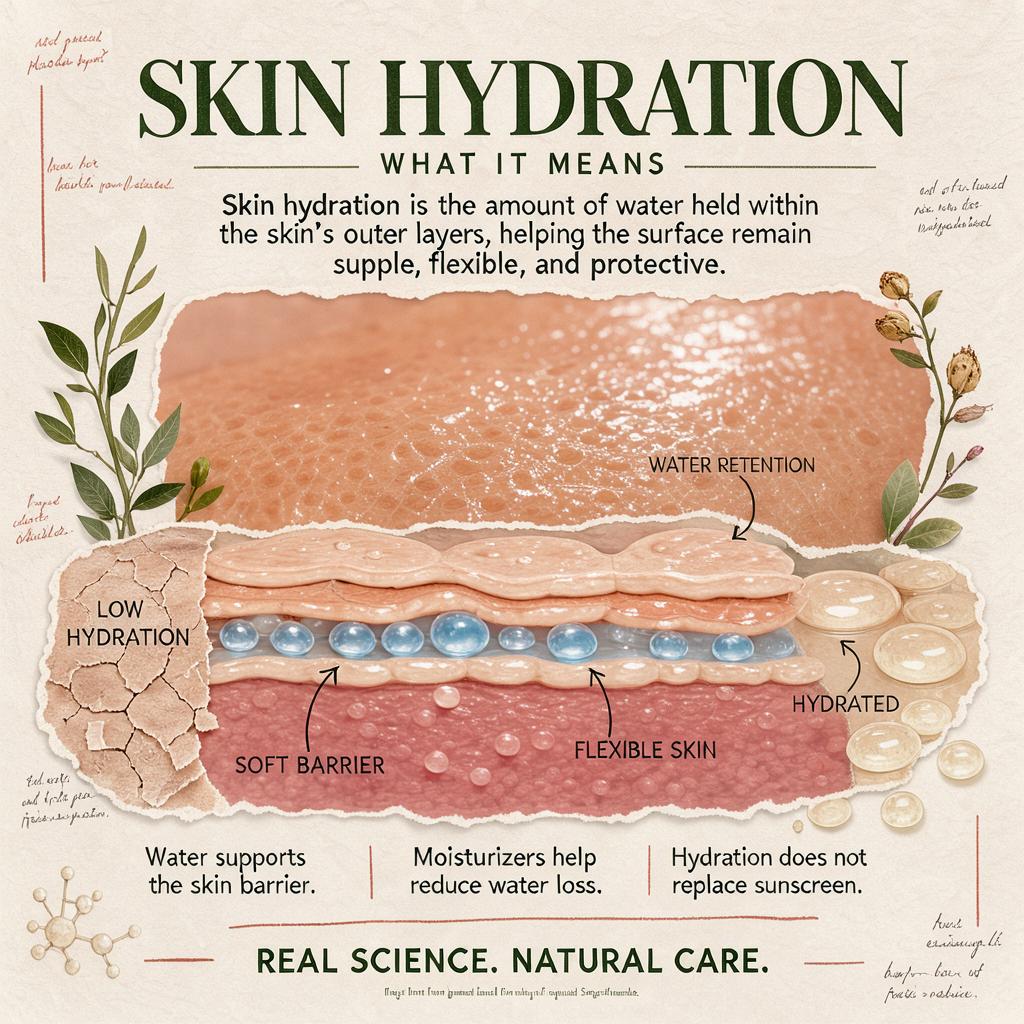
Hydrated skin means the stratum corneum (outermost skin layer) retains adequate water—measured instrumentally in arbitrary units via corneometers (~38.7 AU median in one in-vivo study) —which supports barrier integrity, plasticity, and altered friction behavior, with hydration varying strongly by body site, sex, and age.
Long Answer
Hydrated skin scientifically refers to the stratum corneum holding sufficient water. It is objectively measurable: corneometer readings reported a median of 38.7 AU (range 4–112) across 50 adults, showing 'hydration' spans a wide physiological range rather than one fixed value .
Hydration is functionally meaningful: hydrated stratum corneum swells and changes surface geometry (contour area 8.0→6.8 cm² after hydration), affecting permeability , and low hydration characterizes barrier-compromised sites like elbow (28 µS) versus highly hydrated neck (225 µS) in healthy controls .
Sex differences are minimal (male 48.42 ± 22.12 vs female 49.06 ± 16.09 AU), while body region dominates . Note: newer dermal measurements show water content paradoxically correlates with age (r=0.550), so 'more water' is not always 'healthier' .
Counterpoints: corneometer AU values are instrument-dependent (not directly comparable across devices); NIR methods report human skin water as 44.3–82.0% relative content , a different unit entirely. What would change this conclusion: standardized cross-device validation showing AU thresholds predict clinical outcomes (e.g., dryness symptoms) universally.
We'll email you the results when your analysis is finished.
Hypothesis Graveyard
'More water = healthier skin' — falsified by Raman data showing dermal water correlates positively with age and photoaging (r=.550), indicating excess water in sun-exposed dermis reflects damage, not health.

 Explore by Goal
 Quick Answer
 Long Answer
 Top Data Sources
 Ask a Follow-Up
 Key Insight
 Keep Exploring
 Hypothesis Graveyard
 Potential Experiments
 Discussion
