See which claims are backed by experiments, exact reported results, and linked sources — not summaries.Know what the science actually supports before you trust the answer.
Press Enter ↵ to find evidence
Explore by Goal
"Biology sees right and wrong as the same color in different light."
- Delia Owens
Quick Explanation
Copied
Humans cannot currently live on Mars without continuous life-support and environmental protection. The supplied evidence supports that parts of early Mars were habitable for extended periods, but it does not demonstrate present-day human habitability or confirmed Martian life.
Long Explanation
What the evidence actually supports
Curiosity data from three Gale-crater drill samples show clay-mineral features interpreted as glauconitic, with geochemical modelling consistent with long-lived, low-temperature lakes around 3–15 °C. This supports ancient environmental habitability—the past presence of conditions potentially compatible with life—not a continuously habitable Mars today. The interpretation remains uncertain because CheMin data can make glauconite difficult to distinguish from altered smectites, and the sample set is small.
Could organisms live there?
Terrestrial analog experiments show that an Antarctic Shewanella strain can reduce iron minerals under cold, anaerobic microcosm conditions, producing magnetite/goethite changes together with riboflavin, dimethyl sulfide, and gene-expression changes. These are candidate biosignature patterns, not evidence that Mars currently contains life; the experiment used one cultured Earth bacterium and laboratory conditions.
Hot-spring isotope work also demonstrates that potentially durable archaeal lipid signals can persist while apparent production is extremely slow: approximately 16 ± 3 years at Yellowstone Beryl Spring, with no detectable uptake during 14 days at El Tatio. This helps define how slowly biosignatures might form or persist in extreme environments, but it does not establish Martian organisms.
Bottom line: “Live on Mars” is presently a technological survival problem, not an achieved biological settlement condition. The supplied studies support ancient aqueous habitability and methods for testing preserved or active biosignatures, but provide no evidence sufficient to conclude that humans can live unaided on Mars or that life exists there now. Confidence: high for this evidence-bound conclusion; low for claims about undiscovered present-day Martian life.
We'll email you the results when your analysis is finished.
Hypothesis Graveyard
Unaided human habitation is not supported by the supplied evidence because none of the cited studies measures human survival, habitat performance, or present Martian environmental conditions.
A single mineral, volatile, or organic signal should not be treated as proof of life because the Mars-analog study reports possible abiotic contributions and emphasizes multi-line evidence.

 Explore by Goal
 Quick Explanation
 Long Explanation
 Top Data Sources
 Ask a Follow-Up
 Key Insight
 Keep Exploring
 Hypothesis Graveyard
 Potential Experiments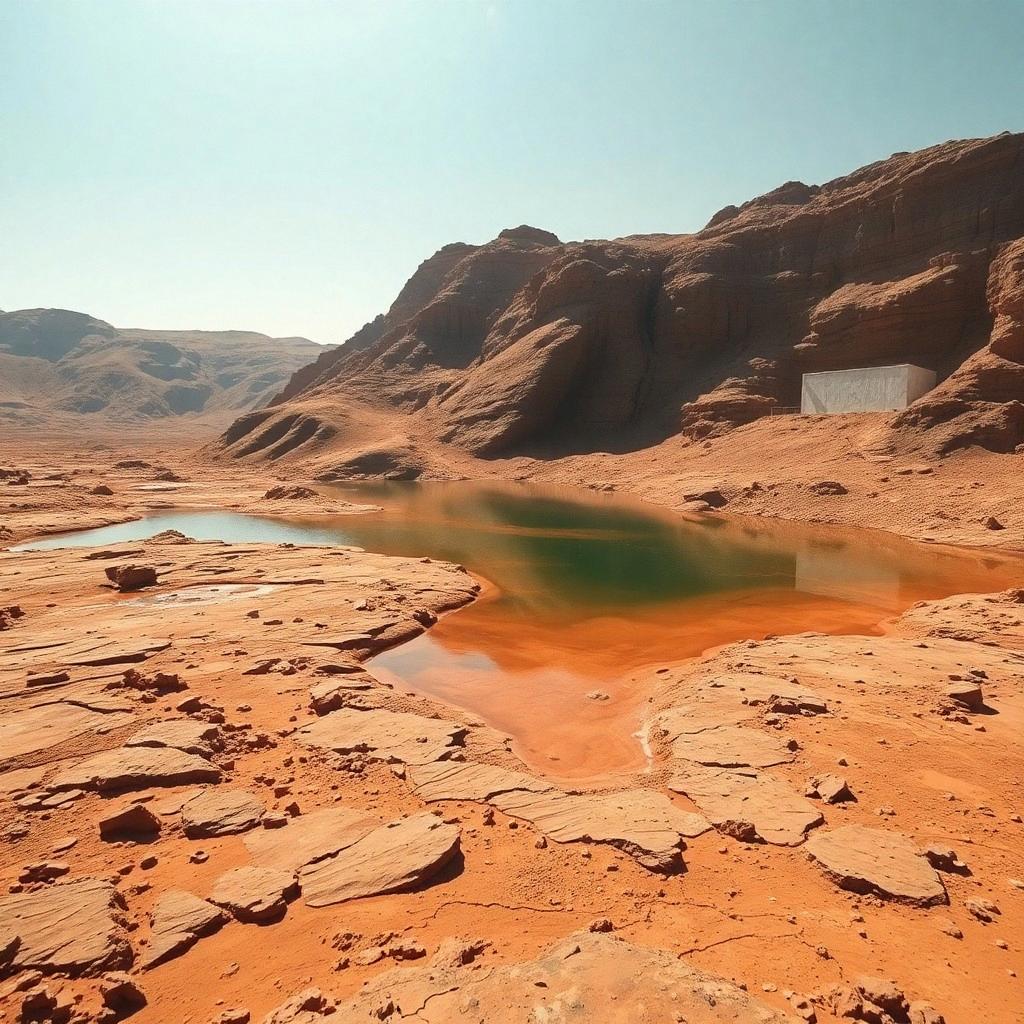
 Discussion