Ask questions across claims linked to experiments, exact results, limitations, and sources.Know what falsifiable science actually supports before you trust the answer.
Press Enter ↵ to search evidence
Explore by Goal
"The scientific man does not aim at an immediate result. He does not expect that his advanced ideas will be readily taken up. His work is like that of the planter - for the future. His duty is to lay the foundation for those who are to come, and point the way."
- Nikola Tesla
Quick Answer
Copied
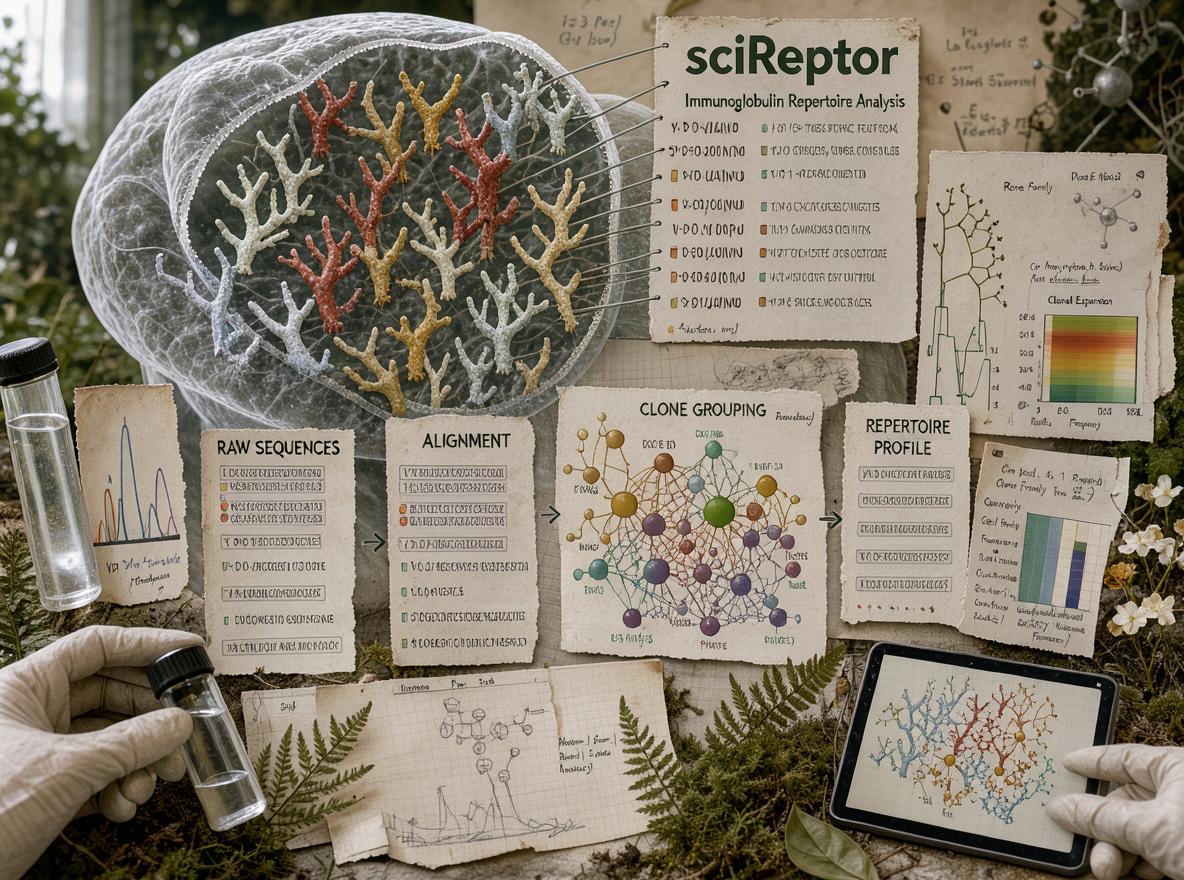
sciReptor (Imkeller et al., BMC Bioinformatics 2016) was the first antigen-receptor pipeline purpose-built around single-cell data via a relational database linking paired heavy:light chain sequences to flow-cytometry metadata, validated on only three small test datasets (1,152; 1,152; and 384 cells) with no benchmarking against alternatives. Its contribution was structural and durable, but the methodology was never rigorously compared to contemporaneous toolkits.
Long Answer
What the paper actually delivers
sciReptor is a toolkit (Perl/R/Python, MariaDB backend, AGPLv3) that assigns an event ID to every sorted cell, groups heavy, kappa, and lambda sequences by that ID, and links the paired chain calls to user-supplied metadata including flow-cytometry index data — capabilities the authors argue existing bulk-oriented tools (IMGT/HighV-QUEST, IGGalaxy, LymAnalyzer, pRESTO, Change-O) lacked . The pipeline chains established components — IgBLAST for V/D/J assignment and Change-O-style downstream clonality/hypermutation concepts — so the novelty lies in the data model (the cell as a first-class entity in a relational schema), not in new algorithms.
Critical assessment
Strengths: The core claim — no other ARR tool at the time represented single cells as addressable data structures enabling sequence–phenotype linkage — was plausible and well-motivated, and the authors provided a pre-configured virtual machine, manual, test datasets, and public code, which supports reproducibility. The paper explicitly scopes what the software can do rather than overclaiming performance.
Weaknesses: Validation is demonstrative, not comparative: three datasets totaling ~2,688 sorted cells, one co-authored by the developers themselves (matrix PCR), one Sanger set with a deposited accession range (ENA LN879549–LN879837), and no head-to-head accuracy metrics against any alternative pipeline. Error rates of consensus building, SHM-annotation accuracy, and mispairing frequency are never quantified. The stack (Python 2.7, MariaDB 5.5, Roche/454 dependence) was dated even at publication, and Roche/454's exit from the market severely limits direct applicability today. The claim that no existing tool handles single-cell data is asserted rather than systematically surveyed — plausible, but framed by the authors' own platform (citation bias risk). Importantly, the authors acknowledge TCR extension and antigen-binding integration were future work, so reviewers should not treat those as delivered features.
Confidence and what would change the verdict
Confidence that the software exists and does what is described: high, given the full text and code repository. Confidence that it was the unique single-cell solution: moderate — it rests on the authors' survey of five tools and could be overturned by undocumented contemporaneous workflows. A rigorous external benchmark against Change-O/IgBLAST-native approaches on paired-chain recovery and SHM-calling accuracy, never provided here, is the key missing evidence.
Author reviews:
Feedback:
Updated: November 19, 2026
BGPT Paper Review
Study Novelty
70%
First toolkit structurally built around single-cell paired-chain repertoires with relational metadata linkage; the underlying algorithms (IgBLAST, BLAST, MUSCLE, RazerS3) were all pre-existing, so novelty is architectural rather than algorithmic.
Scientific Quality
70%
Honest scope, working code, public test data and VM. However, purely demonstrative validation (~2,688 cells), zero quantitative benchmarking or error-rate reporting, and reliance on soon-obsolete platforms (Roche/454, Python 2.7) temper the quality score.
Study Generality
70%
Applies to human and murine B-cell repertoires across matrix-PCR, conventional PCR, Sanger, and NGS inputs, and was designed to extend to TCR data, but is niche relative to general repertoire tooling and was never generalized broadly in practice.
Study Usefulness
80%
Filled a genuine gap: preserved heavy:light pairing and enabled sequence-to-flow-cytometry linkage, which is essential for interpreting B-cell responses; its database design anticipated later single-cell data integration needs.
Study Reproducibility
80%
Code (GitHub, AGPLv3), step-by-step manual, pre-configured VM, three public test datasets, and an ENA accession for the Sanger set substantially support reproducibility, though exact per-cell validation metrics are not published.
Explanatory Depth
50%
Describes the data model and workflow clearly but offers no quantitative error model, no algorithmic analysis of consensus-calling or SHM-annotation accuracy, and no theoretical treatment of mispairing or cross-contamination rates.
Parsing the three published sciReptor test datasets, computing per-cell read-depth and V-J usage distributions, and benchmarking heavy:light pairing recovery against an IgBLAST-based reference workflow to quantify annotation concordance.
Get emailed when your analysis is done!
We'll email you the results when your analysis is finished.
Hypothesis Graveyard
Existing bulk tools (Change-O, pRESTO) could trivially be adapted for single-cell pairing — falsified as a critique because none implemented cell-level identifiers or metadata linkage at the time; the relational design was the missing piece, not a wrapper.
IgBLAST alone suffices for single-cell annotation — falsified because IgBLAST annotates reads per locus but performs no consensus building, barcode demultiplexing, or heavy:light event grouping.

 Explore by Goal
 Quick Answer
 Long Answer
 Top Data Sources
 Ask a Follow-Up
 Key Insight
 Keep Exploring
 Analysis
 Hypothesis Graveyard
 Potential Experiments
 Discussion
