Why BGPT?
logo

Review Against the Reported Record

Check a paper's claims against linked experiments, exact results, stated scope, and limitations.Know what falsifiable science actually supports before you trust the answer.

Press Enter ↵ to search evidence


     Quick Answer


    Graham's 2002 review proposes that T-helper polarization, while adaptive against single infections, becomes an ultimate cause of immunopathology during concomitant infection by Th1-requiring and Th2-requiring parasites, illustrated by lethal liver damage in mice coinfected with Schistosoma mansoni and Toxoplasma gondii


     Long Answer


    Core Argument

    Graham frames infection-related immunopathology as a phenotype–environment mismatch: the T-helper subset a host mounts must match the parasite type (Th1 for intracellular, Th2 for extracellular), but mutual cytokine downregulation polarizes responses so that only one Th phenotype can dominate at any site and time . When S. mansoni (Th2-dominant) precedes T. gondii (Th1-dominant) in mice, coinfected animals show elevated plasma TNF-α, hepatocyte necrosis, shrunken egg granulomas, and early death—yet paradoxically less intestinal pathology—because each infection cross-modulates the other's required response . Order of infection reverses outcomes: T. gondii first ameliorates schistosomiasis .

    Reported ELISA-derived cytokine concentrations from wild-type mouse splenocyte cultures (Table 3 of the paper); t is the proportion of Th1 cytokines. Plasmodium and Schistosoma require balanced Th1/Th2 across infection phases, not a single pole .

    Critical Appraisal

    • Strength: The taxonomy of immune errors (recognition vs. effector errors) and the framing of Th conflict via optimality/kin-recognition thresholds generate genuinely falsifiable predictions (e.g., joint coinfection response ≈ fitness-weighted average of single-infection optima) .
    • Limitations: The human S. mansoni–T. gondii coinfection pathology is untested; only co-occurrence prevalence (~13–21% coinfected in Sudan) is reported. The Th1/Th2 dichotomy is explicitly acknowledged as a simplification (cytokine continua, Th3 cells exist), and the mouse data come from inbred strains, not outbred or wild hosts .
    • Blind spot: Parasite-driven immune manipulation is set aside as a coevolutionary cause, so host-only optimization may understate realized pathology in natural multi-parasite systems.


    Feedback:    

    Updated: November 21, 2026

     BGPT Paper Review


    Study Novelty

    70%

    For 2002, recasting immunopathology as constrained optimization under multiparasite selection—rather than host or parasite error alone—was a genuinely fresh synthesis linking evolutionary ecology to immunology.


    Scientific Quality

    80%

    A well-structured, heavily referenced QRB review with transparent taxonomy and a concrete case study; weaknesses are reliance on secondhand murine data, absence of primary human pathology data, and an explicitly simplified Th1/Th2 binary.


    Study Generality

    80%

    The mismatch framework applies across host–parasite systems and connects to broader phenotypic-plasticity theory, though the quantitative model is instantiated only in one murine coinfection.


    Study Usefulness

    70%

    Provides testable predictions for coinfection immunology and a conceptual bridge for ecological immunology, but no direct clinical protocol or intervention follows from it.


    Study Reproducibility

    50%

    As a review, it reproduces others' experiments rather than new data; the optimality model's parameter-estimation scheme is described but not validated within the paper itself.


    Explanatory Depth

    70%

    Offers a mechanistic proximate cause (cytokine cross-regulation, TNF-α hepatotoxicity) plus an ultimate cause (polarization constraint), though quantitative optimality testing remained incomplete.


    🎁 Authors: Collect 219 Free Science Tokens (≈ $21.9 USD)

    Claim My Author Tokens

    Use for 54 days of free BGPT access (4 tokens = 1 day) or trade/sell (≈ $21.9 USD)

     Top Data Sources ExportMCP


     Hypothesis Graveyard


    'Coinfection pathology is simply additive of single-infection burdens' — rejected by the supraphysiologic TNF-α and necrosis observed beyond additive combinations in the murine case study.

     Science Art


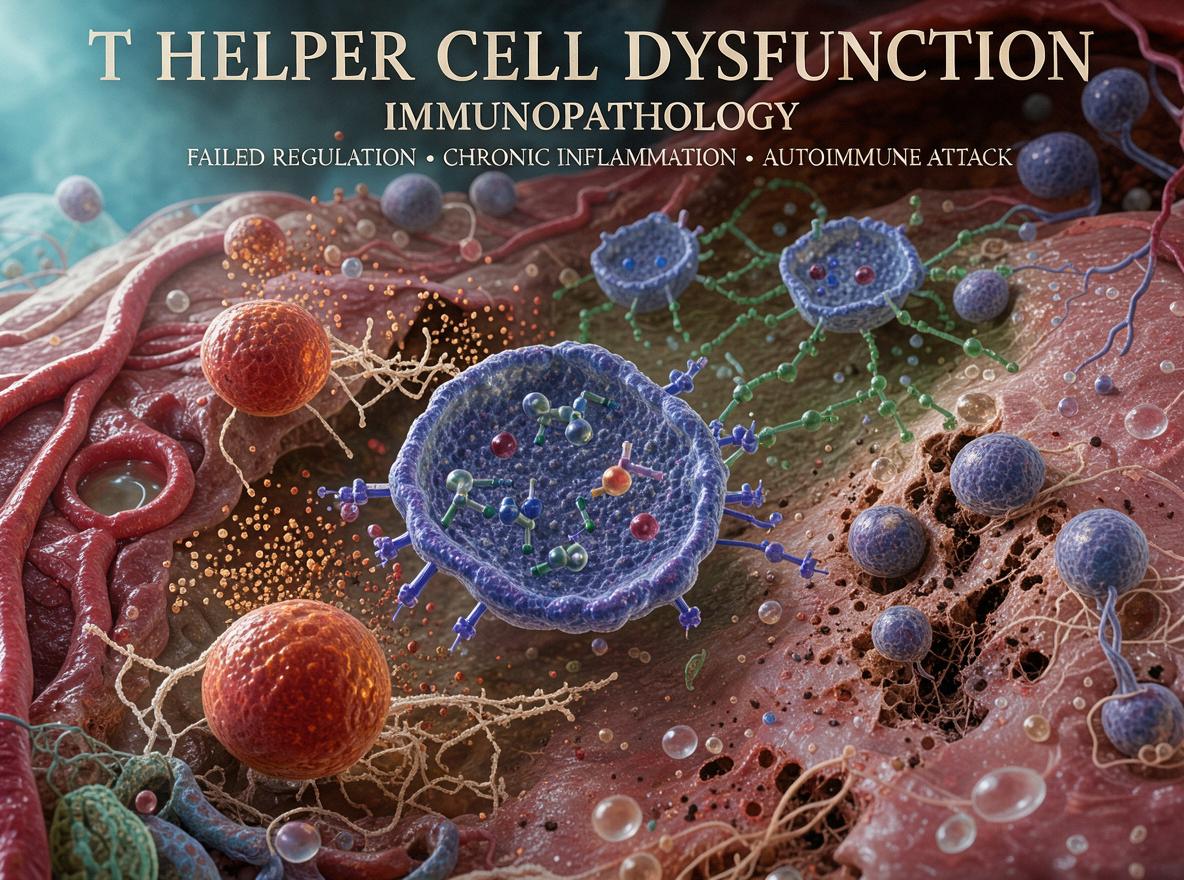
    Paper Review: When T‐Helper Cells Don’t Help: Immunopathology During Concomitant Infection Science Art

     Science Movie


    Make a narrated HD Science movie for this answer ($64 per minute)


     Discussion


    Stay current without chasing every paper.

    Know what changed, what holds up, and what remains uncertain. Every Friday. No ads.


    My BGPT