Check a paper's claims against linked experiments, exact results, stated scope, and limitations.Know what falsifiable science actually supports before you trust the answer.
Press Enter ↵ to search evidence
Explore by Goal
"Science is the systematic classification of experience."
- George Henry Lewes
Quick Explanation
Copied
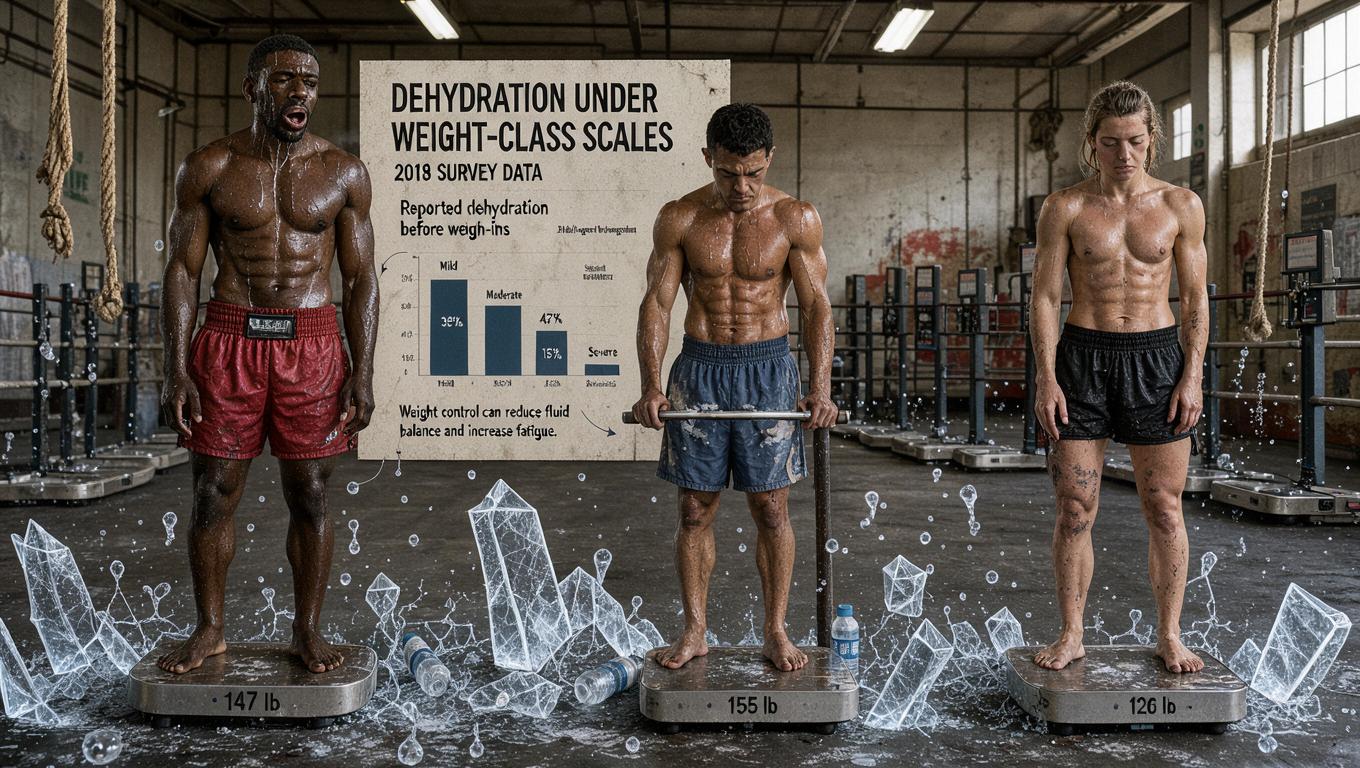
Barley et al. surveyed 637 combat athletes across seven sports and found body mass manipulation in ≥85% of every group, with MMA reporting the largest acute losses (~11.5% body mass, ~4% within 24 h of weigh-in) and the highest sauna (76%) and water-loading (67%) use . The design is observational and self-reported, but the large sample and validated instrument make it the most comprehensive cross-sport comparison of weight cutting practices to date.
Long Explanation
Key Quantitative Findings
The study administered a modified, previously validated judo questionnaire (Artioli et al.) via Qualtrics to 1,051 recruited athletes, yielding 637 analyzable responses across BJJ (25%), wrestling (27%), judo (12%), MT/K (12%), MMA (11%), boxing (6%), and TKD (6%) . Over 85% of athletes in every sport reported manipulating body mass. MMA athletes reported losing ~11.5% of body mass for competition and ~4% within 24 h of weigh-in — both significantly greater than all other sports (P<0.001) .
Method prevalence differed sharply by sport: sauna (MMA 76%), water loading (MMA 67%), rubber/plastic suits (MMA 63%), heated-room training (wrestling 83%), and spitting (wrestling 47%) . Diuretics, laxatives, diet pills, and vomiting were low prevalence in all sports with no main effects.
How It Fits the Wider Evidence
Performance consequences remain contested. Controlled studies show acute dehydration <5% body mass impairs repeat-effort performance even 24 h later in MMA athletes , yet real-life MMA competition data suggest weight regain — not weight loss — predicts success . A 2024 judo scoping review adds nuance: rapid weight loss impairs performance without recovery time, but with >4 h recovery no negative judo-specific performance effects were observed, while >5% losses were linked to SIgA decreases and URTI incidence . Qualitative work confirms athletes report emotional distress — crying, social isolation, lost motivation — during cutting .
Critical Assessment
Strengths: large n, validated instrument, cross-sport scope, and appropriate post-hoc corrections (Tukey-Kramer for unequal n). Weaknesses the authors acknowledge: self-report bias, unequal sport/gender distributions (wrestling 98% male; TKD 44% male), differing competitive levels, and cross-sectional design . Additional blind spots: the survey asked about behaviors, not verified magnitudes (no weigh-in data); no youth/minor stratification despite wrestling's young mean age (21±7 y); and health-outcome claims (brain injury risk, cardiovascular complications) rest on plausibility arguments the authors themselves admit lack "systematic supporting evidence." What would change these conclusions: prospective measurement of actual weigh-in masses across sports, or demonstration that self-reported magnitudes do not differ between sports.
First large-scale comparison of weight-cutting practices across seven combat sports; the finding that MMA's practices are more extreme, and quantification of water loading prevalence, were new in 2018.
Scientific Quality
70%
Large sample, validated instrument, and correct post-hoc tests; but self-reported data, unbalanced sport/gender distributions, no measured weights, and health-risk claims lacking systematic evidence temper the score.
Study Generality
60%
Descriptive findings generalize to weight-class combat sports broadly, but no mechanistic insight; conclusions are specific to athlete populations surveyed.
Study Usefulness
80%
Directly informs regulators, coaches, and support staff about which risky practices occur in which sport; cited basis for later weight-cutting policy discussions.
Study Reproducibility
60%
Survey instrument and analysis methods are described (Qualtrics, SPSS v24, ANOVA with Tukey-Kramer), but the modified questionnaire and raw data are not publicly archived.
We'll email you the results when your analysis is finished.
Hypothesis Graveyard
'Longer rehydration windows cause more cutting' — rejected by the paper's own data (MMA vs TKD/MT/K showed equal windows but unequal losses), which the authors acknowledge.
'Weight regain confers a performance advantage via superior rehydration skill' — the 2019 MMA study (n=15) showing WRG-winners association may simply reflect heavier habitual body mass, not causation.

 Explore by Goal
 Quick Explanation
 Long Explanation
 Top Data Sources
 Ask a Follow-Up
 Key Insight
 Keep Exploring
 Hypothesis Graveyard
 Potential Experiments
 Discussion
