Analyze how experimental results and claims are presented, scoped, and limited in a paper.Know what the science actually supports before you trust the answer.
Press Enter ↵ to analyze
Explore by Goal
"The biology of mind bridges the sciences - concerned with the natural world - and the humanities - concerned with the meaning of human experience."
- Eric Kandel
Quick Explanation
Copied
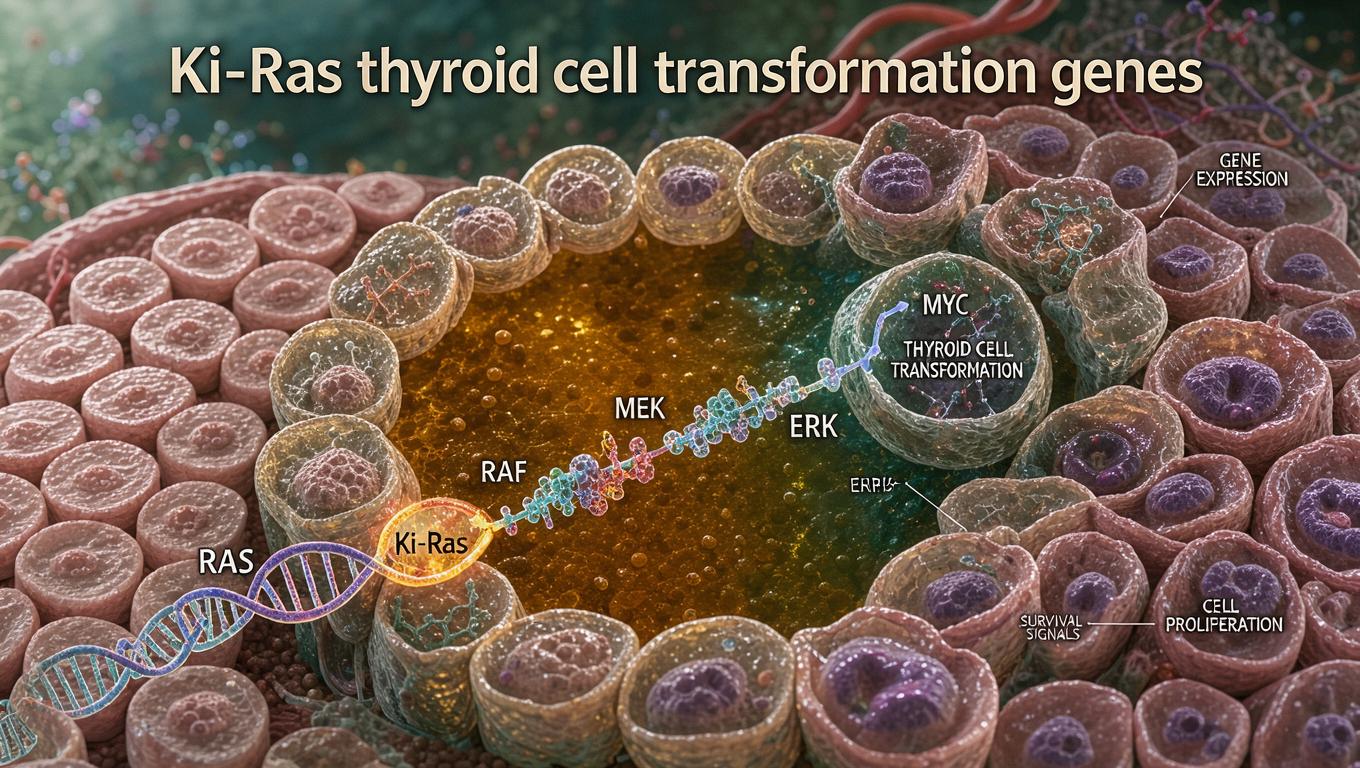
Visconti et al. (2007) profiled Ki-Ras-transformed FRTL-5 rat thyroid cells by microarray, finding ~50 upregulated and ~40 downregulated genes at a 10-fold cutoff, corroborated by RT-PCR in human thyroid carcinoma lines and tumor samples .
Long Explanation
Study Design and Core Findings
Visconti and colleagues used FRTL-5 rat thyroid cells infected with Kirsten murine sarcoma virus carrying v-Ki-Ras as a model of complete thyroid transformation. Affymetrix oligonucleotide arrays interrogating ~17,000 rat sequences identified ~1,000 genes changed twofold; applying an arbitrary tenfold filter narrowed this to ~50 upregulated and ~40 downregulated genes. All thyroid differentiation markers (thyroglobulin, TSH receptor) were severely repressed, and Ki-Ras itself was upregulated, serving as an internal positive control .
Cross-System Validation
RT-PCR confirmed direction (not exact magnitude) of all tested genes in FRTL-5 v-Ki-Ras. RalA was induced in PC Cl3 v-mos and v-raf lines (but not E1A alone), suggesting Raf-dependent regulation. In seven human thyroid carcinoma lines (WRO, FB-2, NPA, TPC-1, B-CPAP, FRO, ARO), Annexin A2 and RalA were upregulated in all seven; CD24 and Dusp1 were downregulated in all; CD24 was undetectable in 4/7 lines and strongly repressed in all anaplastic tumor samples .
Notable Findings and Counterpoints
The CD24 result contradicts most cancer literature, where high CD24 correlates with aggressive epithelial cancers (ovarian, breast, lung, prostate, pancreatic) . The interferon-inducible gene downregulated by Ras in rat cells was also repressed in fibroblast and ovarian Ras-transformation datasets, but human tumor confirmation was only preliminary. Notably, only 6 of ~100 Ras-modulated genes overlapped with prior Ras-transcriptome studies in mast cells and fibroblasts, suggesting thyroid-specific regulation .
Key Limitations
Single rat cell line per condition; no biological replicates or statistical treatment of microarray data reported
Tenfold threshold is arbitrary; 90% of twofold-changed genes discarded without independent validation
Number of human tumor samples not specified; matched normal-tumor design helps but sample size limits power
No public data deposition or accession numbers; raw data not independently verifiable
Causality between gene changes and transformation not established by knockdown/overexpression
Rat-to-human species transfer assumed without systematic cross-species validation
Confidence note: The central transcriptional findings are internally consistent (RT-PCR concordance across rat, human lines, and tumors), but the strength of the evidence rests on semiquantitative PCR rather than quantitative methods, and the absence of replicates/public data weakens reproducibility. What would change this assessment: independent replication in Ras-mutant human thyroid cohorts with RNA-seq, and functional tests of candidate genes in transformation assays.
Feedback:
Updated: November 01, 2026
BGPT Paper Review
Study Novelty
60%
First Ras-transcriptome in thyroid epithelial cells with human tumor validation; built on prior Ras-profiling in fibroblasts and ovarian cells, so incremental rather than groundbreaking.
Scientific Quality
60%
Logical progression from cell model to human tumors, but no statistical treatment of microarray data, no replicates reported, arbitrary thresholds, no public data deposit, and semiquantitative RT-PCR limits rigor by modern standards.
Study Generality
50%
Findings are thyroid- and Ras-specific; only 6/100 genes overlapped with other Ras-transformation studies, limiting transferability but also implying genuine tissue specificity.
Study Usefulness
60%
Identified candidate diagnostic/prognostic markers (CD24, Annexin A2, RalA) for thyroid cancer and a tissue-specific Ras signature; however, targets were never systematically pursued in larger cohorts.
Study Reproducibility
40%
No raw data accession, no replicate count, primers available only on request, and gene lists only in figures; independent verification would require substantial reconstruction.
Explanatory Depth
40%
Descriptive profiling without mechanistic dissection of how Ras regulates individual targets; RalA/Raf connection is suggestive but not causally demonstrated.
Comparing the 100-gene Ras signature against TCGA thyroid carcinoma RNA-seq to quantify CD24, RalA, and Dusp1 expression across histological subtypes and validate the paper's human tumor findings.
Get emailed when your analysis is done!
We'll email you the results when your analysis is finished.
Hypothesis Graveyard
CD24 overexpression universally marks aggressive epithelial cancer: contradicted in thyroid anaplastic carcinoma where CD24 is silenced.
Ras target genes are cell-type invariant: only 6/100 genes overlapped with fibroblast/ovarian Ras profiles, falsifying universal Ras transcriptional programs.

 Explore by Goal
 Quick Explanation
 Long Explanation
 Top Data Sources
 Ask a Follow-Up
 Key Insight
 Keep Exploring
 Analysis
 Hypothesis Graveyard
 Potential Experiments
 Discussion
