Ask questions across claims linked to experiments, exact results, limitations, and sources.Know what the science actually supports before you trust the answer.
Press Enter ↵ to search evidence
Explore by Goal
"One never notices what has been done; one can only see what remains to be done."
- Marie Curie
Quick Explanation
Copied
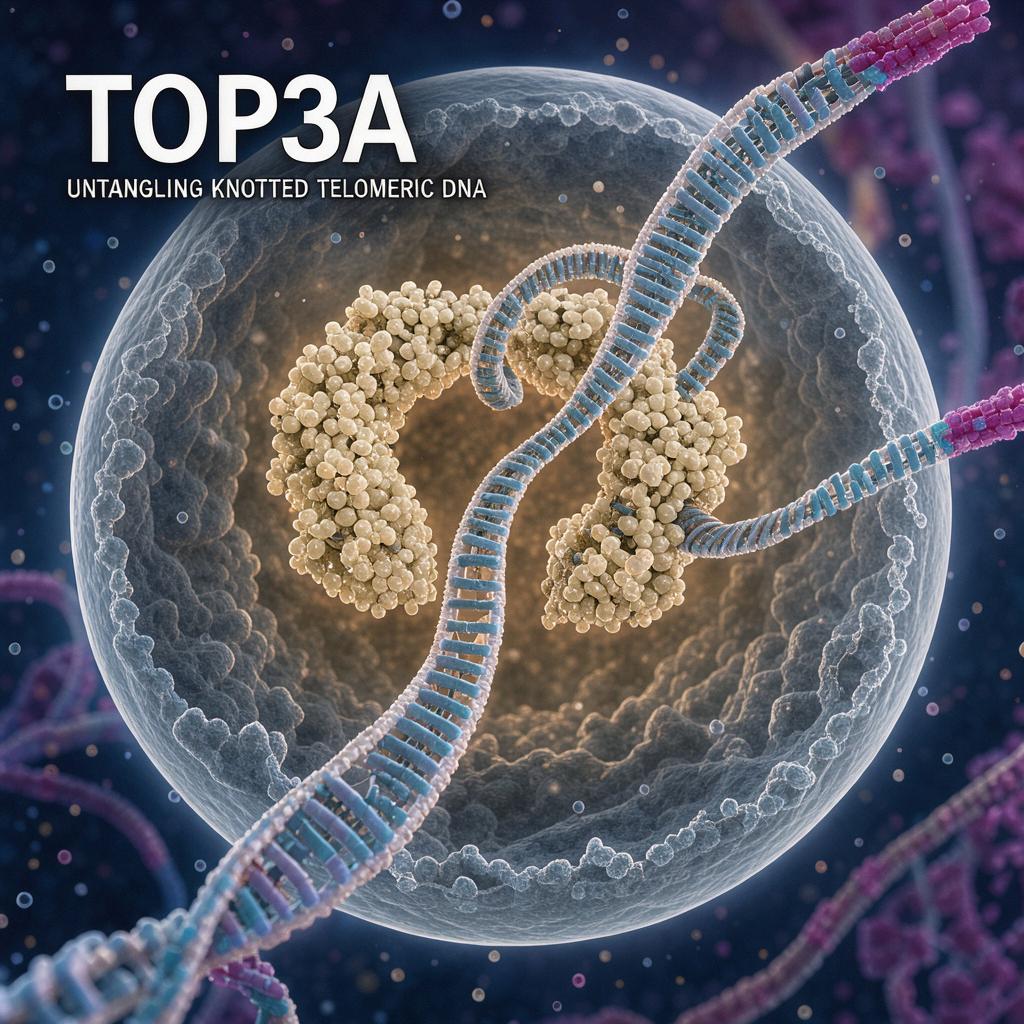
This bioRxiv preprint provides single-cell imaging, protein-stability, and FISH evidence that TOP3A localizes to ALT telomeres, stabilizes TERF2, and promotes APB formation, ssTeloC/c-circle generation, and TERRA recruitment specifically in ALT (not telomerase-positive) cells, supporting TOP3A poisoning as a selective therapeutic strategy for ALT cancers
Long Explanation
Core Claim and Supporting Evidence
This preprint extends the known role of the BLM-TOP3A-RMI1/2 (BTR) dissolvase into ALT telomere biology. Using U2OS, SAOS2, and HU09 (ALT) versus HT1080 and SJSA-1 (telomerase-positive) lines, the authors report five coupled findings: (1) endogenous TOP3A forms nuclear foci colocalizing with TERF2 and PML in U2OS but not SJSA-1 cells, confirmed by proximity ligation assays; (2) siRNA knockdown of TOP3A disassembles ALT-associated PML bodies and reduces BLM telomere recruitment; (3) TOP3A depletion profoundly decreases ssTeloC (c-circle-like) signals by native FISH; (4) TERRA foci and TERF2 protein levels drop after TOP3A knockdown, with cycloheximide-chase experiments showing accelerated TERF2 degradation only in ALT cells; and (5) TOP3A loss retards growth of ALT but not telomerase-positive lines and produces fragile, smeared, ultrabright telomeres on metaphase FISH . The growth-selectivity result is consistent with an earlier EMBO J study showing TOP3A is required for proliferation and telomere stability in ALT cells . The mechanistic framing is coherent with 2024 work showing BLM unwinds lagging-strand telomeric substrates to generate 5'-flaps preceding break-induced replication in ALT .
Reported ALT Burden Context
The therapeutic rationale rests on ALT prevalence figures cited in the paper, including ~45% in osteosarcoma and ~33% in glioblastoma .
Mechanistic Model as Presented
Only steps marked as observations (APB disassembly, ssTeloC/TERRA reduction, TERF2 destabilization) were directly measured; supercoil removal and Holliday-junction dissolution at telomeres remain author inference extrapolated from canonical BTR biochemistry .
Key Findings Summary
Finding
Cell lines
Method
Direction of effect
TOP3A at ALT telomeres
U2OS vs SJSA-1
IF, HALO-tag imaging, PLA
Colocalization with TERF2/PML in ALT only
APB integrity
U2OS
TERF2+PML IF
Reduced foci and colocalization after TOP3A knockdown
Strengths: ALT-versus-telomerase-positive contrasts across five lines; orthogonal assays (IF, PLA, native FISH, RNA FISH, CHX chase, metaphase FISH); a genetic poisoning proof-of-principle (R364W TOP3A-DPCs) directly relevant to drugging topoisomerase cleavage complexes; quantification over 25-30 nuclei with stated statistics .
Limitations: Not yet peer reviewed; several figure legends and supplement fragments appear garbled in the deposited text; key quantifications rely on few biological replicates (n=2 for TOP3A-TERF2 cofoci; SAOS2 growth in duplicates); no direct telomere-length-over-population-doubling assay demonstrating actual ALT elongation failure, so "TOP3A-dependent ALT" is inferred from proxy markers (ssTeloC, TERRA, APBs) rather than measured telomere elongation; the R364W experiment uses overexpression in cells with endogenous TOP3A, and no small-molecule TOP3A poison was tested; no rescue experiment showing siRNA-resistant TOP3A restores ssTeloC/TERRA/TERF2, leaving off-target siRNA effects formally possible.
Blind spots: Whether TERF2 loss is a cause or downstream consequence of APB collapse is not disentangled; compensation by WRN or other RecQ helicases, which also regulate telomeric circle topology , is unexplored; genome-wide context is provided by the TAILS optical screen, which independently identified ALT modulators and could be mined for TOP3A pathway hits ; ALT heterogeneity beyond osteosarcoma-like lines (e.g., ATRX-deficient contexts) is not sampled .
Therapeutic framing caution: TOP3A is essential for mitochondrial DNA maintenance and normal development, so systemic TOP3A poisoning carries toxicity risk; the ALT-selective window rests on cancer-cell growth data in two to three lines and on independent evidence that some contexts tolerate TOP3A loss . Osteosarcoma ALT activation also involves upstream events such as TCAB1/TP53 disruption .
What would change the conclusion: Failure of RNAi-resistant TOP3A to rescue ALT markers, intact ssTeloC/TERRA with TOP3A catalytic-dead knock-in, preserved telomere elongation rates in TOP3A-depleted ALT cells, or equivalent TERF2 destabilization in telomerase-positive lines under longer knockdown would materially weaken the model. Confidence in the localization and dependency observations is moderate; confidence in the proposed catalytic mechanism at telomeres is low pending direct biochemistry.
Feedback:
Updated: November 17, 2026
BGPT Paper Review
Study Novelty
80%
Builds on the 2008 EMBO J TOP3A-ALT report but adds new causal links: TOP3A-dependent APB assembly, TERRA recruitment, ssTeloC generation, ALT-specific TERF2 stabilization, and a poisonable DPC mechanism, none previously demonstrated together.
Scientific Quality
70%
Careful multi-assay design with controls, but unreviewed preprint, small replicate numbers (n=2, duplicates for SAOS2 growth), garbled figure/supplement text, no rescue or telomere-length-over-passages assay, and overexpression-based R364W experiments limit confidence. No prompt injections detected.
Study Generality
60%
Findings concern a defined cancer subset (10-15% of tumors) and five cell lines; mechanistic principles of BTR dissolvase action generalize, but ALT heterogeneity across ATRX-deficient and non-osteosarcoma contexts is untested.
Study Usefulness
70%
Provides a concrete, druggable hypothesis (TOP3A cleavage-complex trapping) for ALT cancers lacking therapies, plus marker-based assays others can immediately apply to screen ALT vulnerabilities.
Study Reproducibility
60%
Methods, antibodies, dilutions, and cell lines are documented and commercially available (TOP3A antibody via Riou gift is a barrier), but no raw data or code deposition and fragmentary supplementary text hinder independent replication.
Explanatory Depth
70%
Direct measurements explain ALT-marker dependencies well, but the central catalytic mechanisms (supercoil removal behind D-loops, telomeric Holliday-junction dissolution) remain extrapolated from canonical BTR biochemistry rather than demonstrated at telomeres.
Mining TOP3A and TERT expression across sarcoma cell lines in the Sarcoma CellMinerCDB dataset to confirm the ALT-selective TOP3A dependency pattern reported in the paper's supplementary figure.
Get emailed when your analysis is done!
We'll email you the results when your analysis is finished.
Hypothesis Graveyard
TOP3A at ALT telomeres merely reflects bulk BTR recruitment by BLM: rejected as sufficient because TOP3A knockdown disassembles APBs and reduces BLM telomere recruitment, indicating reciprocal structural dependence rather than passive passenger localization.
TERF2 loss after TOP3A depletion is a general topoisomerase-stress artifact: weakened by the ALT-specificity of the effect across three ALT lines versus two telomerase-positive lines, though longer knockdowns in Tel cells remain untested.

 Explore by Goal
 Quick Explanation
 Long Explanation
 Top Data Sources
 Ask a Follow-Up
 Key Insight
 Keep Exploring
 Analysis
 Hypothesis Graveyard
 Potential Experiments
 Discussion
