Analyze how experimental results and claims are presented, scoped, and limited in a paper.Know what the science actually supports before you trust the answer.
Press Enter ↵ to analyze
Explore by Goal
"The biology of mind bridges the sciences - concerned with the natural world - and the humanities - concerned with the meaning of human experience."
- Eric Kandel
Quick Explanation
Copied
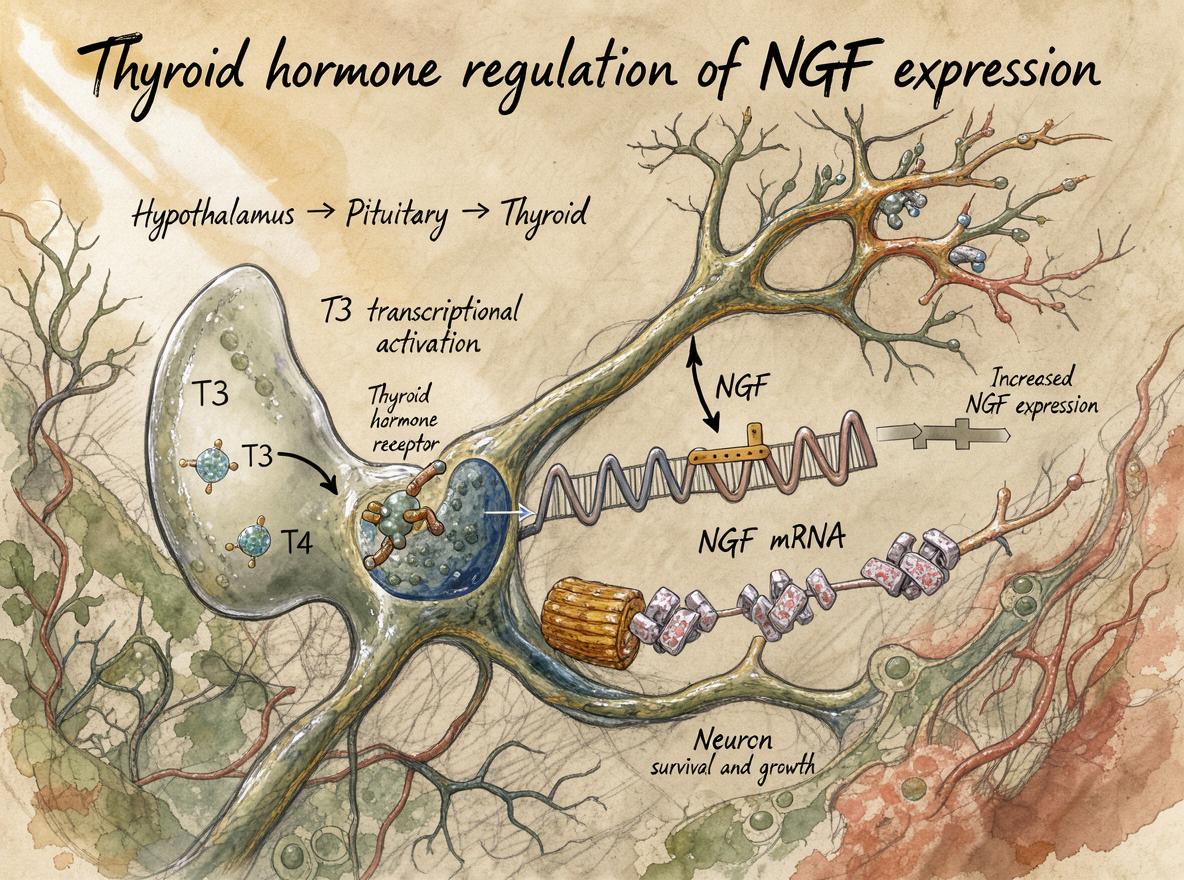
Thyroid hormone (500 µg/kg i.p., 8 days) significantly increased NGF and NT-3 mRNA (~50%) in the hippocampus of aged rats, with smaller non-significant cortical increases, but these RNA changes did not translate into hippocampal ChAT activity; BDNF was not induced, and cortical ChAT (+28%) rose without matching neurotrophin increases .
Long Explanation
Core Finding: RNA Up, Protein Function Disconnected
Giordano et al. (Abbott Laboratories, Molecular Brain Research, 1992) administered l-thyroxine (500 µg/kg i.p. daily, 8 days) to 22–23-month-old male Sprague-Dawley rats and quantified neurotrophin mRNAs by rtPCR normalized to cyclophilin. In the hippocampus, NGF and NT-3 RNA rose ~50% (NGF: 2.40→3.66, P<0.005; NT-3: 2.67→4.08, P<0.005); BDNF fell slightly and non-significantly (0.82→0.68) . Cortical changes (~30–49%) did not reach significance.
Critically, ChAT activity—the functional readout—was unchanged in the hippocampus despite robust NGF induction, while cortex showed a modest +28% ChAT increase without significant neurotrophin RNA changes. The authors also report unpublished nBM-lesion data: TH reduced lesion-induced ChAT loss only marginally (42% vs 35% decrease), unimpressive versus ~350% survival gains from direct NGF administration. The authors themselves conclude the ~50% induction level is "unclear whether... biologically significant" and that NGF lacks a thyroid response element, implying indirect regulation .
Strengths
Honest, self-critical interpretation: the paper explicitly flags the RNA–protein gap and weak ChAT coupling rather than overselling the therapeutic hypothesis.
Methodological care for its era: cycle curves verified linear amplification range, NGF primers spanned an intron, duplicate assays, normalization, and multiple runs per sample.
Dose framing is reasonable (500 µg/kg matches levels used to induce T3 nuclear receptors).
Weaknesses and Blindspots
Small, variable n: Table II n=4–7 per group; S.E.M. overlap is substantial for cortical comparisons.
No protein measurement: only RNA was quantified; the authors concede mRNA may rise while protein falls.
Pooled cDNA for cycle optimization from single control pools—risk of biased calibration.
Statistical multiplicity: six t-tests with no correction; cortex effects labeled "approaching significance" may reflect chance.
Sex/age confounds: only aged males; no young-adult replication shown in this paper (mentioned only as "data not shown").
Missing toxicity data: hyperthyroid dosing effects on weight/behavior unreported.
Context and Legacy
The study builds on earlier evidence that thyroxine raises NGF in adult mouse brain and situates itself within the NGF-for-Alzheimer's therapeutic debate of the era. Later work complicated the neurotrophin-replacement hypothesis: NGF protein is elevated, not reduced, in symptomatic AD cortex , and BDNF/NT-3 show largely complementary, cell-type-specific developmental roles . Confidence: moderate—findings are plausible and internally consistent but small-n, RNA-only, and unreplicated within this paper.
Feedback:
Updated: November 01, 2026
BGPT Paper Review
Study Novelty
60%
Extends prior thyroxine-NGF induction findings to NT-3 and BDNF via rtPCR in aged rats; first demonstration of TH-inducible NT-3, but conceptually incremental on Walker et al. 1979.
Scientific Quality
70%
Careful rtPCR calibration and honest self-critique, but small n (4-7), no protein assays, multiple uncorrected t-tests, pooled calibration cDNA, and unpublished lesion data reduce rigor.
Study Generality
60%
Establishes a general principle (small endocrine molecules can induce multiple neurotrophin mRNAs) but is limited to two brain regions, one sex, one age, one species.
Study Usefulness
60%
Proof-of-principle for BBB-permeable neurotrophin inducers was valuable for AD drug discovery in 1992; the negative ChAT coupling tempered that promise honestly.
Study Reproducibility
60%
Primers, doses, cycle numbers, and analysis pipeline are fully reported, aiding replication, but pooled calibration samples and small n weaken confidence in exact effect sizes.
Explanatory Depth
50%
Proposes indirect (non-TRE-mediated) regulation and regional receptor distribution as explanations, but provides no direct mechanistic tests; key mechanistic claims rest on unpublished sequencing data.
We'll email you the results when your analysis is finished.
Hypothesis Graveyard
Direct TRE-mediated transcriptional activation of NGF: rejected by the authors' own sequencing of the NGF promoter showing no thyroid response element.
Competition immunoassay overestimation of TH-induced NGF protein (earlier studies): largely superseded by this rtPCR study confirming real RNA increases, though protein quantification remains missing.

 Explore by Goal
 Quick Explanation
 Long Explanation
 Top Data Sources
 Ask a Follow-Up
 Key Insight
 Keep Exploring
 Hypothesis Graveyard
 Potential Experiments
 Discussion
