Analyze how experimental results and claims are presented, scoped, and limited in a paper.Know what the science actually supports before you trust the answer.
Press Enter ↵ to analyze
Explore by Goal
"The goal of science is not to open the door to infinite wisdom, but to set a limit to infinite error."
- Bertolt Brecht
Quick Explanation
Copied
The Hogle, Chow & Pilman article 'The Structure of Poliovirus' is a landmark 1987 Scientific American review of the first atomic-resolution X-ray structure of a human virus, resolving at 2.9 Å the icosahedral coat built from VP1–VP4 beta-barrel pentamers Scientific American poliovirus structure review. Its conceptual framework remains valid, though the article predates later discoveries such as vaccine-derived poliovirus evolution Annual Review of Microbiology VDPV endgame review.
Long Explanation
Evidence Base of the 1987 Structure Determination
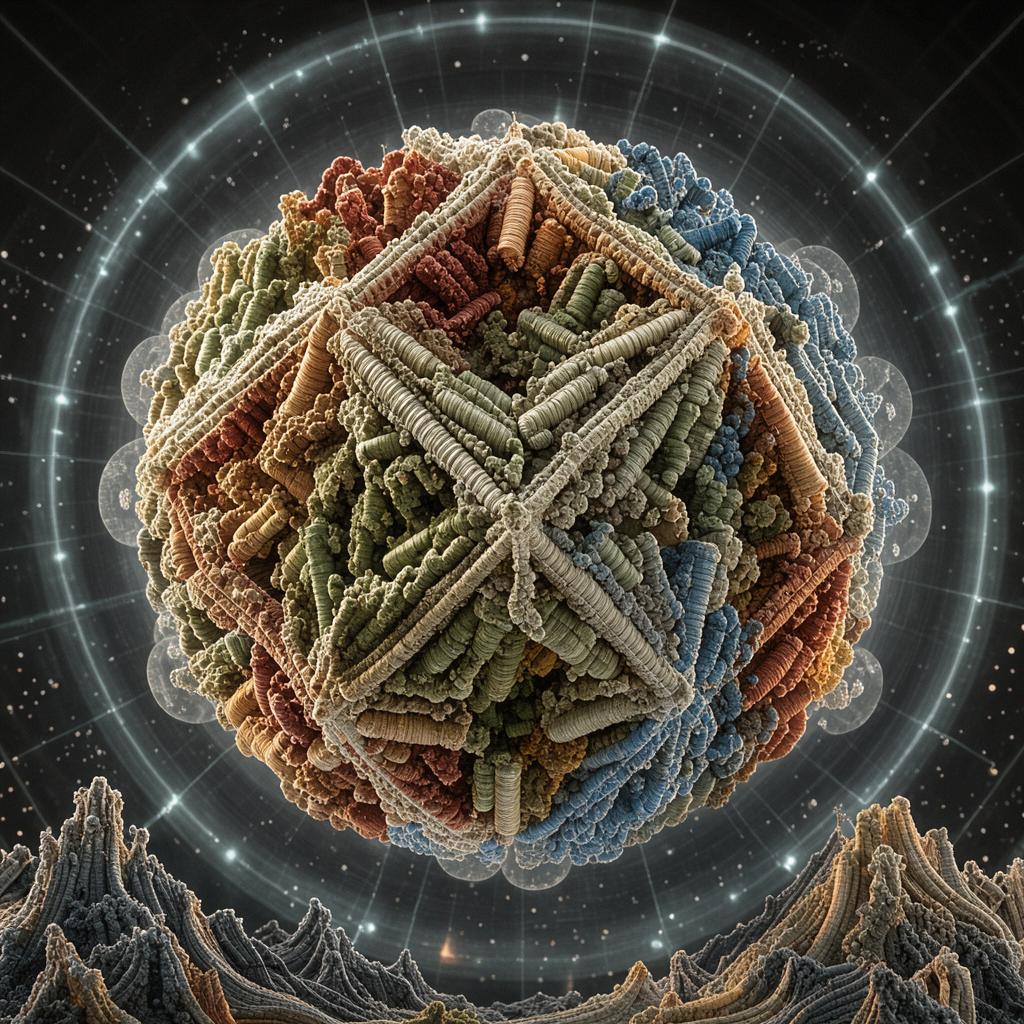
The article reports that the authors solved the Mahoney type 1 poliovirus structure by X-ray crystallography at 2.9 Å resolution, collecting nearly five million measurements from 84 crystals — a formidable dataset for 1987 Hogle et al. Scientific American structure report. The key structural findings: VP1, VP2, and VP3 share an eight-stranded beta-barrel core; 60 copies of each assemble into 12 pentamers ('molecular mountains' with VP1 at the peak and VP4 lining the interior); surface loops mediate interactions with receptors and antibodies; and the RNA genome is inferred — not directly observed — to be densely packed in the central cavity.
Interactive atomic model of poliovirus capsid (PDB 2PLV, Mahoney strain) — cartoon colored by spectrum, semi-transparent surface.
Critical Appraisal
Strengths: The crystallographic methodology (crystallization, heavy-atom phasing, symmetry exploitation via Bricogne's algorithm) is explained transparently, and the structural claims were later validated independently through the PDB deposition of 2PLV and decades of picornavirus research. The link to rational vaccine and antiviral design was prescient — subsequent work on capsid-stabilizing compounds and the codon-deoptimized Sabin 2 attenuation strategy builds directly on capsid structure knowledge PNAS codon deoptimization attenuation study.
Limitations and blind spots: (1) The RNA genome is not directly resolved — packing density is inferred from calculations, a caveat the authors do acknowledge. (2) Crystallography captures a single static, low-energy conformation; poliovirus undergoes major conformational rearrangements during cell entry that this static map cannot reveal. (3) Antigenic loop flexibility and receptor-binding ('canyon') hypotheses required later cryo-EM and receptor-complex structures to fully test. (4) As a popular-science review, it contains no formal methods, statistics, or data-availability statements; reproducibility rests on the companion Nature paper and PDB entry, not this text itself. (5) The article does not anticipate the later recognition that live-attenuated vaccine strains frequently revert and circulate — a development that reshaped eradication strategy VDPV endgame narrative review.
Historical and Scientific Significance
The article correctly frames poliovirus as a bridge between plant-virus crystallography (TBSV, SBMV, STNV, TCV) and medically important picornaviruses. Later work confirmed that intrahost viral evolution, not just structure, governs tissue tropism and pathogenesis Nature Communications intrahost evolution study — highlighting that structure was necessary but not sufficient for a complete mechanistic picture. Confidence: high on structural facts (directly reported and PDB-corroborated); moderate on downstream interpretation, which relies on post-1987 literature not present in the article itself.
Feedback:
Updated: October 31, 2026
BGPT Paper Review
Study Novelty
90%
The first atomic-resolution structure of a human (animal) pathogenic virus, following only plant-virus structures (TBSV 1978); the 2.9 Å Mahoney strain map was genuinely groundbreaking for structure-based vaccinology.
Scientific Quality
80%
As a Scientific American review, the underlying crystallography is exceptional and transparently described (5M measurements, 84 crystals, heavy-atom phasing, symmetry methods); but the popular format lacks formal methods, statistics, and data statements, and its structural claims rest on the companion primary paper.
Study Generality
70%
Structure-function principles (beta-barrel architecture, icosahedral pentamers, surface loops as antigenic/receptor sites) generalize across picornaviruses and enveloped-adjacent virus families, but the article focuses narrowly on poliovirus and its immediate relatives.
Study Usefulness
80%
Directly enabled structure-guided antiviral design (capsid-stabilizing compounds), clarified antigenic site organization, and laid groundwork for rational attenuation approaches like codon deoptimization; somewhat dated now that cryo-EM dominates.
Study Reproducibility
60%
The article itself is a narrative review without methods or deposited data, but reproducibility is recoverable via the companion primary Nature publication and the PDB entry 2PLV; the crystallographic pipeline described (heavy atoms, symmetry averaging) is standard and checkable.
Explanatory Depth
70%
Excellent mechanistic description of capsid architecture, assembly hierarchy, and structure-function links; weaker on receptor binding, genome organization, and dynamic conformational changes, which the static 2.9 Å map could not capture.
We'll email you the results when your analysis is finished.
Hypothesis Graveyard
'The crystal structure directly represents the infectious virion in vivo.' Later work showed crystal packing and the 2.9 Å map capture a contracted, low-energy state; in vivo particles undergo expansion rearrangements, so the crystallographic model is a snapshot, not the functional form.
'Structural knowledge alone could predict attenuation.' The codon-deoptimization and VDPV literature shows attenuation depends on genomic features (codon usage, CG dinucleotides, mutation rate) beyond capsid structure.

 Explore by Goal
 Quick Explanation
 Long Explanation
 Top Data Sources
 Ask a Follow-Up
 Key Insight
 Keep Exploring
 Hypothesis Graveyard
 Potential Experiments
 Discussion
