Analyze how experimental results and claims are presented, scoped, and limited in a paper.Know what the science actually supports before you trust the answer.
Press Enter ↵ to analyze
Explore by Goal
"Mood reflects the biology of the brain. How you feel is affected by the chemicals in the brain, and these are the same chemicals that form the basis of mood-altering drugs."
- Liz Miller
Quick Explanation
Copied
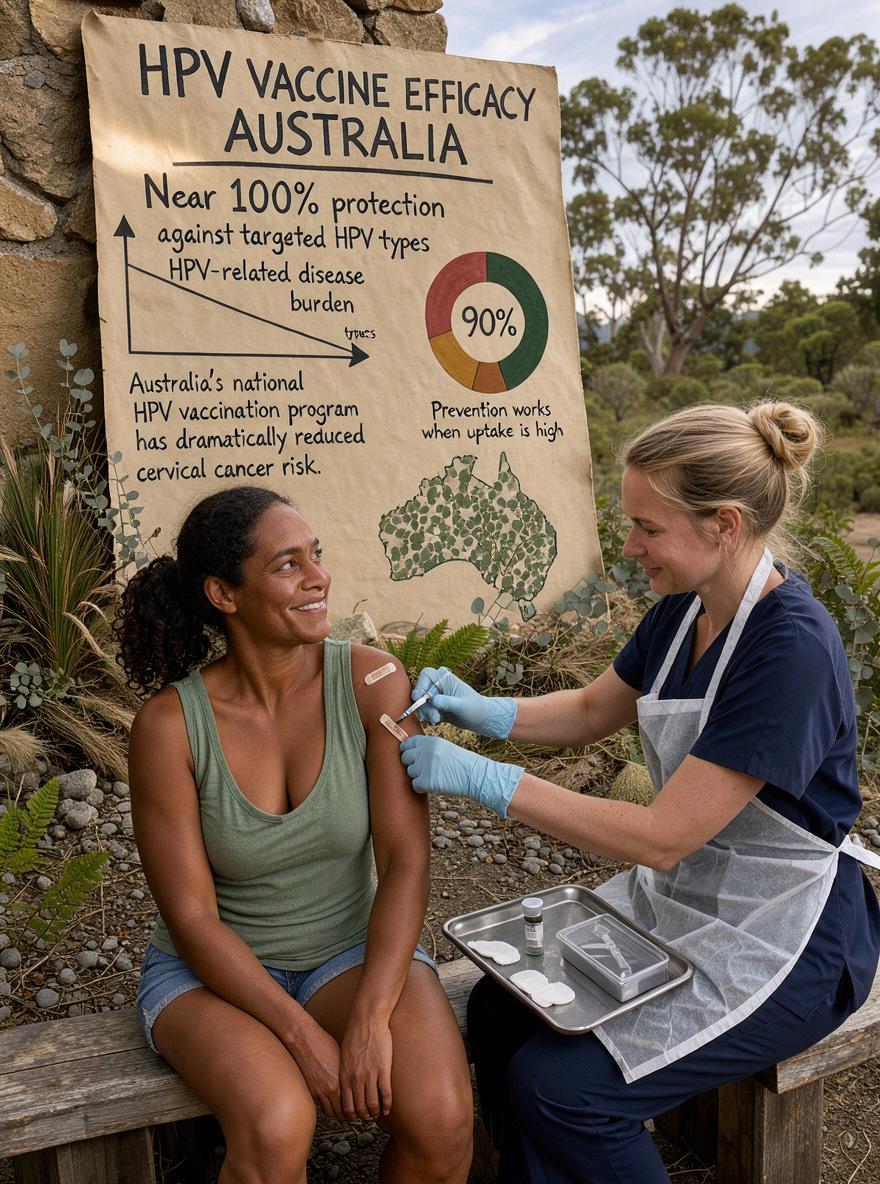
This 2014 narrative review by Garland (Clin Ther) reports that Australia's school-based quadrivalent HPV program achieved ~70-83% 3-dose coverage in adolescents and was followed by rapid declines in genital warts (90%+ in vaccine-eligible young women), HPV prevalence (77%), and vaccine-type high-grade cervical lesions, though it relies on ecological before-after surveillance rather than controlled designs and the author has extensive Merck/GSK conflicts of interest .
Long Explanation
Evidence Summary
The paper reviews Australia's National HPV Vaccination Program, which from April 2007 offered free quadrivalent vaccine to girls aged 12-13 via schools, with a 2007-2009 catch-up for females aged 13-26 . Reported outcomes: genital warts fell ~90% by mid-2011 at Melbourne Sexual Health Centre in vaccine-eligible women, with national sentinel data showing 59% decline in vaccine-eligible women and 39% in unvaccinated heterosexual men (herd effect); HPV vaccine-type prevalence fell 77%; and data linkage showed 47.5% (95% CI 22.7-64.4) vaccine effectiveness against CIN3+/AIS in fully vaccinated Victorian women .
The strongest causal data is the individual-level Victorian registry linkage; the wart and prevalence declines are ecological before-after comparisons vulnerable to secular trends and behavioral confounding, though the authors note no decline in non-vaccine STDs and restriction of wart declines to eligible cohorts . Hazard ratios for 1-2 doses were not significantly different from 1.0, which the paper itself flags against dose reduction; later post-hoc trial analyses reached the opposite conclusion for younger women . A Danish-Swedish cohort found no excess autoimmune, neurological, or venous thromboembolic events .
Conflicts of Interest and Blind Spots
The sole author discloses advisory board fees, lecture fees, and institutional study funding from Merck and GlaxoSmithKline, and membership of the Merck Global Advisory Board and HPV Scientific Advisory Committee . This is a substantial sponsor-aligned COI for an advocacy-toned review; the optimistic framing ("faster, and to a greater extent, than anyone could have predicted") is interpretive language rather than data. Blind spots: no cost-effectiveness analysis of the male program introduced in 2013; cancer endpoints unmeasured; coverage registry data under-notify; methods section ("review of published data") lacks search strategy, making selection of cited studies non-reproducible. The subsequent broader literature corroborates the reported surveillance findings (e.g., 93%/73% wart declines in females <21/21-30 within five years) .
What Would Change the Conclusion
Sustained rises in vaccine-type CIN3+/cancer in screened vaccinated cohorts, detection of unmeasured non-vaccine-type replacement, or coverage data showing the registry estimates were systematically wrong. The paper provides falsification conditions only implicitly; no explicit pre-registered endpoints exist. Overall, the surveillance observations are likely real but causation rests on plausibility and the linkage study rather than randomized evidence.
Author Reviews:
Feedback:
Updated: November 02, 2026
BGPT Paper Review
Study Novelty
60%
At publication (2014), this was among the first comprehensive summaries of real-world population-level HPV vaccine impact (warts, prevalence, CIN3+ linkage), but it is a review synthesizing already-published studies rather than new primary data.
Scientific Quality
60%
No systematic search methodology, single conflicted author, advocacy framing, and reliance on ecological before-after comparisons limit rigor; however, it transparently reports CIs, acknowledges ecologic causation limits, and cites independent registry data accurately.
Study Generality
50%
Findings are specific to Australia's high-coverage school-based program; transferability to lower-coverage or resource-limited settings is asserted but not demonstrated with evidence in the paper.
Study Usefulness
70%
Useful policy template for school-based delivery, registry-based effectiveness monitoring, and herd-immunity documentation; cited heavily as early real-world evidence for quadrivalent vaccination.
Study Reproducibility
40%
Methods section is a single sentence with no search strategy, inclusion criteria, or data-synthesis protocol; underlying registry data are government-sourced and largely reproducible, but the review process itself is not.
Explanatory Depth
50%
Explains surrogate-outcome logic (warts as earliest indicator) and screening-participation interactions, but offers no mechanistic or quantitative transmission modeling; depth limited by narrative format.
We'll email you the results when your analysis is finished.
Hypothesis Graveyard
Hypothesis that wart declines were primarily due to changed sexual behavior or clinic-attendance shifts: weakened because the paper reports no decline in other STIs at the same clinics and declines were restricted to vaccine-eligible cohorts and absent in nonresidents.
Hypothesis that low 3-dose completion makes population impact impossible: weakened by observed 77% prevalence decline despite ~70% completion, implying partial-dose or partial-coverage protection, later supported by dose-sparing trial analyses.

 Explore by Goal
 Quick Explanation
 Long Explanation
 Top Data Sources
 Ask a Follow-Up
 Key Insight
 Keep Exploring
 Hypothesis Graveyard
 Potential Experiments
 Discussion
