Check whether claims match experiments, exact reported results, and stated limitations.Know what the science actually supports before you trust the answer.
Press Enter ↵ to review paper
Explore by Goal
"Biology is also more important than physics, as measured by its economic consequences, by its ethical implications, or by its effects on human welfare."
- Freeman Dyson
Quick Explanation
Copied
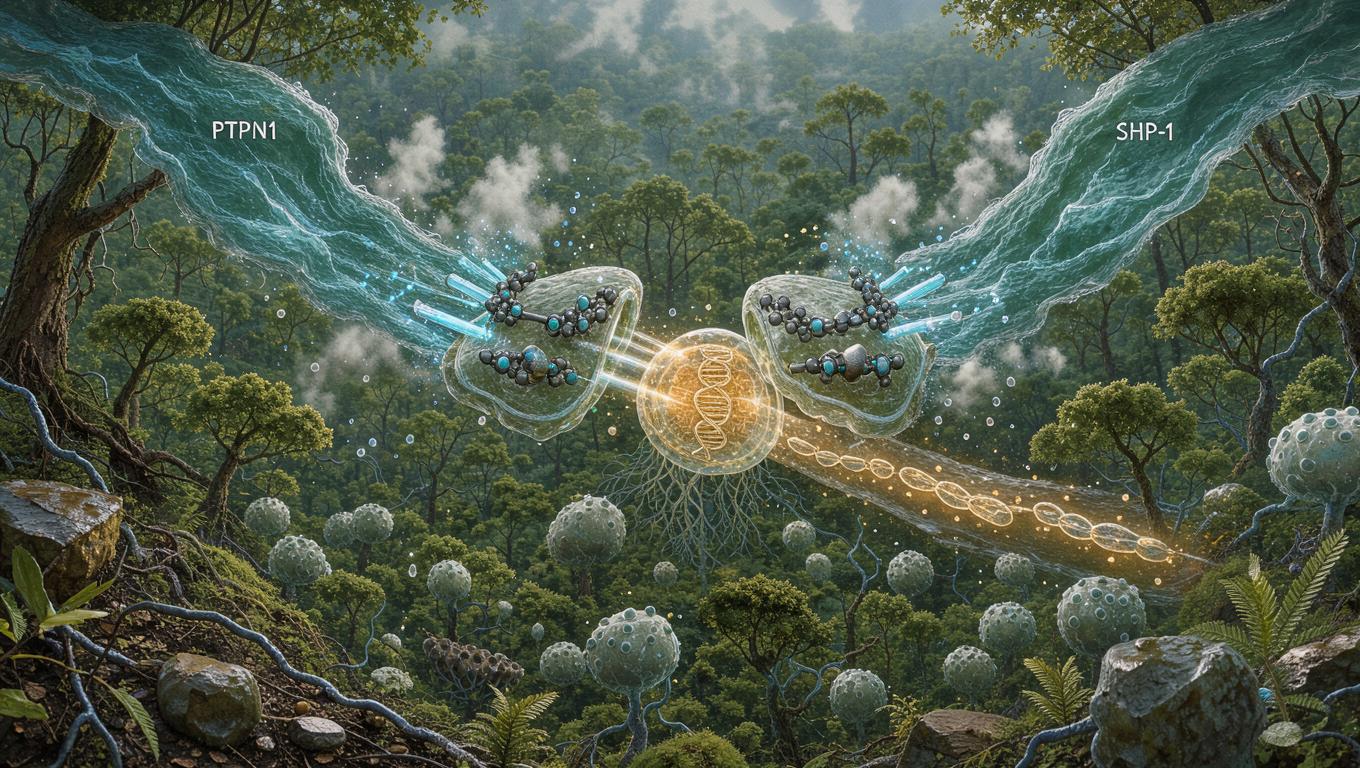
This 2016 Cytokine review by Pike and Tremblay competently synthesizes evidence that the tyrosine phosphatases PTP1B (PTPN1) and TC-PTP (PTPN2) are context-dependent JAK-STAT regulators whose loss cooperates with driver lesions in lymphoid malignancy — PTPN1 mutations in PMBCL/Hodgkin lymphoma (22% and 20%) and PTPN2 bi-allelic deletions restricted to TLX1+ T-ALL (12/36) — and that phosphatase status may predict kinase-inhibitor sensitivity .
Long Explanation
Core Synthesis and Strength of Evidence
The review's central, well-supported claim is that PTP1B and TC-PTP are non-redundant negative regulators of JAK-STAT signaling whose dysregulation is subtype-restricted in lymphoid malignancy. The quantitative backbone is solid: recurrent somatic PTPN1 mutations occur in 22% (17/77) of primary mediastinal B-cell lymphoma and 20% (6/30) of Hodgkin lymphoma cases, with matching cell-line findings, and loss increases phosphorylation of STAT3/5/6, JAK1, and JAK2 . In T-ALL, bi-allelic PTPN2 deletions cluster exclusively in the TLX1+ subgroup (12/36 tumors), and TC-PTP loss heightens signaling from both NUP214-ABL1 (reducing imatinib sensitivity) and oncogenic JAK1 .
Critical Appraisal and Blind Spots
The review honestly flags its hardest problem: both loss and overexpression of each phosphatase associate with malignancy (TC-PTP is required for MYC-driven B-cell lymphoma maintenance, yet its deletion drives TLX1+ T-ALL), making simple tumor-suppressor framing untenable . Gaps the authors partly acknowledge but do not resolve: no systematic meta-analysis; mouse-versus-human discrepancies (e.g., a report finding no elevated IL-7/IL-15-STAT5 signaling in purified TC-PTP-deficient CD8 T cells, with reduced total STAT5 confounding interpretation); unknown frequency of TC-PTP overexpression in human B-cell malignancies; and no causal dissection of whether PTPN1/PTPN2 loss initiates or merely maintains disease. A notable blind spot is the therapeutic paradox the review under-explores: if PTP1B inhibition potentiates anti-tumor dendritic-cell immunity , yet PTPN1 loss in lymphoma cells drives drug-resistance transporter expression, systemic phosphatase inhibition could help and hurt simultaneously — a host-tumor conflict absent from the paper's therapeutic framing. What would falsify its conclusions: sequencing cohorts showing PTPN1/PTPN2 inactivation distributed across (rather than restricted to) these subtypes, or functional data showing phosphatase loss is insufficient to cooperate with any driver lesion.
Therapeutic Framing
The prognostic proposal — PTPN2 status predicting kinase-inhibitor efficacy, PTPN1 loss predicting ABC-transporter drug resistance — remains hypothesis-generating; no clinical validation existed at publication, and the JAK-inhibitor field has since matured considerably . Confidence in the review's mechanistic claims is moderate-to-high; its translational claims remain untested.
Feedback:
Updated: October 27, 2026
BGPT Paper Review
Study Novelty
60%
Timely 2016 synthesis of then-recent PTPN1/PTPN2 sequencing discoveries, but a narrative review consolidating known phosphatase biology rather than generating new concepts or data.
Scientific Quality
70%
Well-organized, well-referenced narrative review by a leading phosphatase lab; limitations include no systematic methodology, reliance on heterogeneous mouse/human data, and acknowledged unresolved mechanistic questions.
Study Generality
50%
Focused on two phosphatases and lymphoid malignancy; the context-dependence lesson generalizes but the paper itself is niche.
Study Usefulness
70%
Useful for hematology/oncology researchers; frames biomarker hypotheses (PTP status predicting inhibitor response) that later work on dual PTP1B/TC-PTP inhibition partially pursued.
Study Reproducibility
40%
No primary data; reproducibility rests entirely on the cited primary studies, whose methods and samples vary widely.
Explanatory Depth
70%
Mechanistic depth is good for a review — substrates, splice variants, cooperation models — but causal directionality (initiation vs maintenance) remains unresolved by design.
We'll email you the results when your analysis is finished.
Hypothesis Graveyard
PTPs as a uniformly tumor-suppressive gene family: falsified by the dual pro/anti-tumor roles of PTP1B and TC-PTP across solid and hematologic cancers.
PTP1B and TC-PTP being functionally interchangeable due to homologous catalytic domains: falsified by their distinct, non-redundant immune phenotypes and subtype-restricted mutation patterns.

 Explore by Goal
 Quick Explanation
 Long Explanation
 Top Data Sources
 Ask a Follow-Up
 Key Insight
 Keep Exploring
 Hypothesis Graveyard
 Potential Experiments
 Discussion
