Go beyond summaries to locate specific, verifiable claims and sources within research.Know what falsifiable science actually supports before you trust the answer.
Press Enter ↵ to search paper
Explore by Goal
"The diversity of the phenomena of nature is so great, and the treasures hidden in the heavens so rich, precisely in order that the human mind shall never be lacking in fresh nourishment."
- Johannes Kepler
Quick Explanation
Copied
Verdict: 'Sustainable aquaculture through the One Health lens' (Nature Food, 2020) is a well-conceived, highly cited conceptual framework paper proposing cross-sector success metrics spanning People, Organism, and Environment domains. Its strength is synthesis and policy framing; its weakness is the complete absence of primary empirical data, meaning the framework's real-world validity remains untested. Supporting literature both illustrates the framework's promise (bioremediation, polyculture, seaweed farming) and exposes its blind spots — notably that even 'sustainably certified' operations can dominate watershed nutrient loading.
Long Explanation
Evidence Supporting the Framework's Relevance
The paper's central claim — that One Health in aquaculture needs operationalizable success metrics across People, Organism, and Environment domains — is grounded in documented failures of sector-specific management. The 15 proposed success metrics (e.g., nutritious safe food, healthy stock, optimal water quality, protected biodiversity) directly map onto empirically documented problems: brackish shrimp farming in Sri Lanka caused 64% mangrove loss in Puttalam Lagoon, groundwater salinization exceeding 35 ppt, and annual BOD discharge of ~9,544 tons , while Chinese mariculture expanded to 11.3 million tonnes by 2001 with accompanying pollution and ecosystem degradation .
The framework's cross-sector logic is also supported by solution-oriented evidence: bio-flocs and periphyton improve nitrogen removal while cutting feed costs ; tilapia polyculture improves feed utilization, water quality, and profitability ; and a mycoalgae biofilm (Mucor indicus + Chlorella vulgaris) reduced TAN from 25 mg/L to undetectable within 48 hours while generating fish-feed biomass .
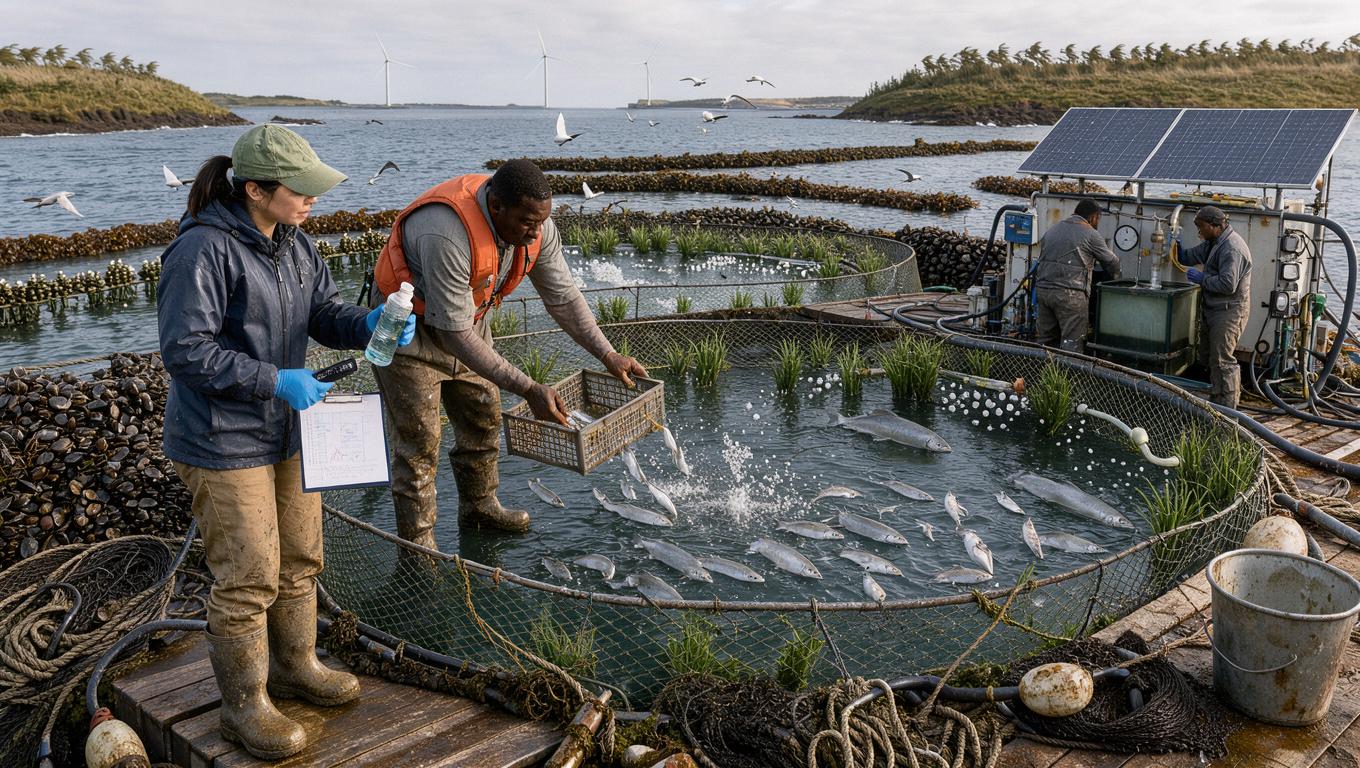
Figure evidence: A critical stress test of the framework's 'Environment' metrics comes from Lake Yojoa, Honduras: a single sustainably certified tilapia net-pen operation contributed ~86% of nitrogen and ~95% of phosphorus loading — far exceeding all six tributaries combined . This directly challenges whether voluntary certification substitutes for the paper's proposed metric-based governance.
Critical Limitations and Blind Spots
The paper itself contains no primary data: the framework derives from literature synthesis and a 2019 workshop, with no underlying datasets reported. The authors acknowledge risks of over- or under-regulation and data gaps for monitoring, but the falsification test — whether the metrics consistently fulfil across sub-sectors and countries and whether policy adoption improves outcomes — remains unperformed. Additional caveats: workshop-derived input introduces participant selection bias; generalizability across diverse species and regions is asserted rather than demonstrated; and Life Cycle Assessment work shows feed dominates environmental impact in cage systems (1,900 kg CO2-eq, 122 kg PO4-eq per tonne of fish) — yet the paper's metric table does not explicitly quantify feed-footprint thresholds. The framework would be strengthened by integrating emerging quantitative tools (eDNA benthic monitoring and omics-driven feed optimization ), which the 2020 paper could not fully anticipate.
Confidence note: The framework's descriptive value is high (conceptual synthesis, strong policy framing), but claims of practical effectiveness are unverified — no empirical validation exists in the paper or the reviewed literature. Conclusions would change if longitudinal studies showed certified operations meeting the paper's Environment metrics without governance intervention.

 Explore by Goal
 Quick Explanation
 Long Explanation
 Top Data Sources
 Ask a Follow-Up
 Discussion
 My BGPT