Why BGPT?
logo

Deconstruct Scientific Papers

Go beyond summaries to locate specific, verifiable claims and sources within research.Know what falsifiable science actually supports before you trust the answer.

Press Enter ↡ to search paper


     Quick Explanation


    This 2018 pan-cancer survey of miRNA–miRNA cooperation across 18 TCGA cancer types (6,348 tumors) reports a scale-free, modular cooperative network (762 pairs among 149 miRNAs) that is mostly cancer-specific (88% of pairs in one cancer), with hub miRNAs linked to drug targets and cooperative modules predicting survival in several cancers. The findings are largely consistent, correlative bioinformatics observations whose main weakness is indirect evidence of cooperativity rather than functional validation.


     Long Explanation


    Pan-cancer cooperative architecture

    The study integrated paired miRNA/mRNA expression with copy number and promoter methylation data across 18 cancer types (6,348 tumor samples, 20,472 mRNAs, 867 miRNAs), defining cancer-context miRNA-target regulation via a multivariate linear model restricted to negatively correlated, Ago CLIP-supported pairs; filtering on CLIP support raised precision ~7.5-fold on average versus correlation-only pairs (up to 12.6-fold in LIHC, 4.7-fold in PRAD)
    Feedback:    

    Updated: November 25, 2026


     BGPT Paper Review


    Study Novelty

    80%

    First systematic pan-cancer survey (18 TCGA types) of miRNA–miRNA cooperative regulation, moving beyond single-cancer network studies to identify conserved vs rewired hubs and modules.


    Scientific Quality

    70%

    Rigorous multi-omics pipeline with CLIP-support filtering and ROC/KM validation, but entirely computational: cooperativity is inferred from shared GO/PPI modules without experimental synergy assays; some downstream cited work was later retracted.


    Study Generality

    80%

    Pan-cancer scope with tissue-of-origin concordance makes findings broadly applicable to oncology and network biology, though limited to 18 TCGA adult carcinomas.


    Study Usefulness

    70%

    Provides candidate hub miRNAs, drug-target links, and prognostic modules useful for biomarker hypothesis generation; clinical utility remains unvalidated.


    Study Reproducibility

    60%

    Public TCGA data, named tools (starBase, multiMiR, CFinder, igraph, pROC), and described models aid replication, but no code/data repository or full parameter dump is provided.


    Explanatory Depth

    60%

    Summarizes statistical principles (scale-free topology, expression conservation) but mechanisms of cooperation are inferred topologically, not mechanistically demonstrated.


    🎁 Authors: Collect 225 Free Science Tokens (β‰ˆ $22.5 USD)

    Claim My Author Tokens

    Use for 56 days of free BGPT access (4 tokens = 1 day) or trade/sell (β‰ˆ $22.5 USD)

     Top Data Sources ExportMCP


     Hypothesis Graveyard


    miRNA cooperation conservation should mirror mRNA conservation (ceRNA-like logic) β€” falsified here: only 0.1% of pairs conserved in >5 cancers despite high miRNA recurrence, so rewiring dominates.


    Cooperatively acting miRNAs must be co-expressed by the same principle as synthetic lethality β€” weakened because expression correlation alone cannot establish joint repression of shared targets, and Asensor data show context-dependent activation rather than uniform repression.

     Science Art


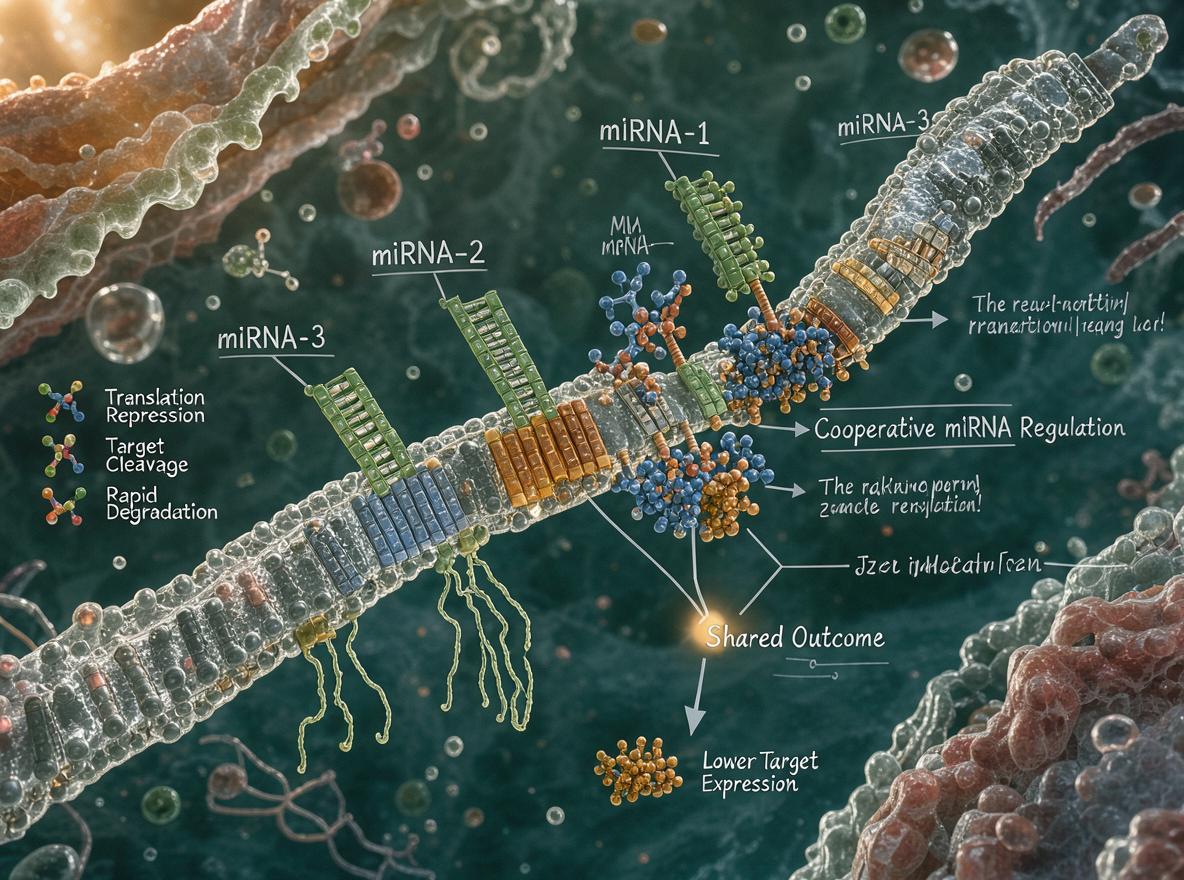
    Paper Review: Survey of miRNA-miRNA cooperative regulation principles across cancer types Science Art

     Science Movie


    Make a narrated HD Science movie for this answer ($64 per minute)


     Discussion


    Stay current without chasing every paper.

    Know what changed, what holds up, and what remains uncertain. Every Friday. No ads.


    My BGPT