Check whether claims match experiments, exact reported results, and stated limitations.Know what the science actually supports before you trust the answer.
Press Enter ↵ to review paper
Explore by Goal
"Nothing in life is to be feared, it is only to be understood. Now is the time to understand more, so that we may fear less."
- Marie Curie
Quick Explanation
Copied
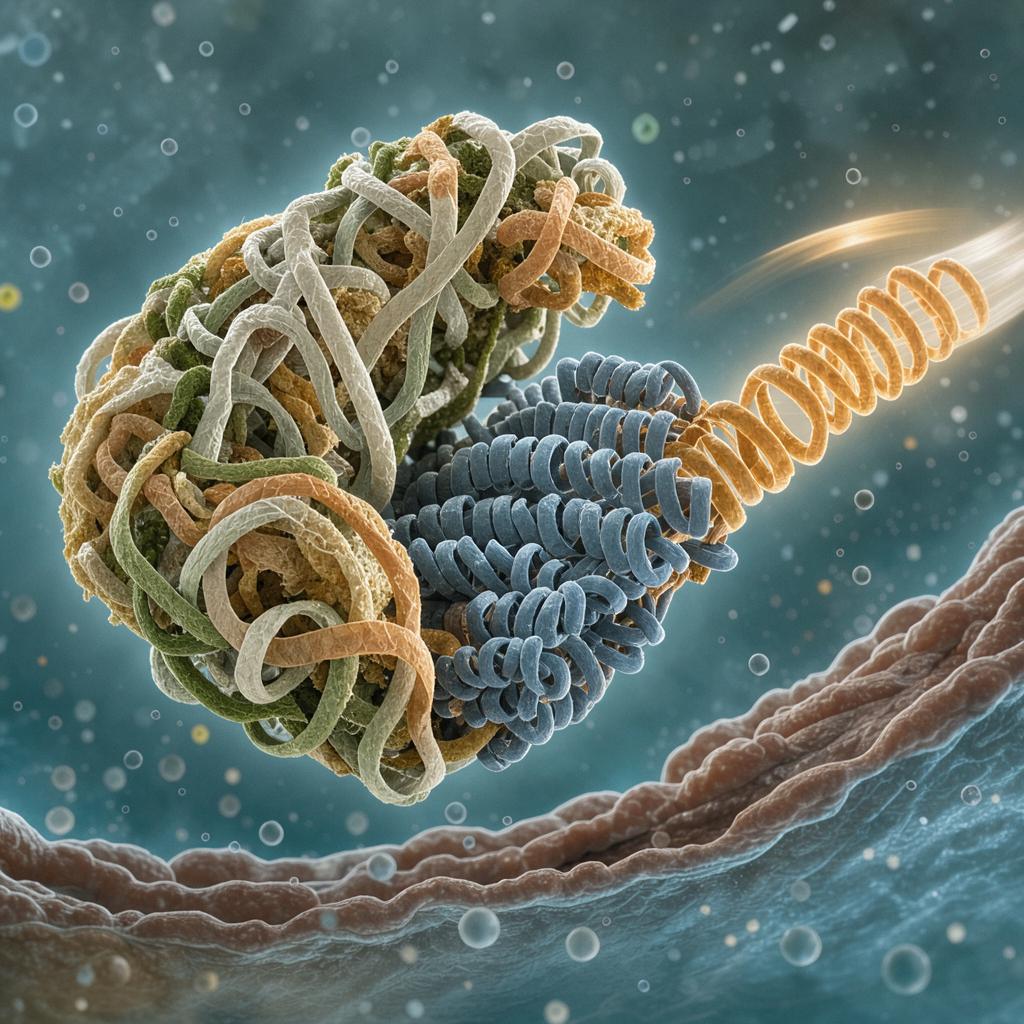
This landmark 2011 Nature study by Rasmussen et al. captured the first agonist-bound, active-state structure of a diffusible-ligand GPCR (β2AR, PDB 3P0G) using the G-protein-mimetic nanobody Nb80, revealing that subtle ligand-pocket changes (2.1 Å TM5 inward shift) allosterically drive an 11.4 Å outward TM6 movement conserved with opsin Rasmussen et al. 2011.
Long Explanation
Why This Paper Mattered: The Active-State Barrier
Before 2011, all GPCR structures from diffusible-ligand receptors were inactive, inverse-agonist-bound states. The β2AR active state is intrinsically unstable without Gs, so the Kobilka, Weis, and Steyaert groups engineered Nb80 — a 14 kDa camelid nanobody from a llama immunized with agonist-bound receptor — as a Gs surrogate. Nb80 reproduced Gs biochemistry: it increased isoproterenol affinity ~95-fold (Ki 107 → 1.13 nM) versus ~100-fold for Gs (107 → 1.07 nM), while leaving inverse agonist ICI-118,551 binding essentially unchanged reported validation. Bimane fluorescence at Cys265 (TM6) showed Nb80+agonist produced changes indistinguishable from Gs+agonist — strong orthogonal evidence the trapped conformation is the physiological active state.
The Structure: Small Pocket Changes, Huge Cytoplasmic Motion
Crystallized in lipidic cubic phase at 3.5 Å from 23 crystals, the BI-167107–bound β2AR-T4L–Nb80 complex (PDB 3P0G) showed: (1) an 11.4 Å outward movement of TM6 at Glu268(6.30), driven by clockwise rotation around the Pro288(6.50) kink; (2) TM5 inward shift of 2.1 Å at Ser207(5.46); (3) ionic-lock breakage (Arg131–Asp130) and Tyr326(7.53) rearrangement — all remarkably matching opsin/rhodopsin, supporting a conserved activation mechanism structural findings. Notably, the rotamer toggle switch hypothesis was challenged: Trp286(6.48) showed no rotamer change, consistent with 5-HT4 mutagenesis data — a candid negative result against a then-popular model.
Interactive 3D view: β2AR-T4L (spectrum cartoon) in complex with nanobody Nb80 (stick, chain B), the first active-state β2AR structure (PDB 3P0G).
Critical Appraisal and Blind Spots
Strengths: convergent validation (binding affinity, fluorescence, structural homology to opsin); declared no competing financial interests despite a Boehringer Ingelheim co-authorship on the agonist BI-167107; coordinates publicly deposited (3P0G) deposition and disclosure.
Limitations the authors partially acknowledged: 3.5 Å resolution with strong anisotropy precluded water-molecule modeling in the conserved polar network; the T4L fusion sterically blocks real Gs coupling, so G-protein-mimicry is inferred, not direct; Nb80 itself imposes cytoplasmic contacts (Arg131 binds a CDR3 backbone carbonyl), meaning some active-state geometry may be nanobody-stabilized rather than agonist-alone; only 5–10° of diffraction per crystal before radiation damage; and the agonist is a non-catechol ultra-high-affinity ligand (Kd 84 pM, ~150 h off-rate), so pocket geometry may not represent physiological catecholamines — a caveat the authors flag for Asn293(6.55) β-OH chirality interactions. What would falsify the interpretation: showing the agonist-bound receptor crystallized without Nb80 adopts a different, inactive conformation — which the companion irreversible-agonist paper indeed demonstrated companion finding.
Feedback:
Updated: October 27, 2026
BGPT Paper Review
Study Novelty
90%
First-ever agonist-bound active-state structure of a diffusible-ligand GPCR and first use of a G-protein-mimetic nanobody for GPCR crystallization; foundational to all subsequent active-state GPCR structural biology (later Nobel-recognized line of work).
Scientific Quality
90%
Multiple orthogonal validations (affinity, fluorescence, structural homology), deposited coordinates, disclosed funding, candid negative result on rotamer toggle. Weaknesses: 3.5 Å anisotropic data from 23-crystal merge, T4L fusion artifact risk, nanobody-imposed contacts, non-physiological agonist.
Study Generality
80%
Established a reusable methodology (nanobody stabilization) and demonstrated conserved activation mechanics with opsin, generalizing across family A GPCRs, though activation energetics were noted to differ per receptor.
Study Usefulness
90%
Directly enabled structure-based GPCR drug design, biased agonism interpretation, and the nanobody toolkit now standard in GPCR structural biology and pharmacology.
Study Reproducibility
80%
Detailed methods (constructs, LCP conditions, PDB 3P0G) plus quantitative affinity and spectroscopy data support replication, but requiring scarce specialized resources (beamline microcrystallography, llama nanobody discovery).
Explanatory Depth
80%
Provides a mechanistic allosteric propagation model (TM5 Ser207/Pro211 → Phe282/6.44 → TM6 rotation), links pocket chemistry to activation, and tests/refutes the rotamer toggle switch with structural and mutagenesis evidence.
Aligning PDB 3P0G active and 2RH1 inactive β2AR structures to quantify TM5/TM6/TM7 Cα displacements and map nanobody contact residues.
Get emailed when your analysis is done!
We'll email you the results when your analysis is finished.
Hypothesis Graveyard
Rotamer toggle switch of Trp6.48 as a universal GPCR activation trigger — directly refuted here by unchanged Trp286 rotamer in the active structure and 5-HT4 mutagenesis.

 Explore by Goal
 Quick Explanation
 Long Explanation
 Top Data Sources
 Ask a Follow-Up
 Key Insight
 Keep Exploring
 Analysis
 Hypothesis Graveyard
 Potential Experiments
 Discussion
