Analyze how experimental results and claims are presented, scoped, and limited in a paper.Know what the science actually supports before you trust the answer.
Press Enter ↵ to analyze
Explore by Goal
"The diversity of the phenomena of nature is so great, and the treasures hidden in the heavens so rich, precisely in order that the human mind shall never be lacking in fresh nourishment."
- Johannes Kepler
Quick Explanation
Copied
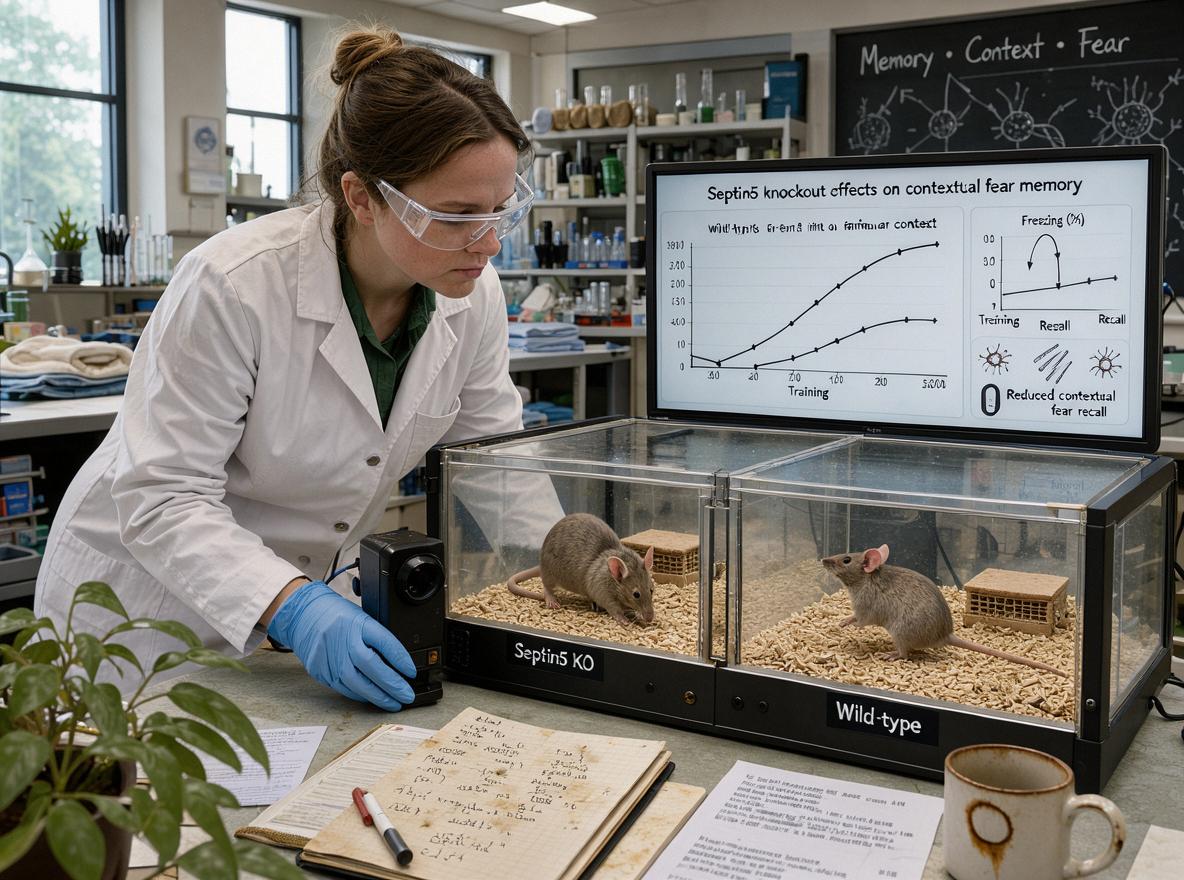
Septin5-/- mice show normal hippocampal ultrastructure (no changes in synapse density, spine volume, PSD area, or sER-containing spines) but impaired contextual fear memory at both 1 day (F1,30=14.79, p=0.0006) and 1 month (F1,30=5.60, p=0.025), with cued fear and object recognition intact
Long Explanation
Core Findings
In adult male Septin5-/- mice, serial-section transmission EM of the hippocampal DG middle molecular layer (2 littermate pairs, 40 dissector pairs) showed no differences in synapse density, spine volume (n=205 vs 208), PSD area (n=204 vs 206), or fraction of sER-containing spines (n=191 vs 200) — contrasting with Septin3-/- mice, which lose sER in spines . Behaviorally, contextual freezing was reduced at 1 day (p=0.0006) and persisted at 1 month (p=0.025), while cued fear was intact at both timepoints (p=0.63, p=0.44) .
At 1 month (32–39 weeks), the same cohort was retested — a repeated-testing design that means the "remote" deficit may partly reflect persistence of the acquisition defect rather than independent consolidation failure. Shock responses and light/dark anxiety were comparable, arguing against gross perceptual confounds .
Mechanistic Context & Critique
The authors propose sER-independent mechanisms via Septin-5's binding to syntaxin-1 and competition with α-SNAP at the SNARE complex, plus Cdk5-dependent phosphorylation regulating this interaction . Independently, Septin5 deletion enhances β-cell exocytosis by releasing microtubule-tethered insulin granules, reinforcing a conserved role for Septin-5 as a negative regulator of vesicle trafficking . Notably, no physiological measures were collected in this study, so a metabolic confound on behavior cannot be excluded. Key limitations: small, all-male cohorts (n=6–19 per group); no hippocampus-specific rescue experiments; no pre-registered thresholds; tests run at 28–39 weeks (older than typical) without age-matched within-genotype controls across timepoints; no effect sizes or confidence intervals reported; raw data available only on request.
What Would Change This Conclusion
Failure to replicate the 1-day contextual deficit in an independent cohort or on a different background strain.
A cued-memory deficit emerging with larger samples (n=13 KO is modest).
Demonstration that aged Septin5-/- mice have normal context freezing, suggesting an age interaction.
Confidence: Moderate — behavioral effects are internally consistent and well-controlled for anxiety/locomotion, but underpowered samples and absence of rescue/physiology data limit causal certainty.
Feedback:
Updated: November 01, 2026
BGPT Paper Review
Study Novelty
70%
First direct comparison of Septin5-/- vs Septin3-/- behavioral and ultrastructural phenotypes, revealing subunit-specific roles; the remote contextual memory finding is new, though septin-KO behavioral work dates to 2009.
Scientific Quality
80%
Rigorous EM sampling, appropriate mixed-effects statistics, and good behavioral controls; deducted for small all-male samples, repeated-testing design confounding remote memory interpretation, no effect sizes, and request-only data access.
Study Generality
70%
Advances understanding of septin subunit specialization in memory broadly, though findings are genotype- and task-specific within one mouse strain and sex.
Study Usefulness
80%
Practically useful for septin biology, 22q11.2-related neurodevelopmental research, and for guiding targeted rescue/region-specific follow-up experiments.
Study Reproducibility
60%
Methods are reasonably detailed and statistics transparent, but data are available only on request and sample sizes limit independent verification.
Explanatory Depth
70%
Phenotyping is thorough and mechanistically framed via SNARE binding, but no direct physiological or molecular measurements link Septin-5 loss to the memory deficit.
We'll email you the results when your analysis is finished.
Hypothesis Graveyard
The remote deficit reflects progressive degeneration — rejected by the paper's own EM data showing normal ultrastructure at 10 weeks; degeneration would require a separate aging cohort to test.
The contextual deficit is a locomotor/perception artifact — largely ruled out by comparable shock responses and light/dark behavior, though subtle acquisition-during-training differences (p=0.053) remain unexcluded.

 Explore by Goal
 Quick Explanation
 Long Explanation
 Top Data Sources
 Ask a Follow-Up
 Key Insight
 Keep Exploring
 Hypothesis Graveyard
 Potential Experiments
 Discussion
