Analyze how experimental results and claims are presented, scoped, and limited in a paper.Know what the science actually supports before you trust the answer.
Press Enter ↵ to analyze
Explore by Goal
"The only way to discover the limits of the possible is to go beyond them into the impossible."
- Arthur C. Clarke
Quick Explanation
Copied
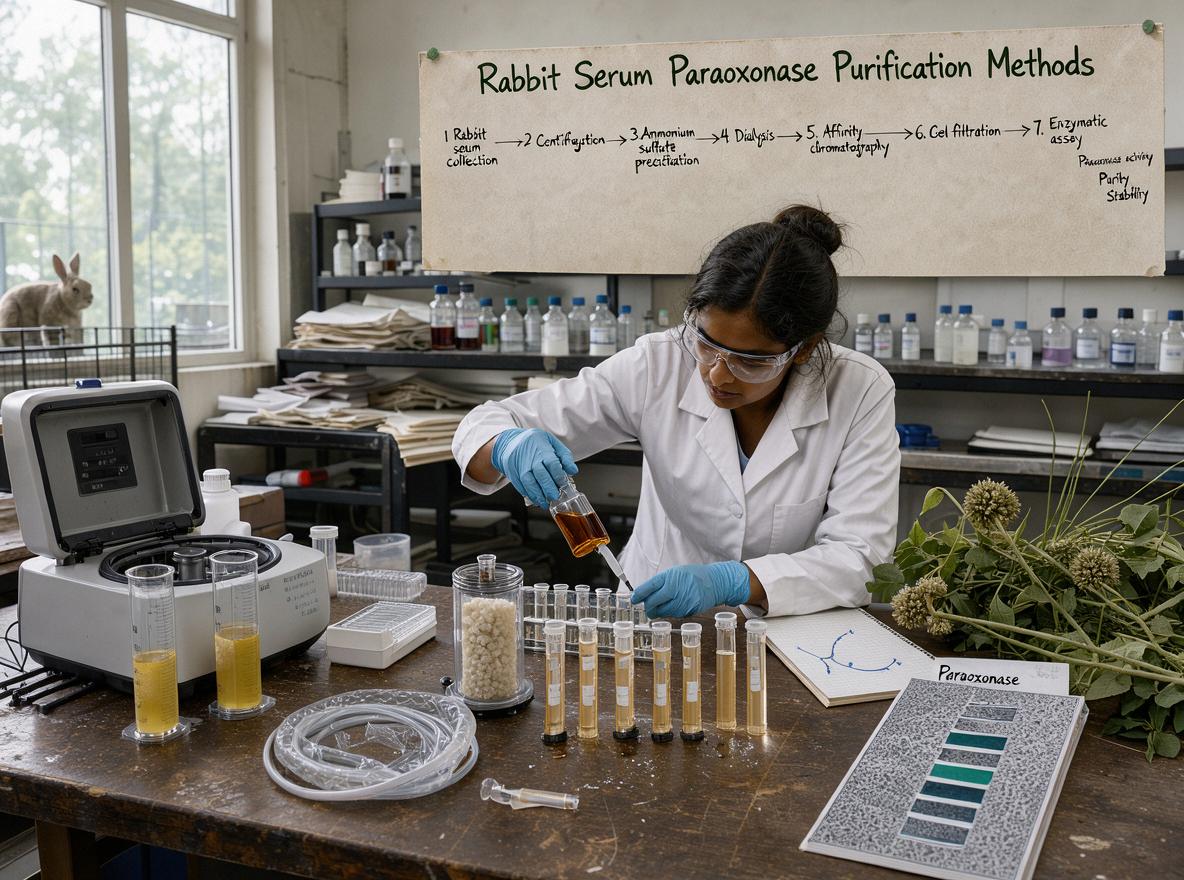
Furlong et al. (1991) purified rabbit and human serum paraoxonase to homogeneity using Cibacron Blue, gel filtration, DEAE-Trisacryl M, and preparative SDS electrophoresis, identifying two active rabbit bands (35 and 38 kDa) that shared identical amino-terminal sequences (AKLTALTLLGLGLALFDGQK), with human differing at residue 4. The work resolved a substrate-specificity controversy and enabled PON1 cloning, but mobility shifts upon re-electrophoresis (35→43, 38→48 kDa) suggest protein denaturation, and conclusions rest on a small number of serum samples.
Long Explanation
Purification Achievements and Key Findings
The paper reports a 73-fold purification of rabbit serum paraoxonase/arylesterase with 31% recovery through four column steps (Cibacron Blue 3GA-agarose, Sephadex G-75, DEAE-Trisacryl M, second G-75), yielding two active bands at 35,000 and 38,000 Da. Upon electroelution and re-analysis, higher molecular weight inactive bands appeared at 43,000 and 48,000 Da, yet all four bands shared an identical amino-terminal sequence (AKLTALTLLGLGLALFDGQK), supporting unfolding rather than distinct protein species as the explanation .
Resolving a Substrate-Specificity Controversy
A central contribution was refuting Mackness et al.'s claim that human serum contains separate paraoxonases and arylesterases. Using activity stains for both paraoxon and β-naphthylacetate after gel electrophoresis, the authors showed the same protein bands hydrolyze both substrates, consistent with Gan et al. (1991) and Smolen et al. (1991) . This resolution proved pivotal for the field, since later reviews confirm PON1's paraoxonase, arylesterase, and lactonase activities share a single active site .
Methodological Strengths and Critical Limitations
Strengths: The renaturation-and-activity-staining strategy after SDS-PAGE was innovative and enabled direct confirmation that sequenced bands were catalytically active PON. Identical N-terminal sequences across four bands plus matching amino acid compositions (consistent with the concurrent rabbit cDNA from Hassett et al., 1991) provide strong identity evidence. Human PON purification achieved a non-blocked N-terminus, a practical advantage over Gan et al.'s preparation.
Limitations: (1) The molecular-weight shift upon re-electrophoresis was interpreted as unfolding or loss of associated material, but the mechanism was left unresolved — the authors explicitly state the reason is unknown. Glycosylation differences (5 potential N-sites in rabbit, 4 in human) were proposed but not tested. (2) Only single serum sources were characterized; the genetically determined human PON1 polymorphism was acknowledged but not addressed at the protein-purification level. (3) No yield is reported for the human purification beyond a 62-fold/18% endpoint, and the preparative gel approach is inherently low-yield. (4) The physiological substrate remained unknown — a point still flagged decades later . (5) Human PON activity-staining after SDS-PAGE was only occasionally successful, limiting cross-species generalization of the renaturation method.
Historical Significance and Blind Spots
This work directly enabled PON1 cloning (companion Hassett et al. paper) and oligonucleotide probe design. The observation that the hydrophobic N-terminus is a secreted-protein leader sequence retained after secretion — proposed as an HDL anchor — anticipated the now-established PON1–HDL association. However, the paper did not test whether the 35/38 kDa doublet reflects differential glycosylation versus proteolysis, did not sequence internal peptides, and relied on the assumption that identical N-termini imply identical proteins (now known insufficient given isoform complexity). Confidence in the core purification claims is high; confidence in the unfolding explanation is moderate and remains mechanistically unresolved.
Feedback:
Updated: October 29, 2026
BGPT Paper Review
Study Novelty
70%
First report of rabbit PON purification to homogeneity with activity-confirmed N-terminal sequencing; contemporaneous with Gan et al.'s human PON purification, so novelty is substantial but shared across competing groups.
Scientific Quality
80%
Rigorous multi-method purification with independent identity confirmation (activity stains, N-terminal sequencing, amino acid composition, cDNA cross-check). Limitations: mobility-shift mechanism unproven, small sample sources, no internal peptide data, and some preparative-gel yield losses.
Study Generality
60%
Findings generalize to PON1 biochemistry broadly (two-species cross-validation, HDL-association insight) but focus narrowly on two species and one enzyme family member; not universally generalizable methodology.
Study Usefulness
80%
Directly enabled PON1 cDNA cloning, resolved a major substrate-specificity controversy, and established purification methodology used by subsequent labs; foundational for the entire PON research field.
Study Reproducibility
70%
Detailed methods (column conditions, buffers, gradients, electroelution device construction) support reproduction, but the renaturation/SDS step is technically finicky and human PON activity-staining was only 'occasionally successful,' reducing reliability.
Explanatory Depth
60%
Good descriptive biochemistry with reasonable mechanistic inference (leader sequence/HD L anchor hypothesis), but the molecular-weight shift explanation remains speculative and untested; no kinetic or structural depth.
We'll email you the results when your analysis is finished.
Hypothesis Graveyard
Separate paraoxonase and arylesterase enzymes exist in serum (Mackness et al., 1987, 1989) — falsified by identical N-terminal sequences across activity-stained bands and by copurification of all three activities in this paper and Gan et al. 1991.
The two active rabbit bands represent two distinct gene products — rejected because identical N-terminal sequences and amino acid compositions across all four bands indicate post-translational modification of a single protein.

 Explore by Goal
 Quick Explanation
 Long Explanation
 Top Data Sources
 Ask a Follow-Up
 Key Insight
 Keep Exploring
 Hypothesis Graveyard
 Potential Experiments
 Discussion
