Analyze how experimental results and claims are presented, scoped, and limited in a paper.Know what the science actually supports before you trust the answer.
Press Enter ↵ to analyze
Explore by Goal
"The day science begins to study non-physical phenomena, it will make more progress in one decade than in all the previous centuries of its existence."
- Nikola Tesla
Quick Explanation
Copied
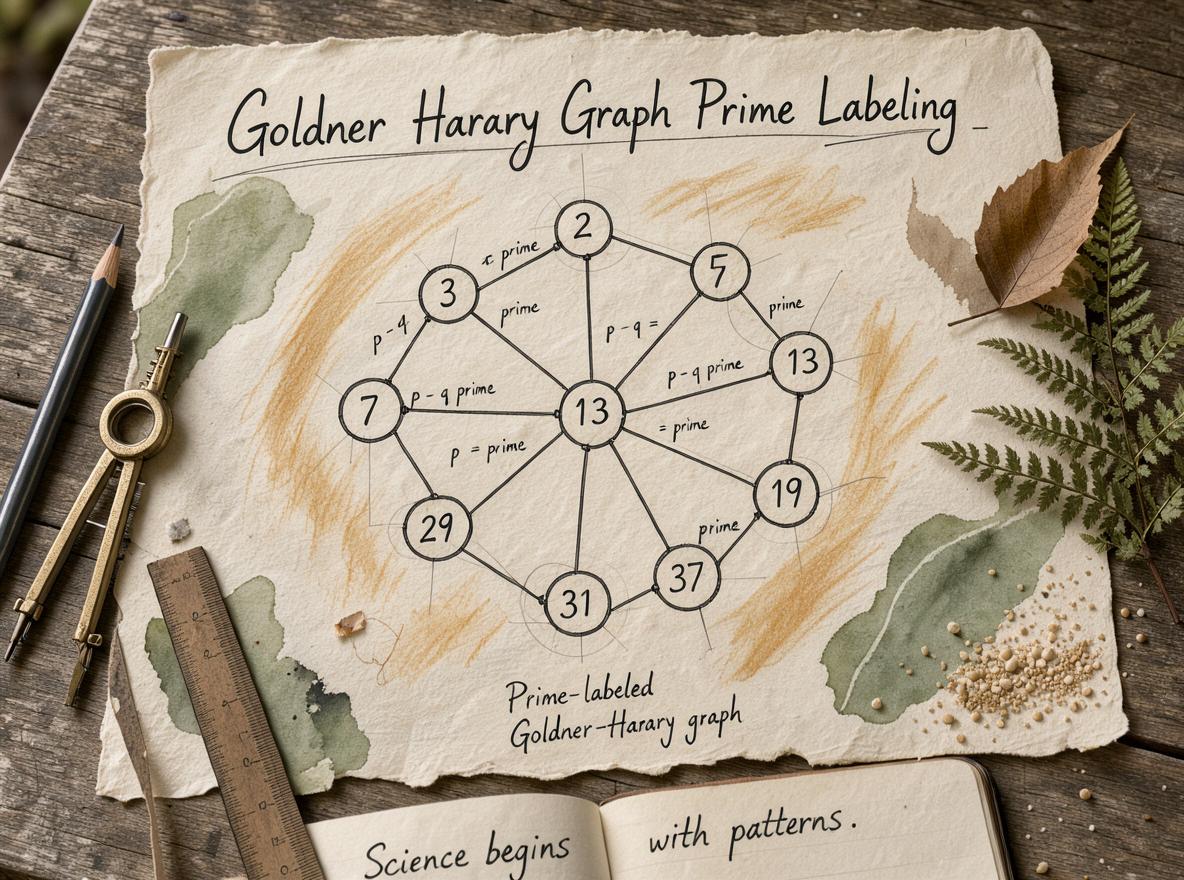
This 2024 paper claims the Goldner–Harary graph (11 vertices, 27 edges) admits prime labeling via duplication, switching, and fusion, but the proof is critically incomplete: the claimed bijection assigns labels outside {1,...,|V|} (e.g., 13, 19, 25, 31, 37 for an 11-vertex graph), violating the prime labeling definition, and verification of only 3 gcd conditions is presented.
Long Explanation
Critical Flaw in the Core Construction
Prime labeling is defined as a bijection f: V(G) → {1, 2, ..., |V|} such that gcd(f(u), f(v)) = 1 for every edge uv . The paper's Theorem 1 assigns f(v4)=13, f(v6)=19, f(v8)=25, f(v10)=31, and later f(v1′)=37 for a 12-vertex graph—labels exceeding the codomain {1,...,11} (or {1,...,12}). This is not a valid prime labeling by the standard definition; it is merely an injective labeling satisfying gcd conditions.
Additional Red Flags
Truncated verification: Only 3 gcd checks (e.g., gcd{f(v7),f(v5)}=1) are shown for a 27-edge graph; the remaining edge checks are asserted, not demonstrated.
Structural corruption: The reference list is garbled—several "references" contain fragmentary proof text, and only three legitimate references survive (Bondy & Murty 1976; Tout et al. 1982; Youssef & Saadalmordeed 2020) .
Internal inconsistencies: Case numbering and vertex names shift mid-proof (e.g., fusion of v7 and v3 concludes, then a Case 2 discusses fusing v7 and v5, then v5 and v4); edge counts after duplication vary without justification (35 vs 30 edges for the same operation).
Broken text flow: Theorem 3 and its cases appear in the annex, disconnected from the body.
Comparison with Rigorous Work in the Same Area
Comparable prime-labeling papers provide complete constructive proofs and computational verification; the Jahangir graph paper includes a C-program checking gcd conditions across the full edge set . This paper offers neither, and its central claim remains unverified as stated.
Verdict
The Goldner–Harary graph may well admit prime labeling (the claim is plausible for such small graphs and consistent with its 4-chromatic number reported elsewhere ), but this paper does not establish it. A correct proof would require either a genuine bijection to {1,...,11} with exhaustive gcd verification, or an explicit relaxation (e.g., "prime labeling with enlarged label set") clearly defined.
Feedback:
Updated: October 31, 2026
BGPT Paper Review
Study Novelty
30%
Extends a well-worn template (prime labeling via duplication/switching/fusion) to one additional named graph; the operation-based approach itself is established in prior work on Jahangir and other graphs.
Scientific Quality
20%
The central construction violates the definition of prime labeling (labels exceed the codomain); gcd verification is truncated; references are corrupted with proof fragments; case numbering is inconsistent. These are fundamental flaws, not cosmetic ones.
Study Generality
30%
Results apply to a single 11-vertex graph and its derived variants; no generalizable method, theorem, or characterization is offered.
Study Usefulness
20%
Even if the claim were correctly proven, establishing primality of one small named graph has minimal downstream impact; the flawed proofs further limit utility.
Study Reproducibility
30%
The graph is standard and labelings are listed, but incomplete gcd verification and corrupted proofs prevent independent confirmation of the claims from the text alone.
Explanatory Depth
20%
No theoretical insight into why the constructions work; proofs assert rather than demonstrate coprimality across edge sets.
We'll email you the results when your analysis is finished.
Hypothesis Graveyard
Assuming the paper is merely incomplete but essentially correct: the labels 13, 19, 25, 31, 37 cannot be relabeled without rechecking all edges, so the core proof cannot be salvaged by minor fixes.

 Explore by Goal
 Quick Explanation
 Long Explanation
 Top Data Sources
 Ask a Follow-Up
 Key Insight
 Keep Exploring
 Hypothesis Graveyard
 Potential Experiments
 Discussion
