Ask questions across claims linked to experiments, exact results, limitations, and sources.Know what the science actually supports before you trust the answer.
Press Enter ↵ to search evidence
Explore by Goal
"The nitrogen in our DNA, the calcium in our teeth, the iron in our blood, the carbon in our apple pies were made in the interiors of collapsing stars. We are made of starstuff."
- Carl Sagan
Quick Explanation
Copied
This Fly addendum synthesizes Piacentini & Pimpinelli's 2009 PLoS Genetics findings into a bold dual-role model where HP1a simultaneously packages DNA for heterochromatin and packages RNA to stabilize euchromatic transcripts via hnRNP partners (DDP1, HRB87F, PEP). While conceptually generative, the evidence remains correlative and Drosophila-specific, with no direct demonstration of transcript stabilization causality .
Long Explanation
The Dual-Role Model and Its Evidence Chain
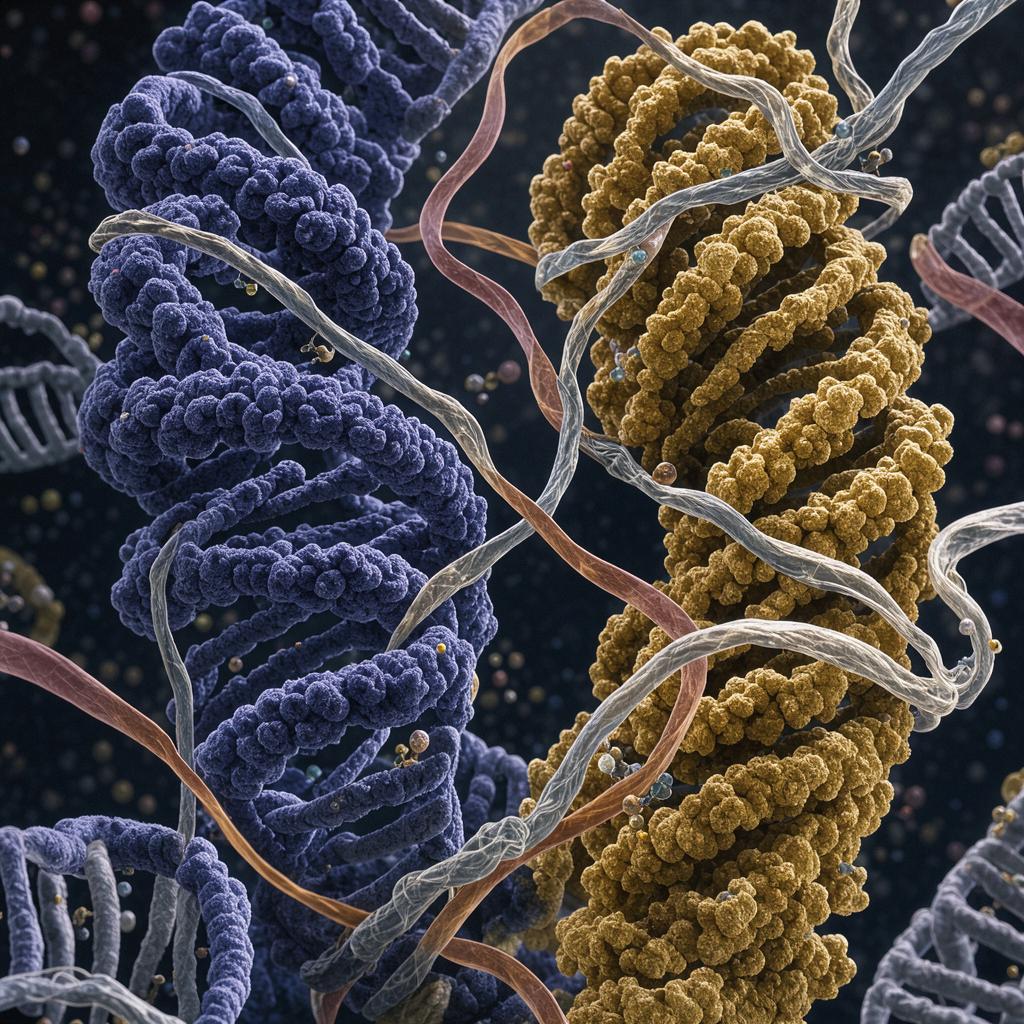
Piacentini and Pimpinelli propose that HP1a and its hnRNP partners (DDP1, HRB87F, PEP) form a nuclear sub-complex performing nucleic acid compaction in two opposite functional contexts: DNA packaging drives heterochromatin formation and silencing, while RNA packaging stabilizes transcripts and reinforces euchromatic expression . The primary evidence comes from their PLoS Genetics paper showing HP1a associates with nascent RNA, binds active Pol II phospho-Ser2 through its chromodomain, and that HP1a depletion reduces target transcript levels .
Critical Assessment: What Is Shown vs. What Is Claimed
The model is conceptually elegant but empirically underdetermined. The core claim that HP1a "stabilizes" transcripts relies on showing reduced transcript levels upon HP1a depletion after actinomycin D blockade—but this conflates transcriptional effects with post-transcriptional stability without direct measurement of RNA half-life or decay kinetics. The in vivo RNase experiment removing HP1a from polytene chromosomes supports physical association with RNA but does not prove causality in the stabilization pathway.
The authors' leap from "HP1a co-precipitates with hnRNPs" to "HP1a-containing hnRNP complexes package RNA" introduces a mechanistic assumption not directly tested—no reconstitution, purification, or structural data of the proposed complex is presented. The dual-role model depends on the unproven premise that the same HP1a molecule partitions between chromatin and RNA compartments dynamically, rather than reflecting two independent functions of a multifunctional protein.
Broader Context and Blind Spots
Subsequent work has partially vindicated the RNA-HP1a connection. The 2017 Nature study demonstrated HP1a undergoes liquid-liquid phase separation in Drosophila embryos, providing a biophysical framework for how HP1a might simultaneously engage chromatin and RNA . More recently, an image-based CRISPR screen in human K562 cells identified that 82.1% of HP1a CLIP signal maps to introns of protein-coding RNAs, with RNA processing mutants dissolving HP1a condensates—independently confirming the RNA-HP1a axis in a different species .
Key blind spots remain: (1) No quantitative RNA half-life measurements directly demonstrate stabilization; (2) the stoichiometry and in vivo relevance of the HP1a-hnRNP complex are unestablished; (3) whether the 100+ RIP-chip targets represent direct binding or indirect co-enrichment with abundant transcripts is unresolved (RIP-chip has known false-positive rates); (4) the model is built on a single organism (Drosophila) with no evolutionary conservation test at the mechanistic level. The authors' claim that hnRNPs "probably bind both RNA and single-stranded DNA" at the chromocenter is speculative and not directly demonstrated.
What Would Disprove This Model
Purified HP1a reconstituted with target RNA and hnRNPs failing to protect transcripts from RNase degradation would falsify the stabilization mechanism. Conversely, chromatin isolation with purified RNA (ChIRP) or CLIP-seq showing HP1a directly contacts specific RNA sequences (not just co-sediments) would strengthen the model. Genome-wide ribosome profiling in HP1a-depleted cells could distinguish translation-level from stability-level effects. The absence of these experiments in the 2009-2010 work reflects the technological limitations of the era rather than methodological weakness of the authors.
Confidence: Moderate. The dual-role concept has aged well and is supported by converging evidence from independent labs and species, but the specific molecular mechanism (HP1a-hnRNP-mediated RNA compaction) remains untested at the biochemical level. The addendum format is appropriate for the conceptual contribution but should not be mistaken for primary data.
Feedback:
Updated: November 12, 2026
BGPT Paper Review
Study Novelty
80%
Challenging the canonical view of HP1a as exclusively a heterochromatic silencer, the paper proposes a dual-role model linking RNA processing and chromatin architecture through shared hnRNP machinery—a concept ahead of its time (2010) that anticipated now-confirmed HP1a-RNA interactions.
Scientific Quality
70%
An addendum/commentary rather than primary research; builds on a well-designed PLoS Genetics study using RIP-chip, RT-PCR validation, and cytological evidence. However, lacks direct biochemical demonstration of transcript stabilization, no RNA half-life measurements, no purified complex reconstitution, and the proposed HP1a-hnRNP mechanism is inferred not tested.
Study Generality
50%
The dual-role model is Drosophila-specific with no cross-species mechanistic validation in the original work. However, the underlying concept—that heterochromatin proteins can function at active euchromatic loci via RNA interactions—has since been confirmed in human cells, suggesting the conceptual framework is more general than the evidence base.
Study Usefulness
70%
Provided a conceptual framework that stimulated subsequent research into HP1a-RNA interactions, phase separation of heterochromatin, and splicing-mediated HP1a regulation. Directly useful for chromatin biologists studying the euchromatin-heterochromatin boundary and RNA-chromatin interplay.
Study Reproducibility
60%
Methods (RIP-chip, RT-PCR, immunoprecipitation, RNase treatment, polytene chromosome staining) are standard and well-described in the underlying PLoS Genetics paper. However, no raw data accession numbers or complete gene lists are provided in the addendum, limiting direct replication of the transcript target list without consulting the primary publication.
Analyzing HP1a target transcripts for enriched sequence features (UTR length, intron density, GC content) and functional GO categories using modENCODE chromatin state data to identify what distinguishes HP1a-bound euchromatic genes from unbound active genes.
Get emailed when your analysis is done!
We'll email you the results when your analysis is finished.
Hypothesis Graveyard
HP1a binds RNA non-specifically as a consequence of its positive charge rather than through sequence/structure-specific recognition. This is no longer the best explanation because the 2025 CRISPR screen shows HP1a specifically enriches 82.1% of CLIP signal in introns (~500 nt average length, ~40% GC), not randomly across transcripts, and hinge domain mutants (3A, 6A) specifically abrogate RNA-dependent phase separation while preserving chromatin binding.
HP1a's presence at active genes is merely a passive consequence of H3K9me3 spreading from nearby heterochromatin islands. This is weakened by the finding that HP1a associates specifically with Pol II phospho-Ser2 (elongating form), is removed by RNase treatment (indicating RNA-dependence), and that its chromodomain-inactive mutant reduces transcript levels—observations inconsistent with passive spreading.

 Explore by Goal
 Quick Explanation
 Long Explanation
 Top Data Sources
 Ask a Follow-Up
 Key Insight
 Keep Exploring
 Analysis
 Hypothesis Graveyard
 Potential Experiments
 Discussion
