Analyze how experimental results and claims are presented, scoped, and limited in a paper.Know what the science actually supports before you trust the answer.
Press Enter ↵ to analyze
Explore by Goal
"The greatest enemy of knowledge is not ignorance, it is the illusion of knowledge."
- Stephen Hawking
Quick Explanation
Copied
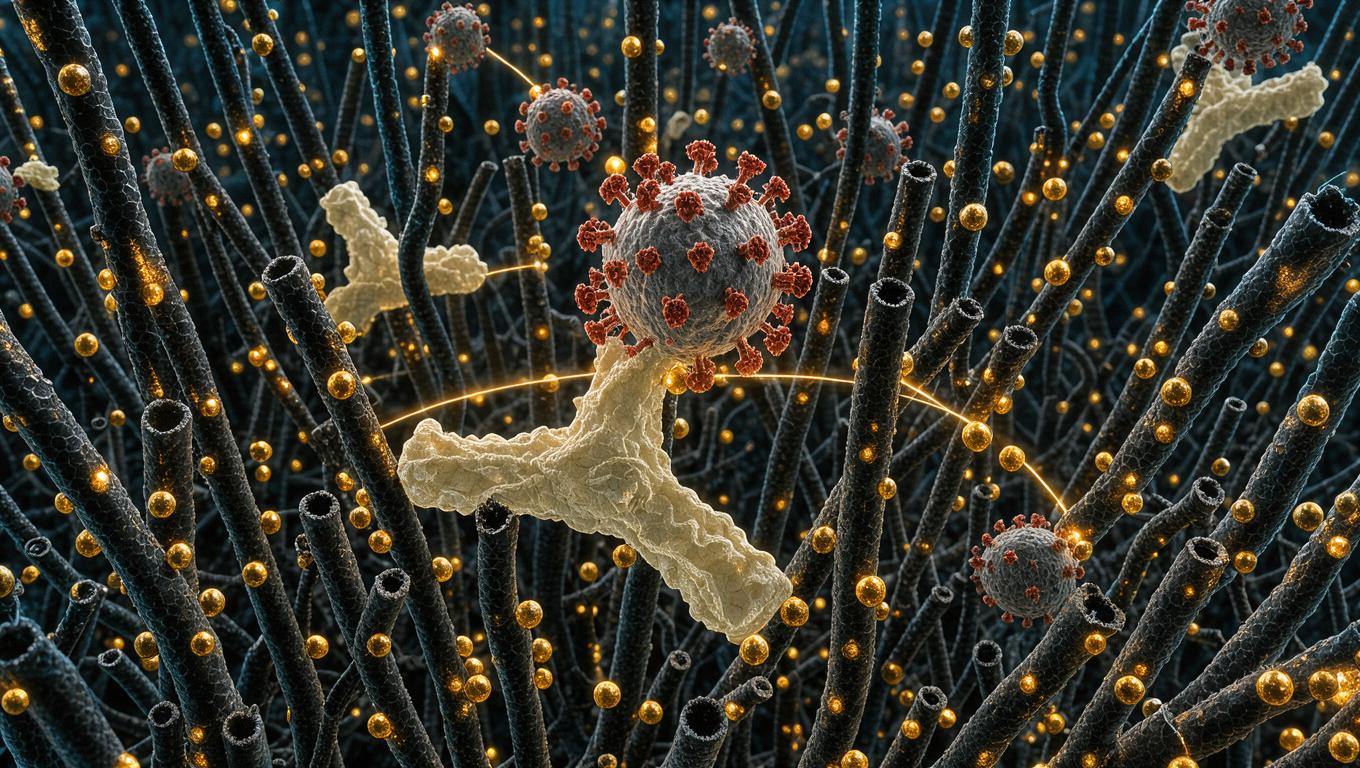
This 2024 review-style paper proposes CNT-FET biosensors coupled with AuNP plasmonic enhancement for rapid viral antigen detection (SARS-CoV-2 S1 at 100 fg/mL), but it blends review content with limited experimental data, lacks LOD/specificity quantification, and was tested only on recombinant proteins rather than clinical samples, making its central claim a plausible-but-unproven proof of concept
Long Explanation
Core Evidence and What It Actually Shows
The paper describes a CNT-FET biosensor where SWCNT channels are functionalized with the pyrene linker PBASE (2 mM; XPS N1s peak at 400.2 eV confirms grafting), coated with anti-SARS-CoV-2 S1 antibodies (1:300 dilution, 12 h at 4 °C on PLL-coated devices, BSA blocking), and exposed to SARS-CoV-2 S1 antigen at 100 fg/mL in 10 mM acetate buffer (pH 6.0), with ≥5 devices per dilution (1:10 to 1:1000) . AuNPs synthesized by citrate reduction (~15 nm, 520 nm LSPR peak, ~2.4 nM) serve as the plasmonic amplification layer .
The Table 1 ranges span four orders of magnitude across targets, but units are mixed (pg/mL vs PFU/mL), making cross-comparison scientifically questionable.
Critical Red Flags
Hybrid review/paper without clear original data: Sections read as narrative review; many results (aMPV titer 1:1024, DENV II E protein, LBL assembly) appear imported from prior work without clear delineation .
Missing quantitative performance: No limit of detection, no dose-response curve values, no signal-to-noise, no negative controls (non-target antigens), no statistical tests, no clinical matrix testing.
Internal inconsistencies: AuNP diameter stated as 15 nm (TEM/extinction) but 19.3–23 nm by SEM after antigen binding — plausibly conjugation, but never reconciled.
Context gap: Comparable CNT-FET work reports rigorous Langmuir modeling and 20 pM thrombin LOD with selectivity controls , and graphene-FET aptasensors report 47 nM IgE Kd , setting a standard this paper does not meet.
Verdict
Reported observations (SEM, XPS, UV-Vis, I-V curves) are internally consistent with an assembled CNT-FET immunosensor, but the plasmonic-enhancement claim — the paper's core novelty — is asserted, not demonstrated: no LSPR shift quantification, no enhancement factor, no AuNP-on vs AuNP-off comparison. The claim remains an unproven hypothesis pending falsification via non-target antigen controls and clinical-sample validation.
Author Reviews
Feedback:
Updated: October 30, 2026
BGPT Paper Review
Study Novelty
40%
CNT-FET + AuNP plasmonic sensing combinations are well established; the paper proposes no new transduction mechanism, material, or architecture beyond combining known elements.
Scientific Quality
30%
No LOD, no statistical analysis, no negative controls, mixed review/experimental content without clear attribution, internal AuNP size inconsistency, and no demonstration of the claimed plasmonic enhancement.
Study Generality
50%
Platform concept generalizes across viral antigens, but shallow treatment limits conceptual advancement beyond existing nanobiosensor reviews.
Study Usefulness
40%
Useful as an entry-point synthesis of carbon nanomaterial FET virus sensing; limited practical value due to absent quantitative benchmarks or validated protocol.
Study Reproducibility
30%
Fabrication steps (citrate AuNP, PBASE functionalization, antibody dilution) are described, but no device yield, no raw I-V data tables, no software, and no data availability statement.
Explanatory Depth
40%
Describes FET operation and LSPR qualitatively but never quantifies the plasmon-CNT coupling mechanism claimed as the core advantage.
We'll email you the results when your analysis is finished.
Hypothesis Graveyard
'LSPR near-fields directly gate CNT channels' — implausible for 15 nm particles spaced tens of nm from the channel; charge transfer and capacitance changes dominate at these length scales.

 Explore by Goal
 Quick Explanation
 Long Explanation
 Top Data Sources
 Ask a Follow-Up
 Key Insight
 Keep Exploring
 Hypothesis Graveyard
 Potential Experiments
 Discussion
