Check a paper's claims against linked experiments, exact results, stated scope, and limitations.Know what falsifiable science actually supports before you trust the answer.
Press Enter ↵ to search evidence
Explore by Goal
"In the fields of observation chance favors only the prepared mind."
- Louis Pasteur
Quick Explanation
Copied
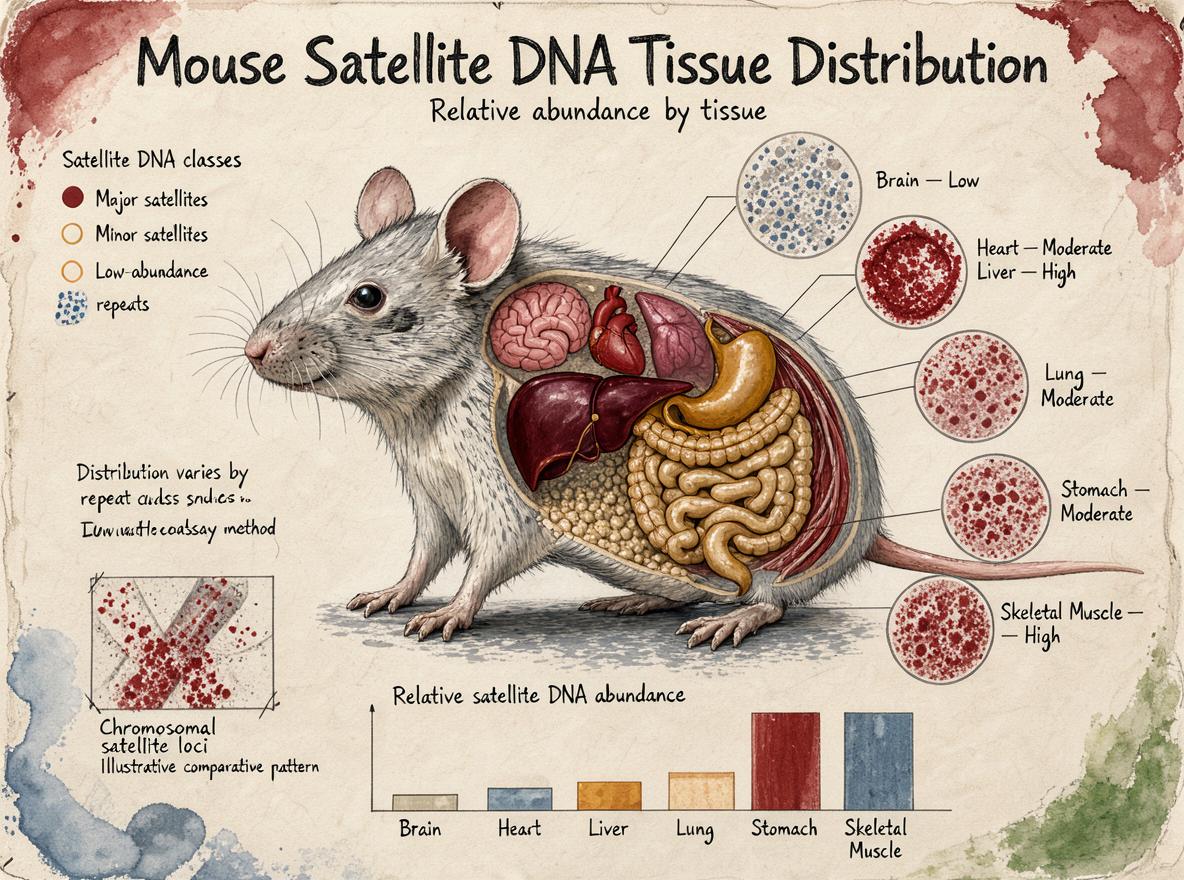
This 1976 study (Prashad & Cutler) developed a high-yield 2.4 M CsCl/chloroform DNA extraction method and reported that satellite DNA stays ~11±1% in spleen/kidney/brain across lifespan but rises ~7–8% to ~12–13% in liver between 350–550 days, coinciding with polyploidization and a ~68% loss of nuclei per gram of liver (Prashad and Cutler 1976 BBA paper).
Long Explanation
Core Findings and Evidence
Prashad & Cutler (1976, Biochimica et Biophysica Acta) discovered that common DNA extraction methods selectively lose satellite DNA, which confounded comparative genomics. Four homogenization buffers gave satellite DNA values ranging from 4–9% on the same liver tissue, with DNA yields of only 18–30% (Buffer-dependent satellite DNA loss Table II). Their solution—a 2.4 M CsCl centrifugation of proteolyzed chromatin lysate plus chloroform cleanup—gave 88–97% DNA yield and eliminated the selective loss.
The key biological result: liver satellite DNA stays ~7–8% until ~320 days, then jumps to ~12–13% by 455 days—coincident with a 3-fold increase in DNA per nucleus (tetra/octaploid cell formation) and a 68% loss of nuclei per gram of liver from 60 to 785 days, while total DNA per gram stays constant (Polyploidization correlates with satellite DNA rise Table X). Shearing (Table VII) and young-old tissue mixing (Table VIII) ruled out mechanical breakage and nuclease artifacts.
Methodological Control Experiments
Shearing DNA by 15 needle passes (≈40% MW reduction) changed satellite DNA by only 1–2%, and mixing 60-day with 550-day liver gave the arithmetic average (10.5%), excluding differential nuclease degradation—sound negative controls for the era.
Critical Assessment
Strengths: novel high-yield method, multiple control experiments, reproducibility (split-liver experiments), and a mechanistically interesting polyploidy-satellite correlation. Weaknesses: single inbred strain, females only; accuracy stated as ±10% with sample sizes of 1–10 mice per age; no statistical testing reported; and the causal mechanism linking polyploidization to satellite DNA enrichment remains only speculative (preferential satellite replication, non-uniform chromosome distribution, aneuploidy). Later work confirmed satellite chromatin condensation changes with age in rat liver, though via different methods (Age-related rat satellite chromatin condensation). The transition at 350–550 days has substantial scatter in Table IX (e.g., 9.0% at 385 days vs 13.0% at 455 days), so the apparent sharpness may partly reflect sampling variance.
Feedback:
Updated: November 24, 2026
BGPT Paper Review
Study Novelty
70%
For 1976, revealing that extraction methods systematically bias satellite DNA quantification and linking liver satellite DNA to polyploidization was highly original; modern repeats research builds on these foundations.
Scientific Quality
70%
Careful controls (shearing, mixing, split-liver replication) and calibration of two detection systems, but no statistical tests, small sample sizes, and a single sex/strain reduce rigor by modern standards.
Study Generality
60%
Findings generalize conceptually (extraction bias affects any comparative DNA study) but the specific age/polyploidy observation is mouse liver-specific.
Study Usefulness
70%
The extraction method was immediately useful and the extraction-bias warning remains relevant; the polyploidy-satellite link stimulates modern centromere research.
Study Reproducibility
80%
Fully detailed protocol (available on request), specific buffer compositions, centrifugation conditions, and calculation methods are given; values reproducible within stated 10% accuracy.
Explanatory Depth
70%
Multiple alternative mechanisms were tested and eliminated; however, the causal link between polyploidization and satellite enrichment remains correlational with four speculative mechanisms untested.
Analyzing Table VI and Table X quantitative data to fit logistic transition models for liver satellite DNA increase and test correlation between DNA-per-nucleus and satellite percentage across ages 10-780 days.
Get emailed when your analysis is done!
We'll email you the results when your analysis is finished.
Hypothesis Graveyard
Nuclease-mediated selective satellite release during aging: rejected by the young-old mixing experiment showing additive values, though the authors' rejection logic assumes nucleases act identically in mixed vs single-age tissue.
Shear-induced satellite release from main-band linkage: rejected because ~40% MW reduction did not raise young-liver satellite DNA from 7% to 12%.
Science Art
Science Movie
Make a narrated HD Science movie for this answer ($64 per minute)

 Explore by Goal
 Quick Explanation
 Long Explanation
 Top Data Sources
 Ask a Follow-Up
 Key Insight
 Keep Exploring
 Analysis
 Hypothesis Graveyard
 Discussion
