Analyze how experimental results and claims are presented, scoped, and limited in a paper.Know what the science actually supports before you trust the answer.
Press Enter ↵ to analyze
Explore by Goal
"The universe is not only queerer than we suppose, but queerer than we can suppose."
- J.B.S. Haldane
Quick Explanation
Copied
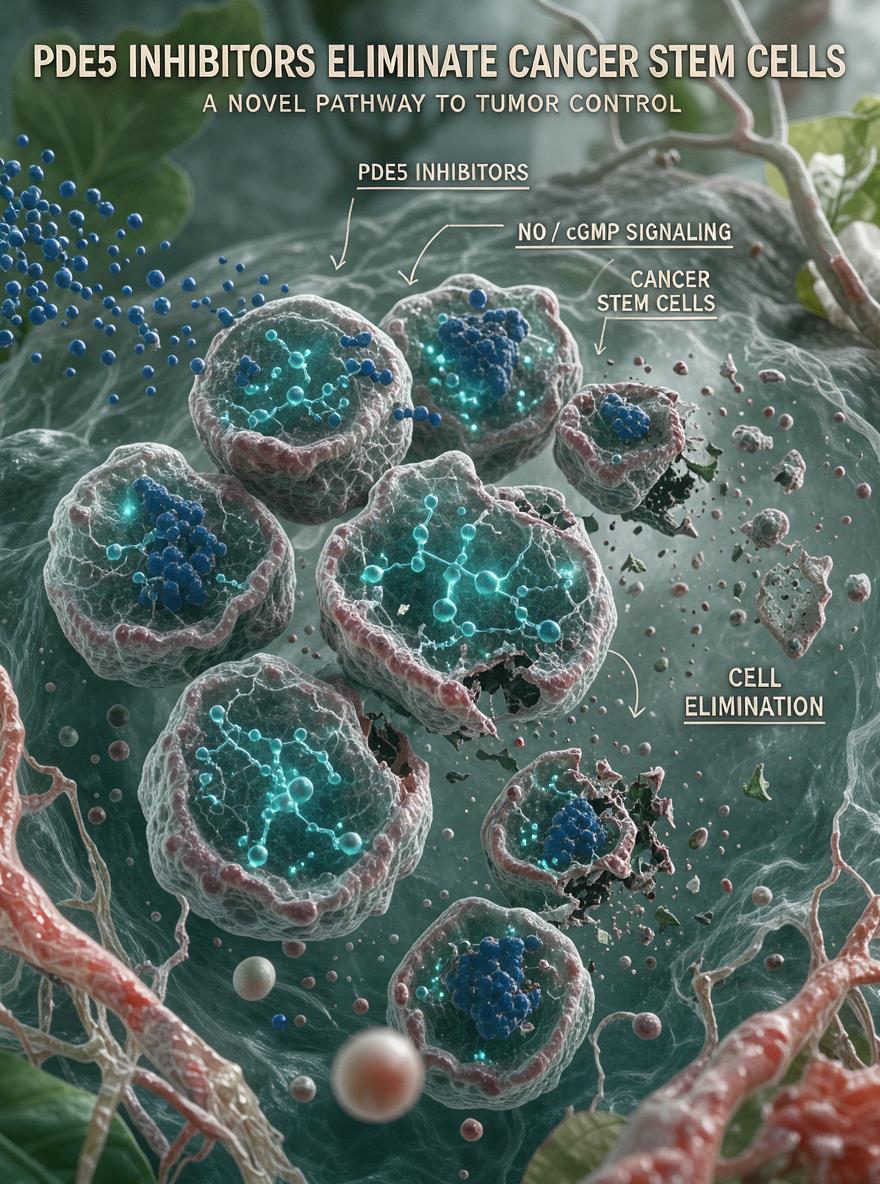
This Bayer-funded in vitro study (Cell Death & Disease, 2018) establishes a high-content Aldefluor screen and reports that PDE5 inhibition (MY5445, sildenafil, vardenafil) eliminates ALDH-high cancer stem cells via a non-canonical cGMP→cAMP→PKA axis, while Wnt inhibition served as assay validation; findings are limited to cell-line models, with 5 of 10 screening hits excluded as ALDH-inhibition false positives, and the cGMP-to-PKA mechanistic link remains unresolved .
Long Explanation
Core Findings and Evidence Quality
All authors are Bayer AG (Berlin) employees, funded by Bayer AG; no conflicts declared. Using a 384-well high-content Aldefluor assay (robust Z′ = 0.35), they screened 1,108 bioactive/FDA-approved compounds in SUM149 breast cancer cells, with DEAB controls and a 6-SD intensity cutoff. Ten hits reduced ALDH-high cells; five were excluded as false positives that directly inhibited ALDH within 2 h and washed out reversibly . Critical self-correction: the authors demonstrate ALDH activity itself is dispensable for CSC maintenance (DEAB fails to reduce tumorsphere formation), so the screen marker is a readout, not a target.
Validation includes: ALDH-high sorted cells showing greater tumorsphere formation and radiation resistance; Wnt inhibition (LGK-974, IWR-1, WIKI4) plus siRNA confirming Wnt dependence; three PDE5 inhibitors and PDE5A siRNA reducing ALDH-high cells and tumorsphere formation; 8-pCPT-cGMP mimicking the effect; PKG inhibition (KT5823) phenocopying rather than reversing it; and PKA inhibition (H-89) rescuing CSC loss . Notably, MY5445 reduced ALDH-high cells (~90% at IC50 3.76 µM) but TFC reduction data show inconsistencies with the abstract's claims of parallel CSC elimination for other hits.
Bars report Table 1 IC50 values; labels show TFC reduction at 10 µM (n ≥ 3, SD). SB 203580 TFC label corresponds to its −24.2% (p<0.05) value.
Critical Limitations and Blind Spots
Mechanistic gap: The cGMP→cAMP→PKA link is inferred, not demonstrated; PDE1/PDE3 inhibitors failed to replicate PDE5 effects, and direct cAMP measurement or CREB phosphorylation data are absent. H-89 has known off-targets beyond PKA.
Model dependence: Nearly all mechanistic work is in SUM149; ALDH as a CSC marker is not universal (the authors cite prostate ALDH counterexamples). Only single-line validation in HCT116 and H358.
No in vivo or patient-derived data: The authors themselves acknowledge that 2D cell lines are limited CSC models and fresh patient cells or animal models are required .
Translation context: Independent in vitro work shows sildenafil potentiates chemotherapy in pediatric CNS tumor cells via a distinct NO/cGMP mechanism, supporting broader PDE5-inhibitor anticancer plausibility but also revealing that mechanisms differ by tumor type , while clinical safety concerns (e.g., melanoma-risk debate) remain unresolved.
What would falsify the central claim: failure of PDE5A knockout (not just siRNA) to reduce ALDH-high cells in multiple lines; demonstration that H-89 rescues via off-target effects; absence of CSC loss with direct cAMP/PKA activation in patient-derived organoids.
Feedback:
Updated: November 01, 2026
BGPT Paper Review
Study Novelty
80%
First small-molecule screen for CSC maintenance using high-content single-cell Aldefluor analysis; the cGMP→cAMP→PKA (non-PKG) mechanism for PDE5 in CSCs was novel, though PDE5's role in prostate CSCs was already published (Liu et al. 2016).
Scientific Quality
70%
Rigorous assay controls (DEAB, Z′ factor, false-positive triage, siRNA concordance, wash-out experiments) but pure in vitro, single dominant cell line, pharmacology with known off-target inhibitors (H-89, KT5823), and no cAMP level measurements. Industry funding with all authors employed by Bayer AG; declared no conflict of interest, which is hard to fully disentangle from sponsor interest in PDE5 assets.
Study Generality
70%
Validation across breast, colon, and lung lines suggests broad CSC relevance, but the ALDH-high marker is tumor-type dependent and the mechanism was tested almost entirely in one line.
Study Usefulness
80%
Repurposing clinically approved PDE5 inhibitors (sildenafil, vardenafil) is immediately actionable; the assay methodology and false-positive filtering approach are transferable to other CSC drug screens.
Study Reproducibility
70%
Detailed methods, IC50s with SDs, n ≥ 3, and supplementary tables provided; however, exact cell passages, raw data depositions, and full siRNA sequences (partially garbled in the published SI) limit independent replication.
Explanatory Depth
70%
Good pharmacological epistasis logic (cGMP analog, PKG inhibitor, PKA rescue), but the key mechanistic bridge (which PDE mediates cAMP accumulation) remains explicitly unresolved; no direct second-messenger quantification.
We'll email you the results when your analysis is finished.
Hypothesis Graveyard
PKG-dependent maintenance of CSCs (Liu et al. prostate model): contradicted here — KT5823 reduced rather than rescued ALDH-high cells in SUM149, showing tissue-type divergence in cGMP signaling downstream of PDE5.
ALDH inhibition as CSC therapy: falsified in this model — DEAB only masked the Aldefluor signal without affecting tumorsphere formation or causing lasting CSC depletion.

 Explore by Goal
 Quick Explanation
 Long Explanation
 Top Data Sources
 Ask a Follow-Up
 Key Insight
 Keep Exploring
 Hypothesis Graveyard
 Potential Experiments
 Discussion
