Analyze how experimental results and claims are presented, scoped, and limited in a paper.Know what the science actually supports before you trust the answer.
Press Enter ↵ to analyze
Explore by Goal
"Biology is the study of complicated things that have the appearance of having been designed with a purpose."
- Richard Dawkins
Quick Explanation
Copied
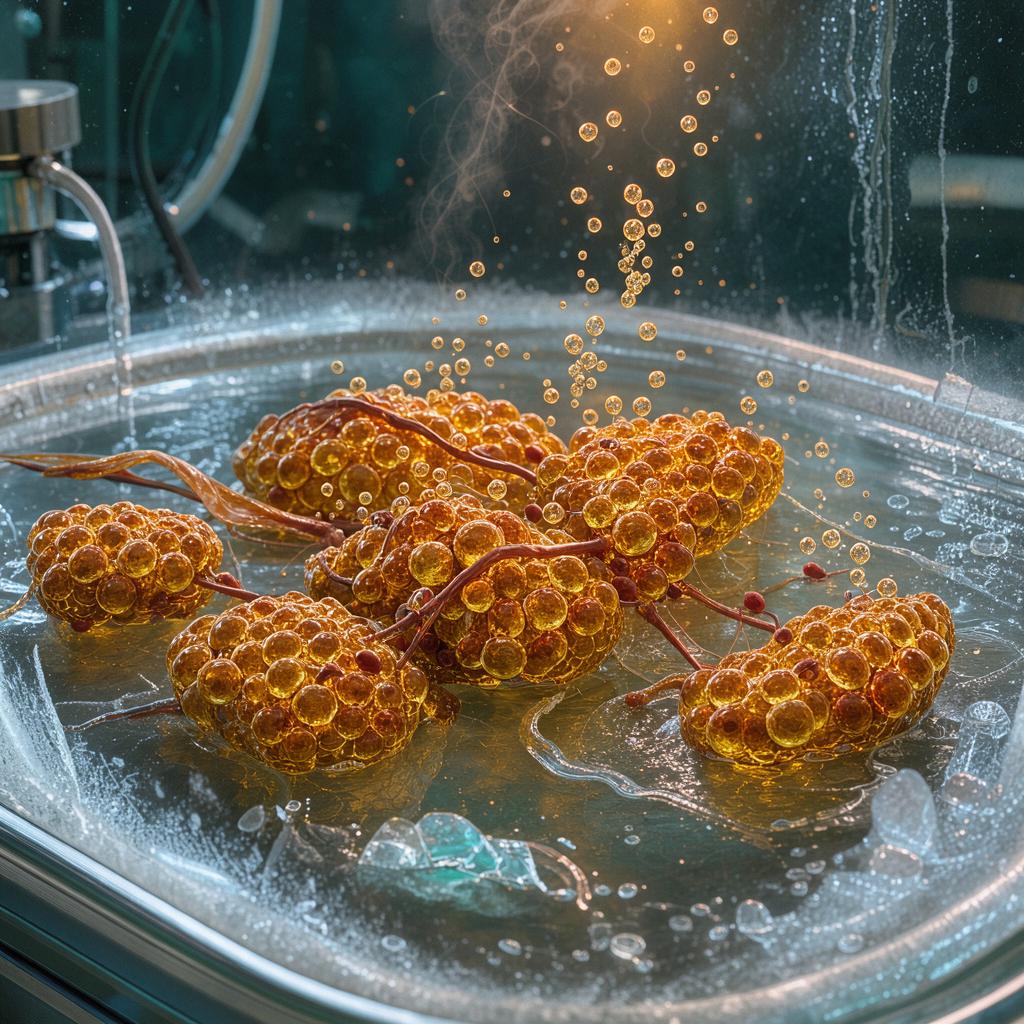
Human islets cultured 2 weeks at 12°C in 50% O₂ retained ~92% of day-0 volume and matched noncultured islets in viability, glucose-stimulated insulin secretion, and diabetes reversal in NOD-SCID mice (75% both groups), a result validated in CMRL 1066 medium
Long Explanation
Evidence Behind the 12°C–50% O₂ Strategy
The paper's logic chain is internally consistent: at 4°C, islets swelled ~20% in 48 h and lost intracellular K⁺ (<50% of 37°C levels), while 12°C and 22°C preserved K⁺ (>80%), establishing 12°C as the lowest temperature compatible with ion-homeostasis in extracellular-type media . Finite-element simulation (COMSOL, Michaelis-Menten O₂ uptake) then showed 12°C-50% O₂ yields near-uniform intra-islet O₂ even in 400 µm islets, whereas 22°C-37°C retain gradients. Empirically, 2-week volume retention was 91.7% (12°C-50% O₂) vs 85% (22°C-50% O₂, p<0.05) in PIM-R, replicated at 89.1% in CMRL 1066.
Function equivalence was adequately powered for a non-inferiority-style claim within mouse limits: 16 PIM-R transplantations (8 control, 8 long-term; 7 isolations) gave identical 75.0% (6/8) reversal rates; 19 CMRL transplantations gave 80.0% vs 77.8% (log-rank p=0.860). In vitro viability (n=5 donors) and stimulation index (n=6 isolations) showed no significant differences. Histology found no significant differences in insulin-, glucagon-, or vWF-positive areas .
Blindspots and Unverified Leaps
Hidden assumption: islets received ≥overnight 37°C recovery before experiments, removing most active acinar cells — the authors acknowledge freshly isolated, low-purity fractions may behave differently, so the optimum could shift for direct-from-isolation culture. Simulation-dependence: the central mechanistic claim (uniform core oxygenation) rests on modeled O₂ gradients parameterized from OCR/DO measurements, not direct intra-islet O₂ sensing (islets are too small); the simulation inputs (diffusivity, Kₘ) were borrowed from prior literature, so model error propagates uncritically into conclusions. Small reversal numbers: 8-10 mice per arm gives wide confidence intervals on 75-80% rates; equivalence claims are underpowered — a true 15-20% functional penalty would likely go undetected. Batch heterogeneity: 20 isolations across many comparisons; no correction for multiple comparisons is described. Species extrapolation: NOD-SCID kidney-capsule engraftment is a favorable site and immunodeficient; results do not address allogeneic inflammatory contexts. Related work supports the thermal-benefit direction: isolation-side cooling (17°C vs 25°C) raised viability from 70% to 83% and stimulation index from 1.7 to 11.4 , and oxygen-tension sensitivity is a general feature of cultured tissues (e.g., follicle culture favors 3-5% over 21% O₂) . Note also the paper frames itself as "culture," not "storage/preservation," a fair distinction given extracellular media throughout.
What would falsify: independent replication showing volume loss or reversal-rate penalty at 12°C-50% O₂, or demonstration that rewarming (8 h at 22°C → 16 h at 37°C) damages islets relative to continuous 37°C handling in clinical workflows. Overall verdict: a careful, mechanistically grounded methods advance with modest but honest evidence; the equivalence claims are plausible but statistically fragile.
Feedback:
Updated: November 02, 2026
BGPT Paper Review
Study Novelty
60%
Combines known hyperoxia (prior work by same group) with a specific optimal hypothermic temperature (12°C), plus oxygen-diffusion simulation — incremental but practically novel protocol optimization.
Scientific Quality
70%
Systematic factorial design, both-media validation, in vivo controls. Weaknesses: small transplant n (8-10/arm), simulation-dependent mechanism, no multiplicity correction, self-citation-heavy lineage.
Study Generality
70%
Principles (suppress metabolism + raise supply) generalize to other fragile 3D tissue cultures, though validated only for human islets in two media.
Study Usefulness
90%
Directly actionable for islet banking, pooling low-yield isolations, and delayed transplantation; uses standard media and equipment (sealed chambers).
Study Reproducibility
80%
Detailed conditions (temperatures, O2%, media, rewarming ramp, IEQ loads, statistical tests) with multiple isolations; COMSOL parameters inherited from cited literature.
Explanatory Depth
70%
Mechanism framed via OCR/DO measurement + FEM oxygen modeling and K+/Na-K-ATPase reasoning; but core oxygenation is inferred, not directly measured.
We'll email you the results when your analysis is finished.
Hypothesis Graveyard
Cryopreservation as the practical islet-banking route: rejected here by 40-60% post-thaw recovery and delayed reversal function, which hypothermic hyperoxic culture avoids without intracellular-like media shock.
4°C intracellular-like storage superiority: prior 48h UW results (95% volume) looked better, but rewarming into standard media collapsed volume — continuity of extracellular environment beats transient cold benefit.

 Explore by Goal
 Quick Explanation
 Long Explanation
 Top Data Sources
 Ask a Follow-Up
 Key Insight
 Keep Exploring
 Hypothesis Graveyard
 Potential Experiments
 Discussion
