Check whether claims match experiments, exact reported results, and stated limitations.Know what the science actually supports before you trust the answer.
Press Enter ↵ to review paper
Explore by Goal
"Science is not only a disciple of reason but, also, one of romance and passion."
- Stephen Hawking
Quick Explanation
Copied
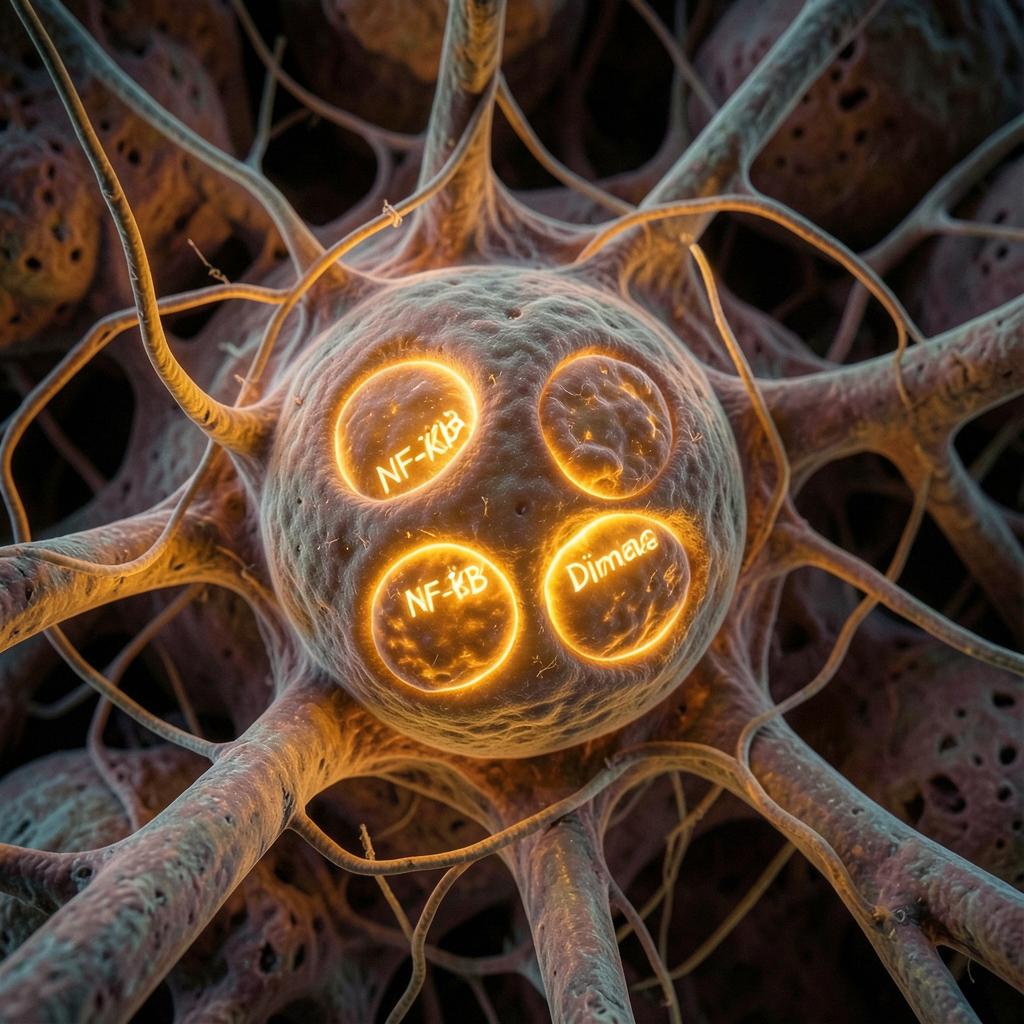
This 2016 Seminars in Cancer Biology review by Matthews et al. is a well-sourced, critical synthesis arguing that NF-κB dysregulation in multiple myeloma arises from both cell-autonomous genetic lesions (~20% of patients, ~40% of cell lines) and microenvironment-driven activation, and that proteasome inhibitors—now a cornerstone of MM therapy—act only partially through NF-κB blockade .
Long Explanation
Core thesis. Matthews et al. (Dana-Farber/Harvard) synthesize ~3 decades of NF-κB research in multiple myeloma (MM), arguing that the pathway's importance was first established functionally (stromal IL-6 regulation, 1996 data), then genomically (recurrent lesions in regulators, not NF-κB subunits), and finally therapeutically via proteasome inhibitors .
The review's most quantitatively grounded claim is that ≥20% of MM patients and ~40% of cell lines harbor at least one lesion (e.g., TRAF3, cIAP1/2, TRAF2, CYLD loss; CD40, LTβR, TACI, NIK gain) conferring constitutive NF-κB activation .
Key critical points
Honest mechanistic hedging. The review explicitly argues NF-κB inhibition is unlikely to fully explain proteasome-inhibitor efficacy—citing the 'proteasome load vs. capacity' model and the narrow clinical spectrum (MM, amyloidosis, Waldenström's, MCL)—a refreshing counterpoint to oversimplified NF-κB-centric narratives .
Cell-autonomous vs. non-autonomous are not mutually exclusive. Stroma co-culture raises NF-κB target gene expression even in genetically activated lines—genetic and microenvironmental activation cooperate .
Corroborating downstream biology. Independent work confirms NIK as a druggable node: mangiferin suppresses NIK/IKK phosphorylation, downregulates XIAP/survivin/Bcl-xL, and kills IM9 cells concentration-dependently (e.g., day-5 viability 9.4% at 50 mg/mL) .
Consistency with the broader literature. The caveats mirror those of a prior Nature Reviews Drug Discovery analysis: immunosuppression risk, paradoxical NF-κB activation (e.g., late bortezomib 'rebound', IAP-antagonist effects), and the need for biomarker-guided, transient inhibition .
Limitations and blind spots
As a narrative review, no new data; frequencies quoted (≥20% patients, ~40% lines) come from 2007-era studies of modest cohorts (62-451 samples), and cell-line frequencies may overstate patient prevalence due to adaptation artifacts .
The correlative author (CSM) discloses extensive industry ties (Millennium/Takeda, Celgene, Novartis, BMS, Merck, Amgen, J&J), relevant given the paper's favorable framing of proteasome inhibitors—though the review itself does foreground non-NF-κB mechanisms, tempering this concern.
The 'proteasome load vs. capacity' model is acknowledged by the authors as insufficient for MCL and hyposecretory MM cases—leaving the true mechanism of MM-selective sensitivity unresolved.
What would change the conclusions: definitive proteasome-inhibitor activity in NF-κB-independent tumors with heavy secretory load, or failure of NIK/TRAF3-stratified trials to show biomarker-response correlation.
Confidence note: moderate-high; the review's claims are well-aligned with primary literature it cites, but quantitative prevalence figures inherit the uncertainty of the original 2007 genomic studies.
Feedback:
Updated: October 25, 2026
BGPT Paper Review
Study Novelty
60%
A 2016 synthesis of pre-existing 2007-2014 findings; the cooperative genetic-plus-stromal activation framing and proteasome load-capacity critique add moderate conceptual value but no new data.
Scientific Quality
80%
Well-referenced (143 citations), critical, and mechanistically nuanced; weak points include reliance on modest 2007 cohorts, absence of new data, and heavy relevant industry COI of the corresponding author (disclosed).
Study Generality
60%
Focuses on one disease, but the genetic-vs-microenvironmental activation duality and proteasome biology principles generalize to other plasma-cell and lymphoid neoplasias.
Study Usefulness
70%
Useful roadmap for biomarker-guided NIK/IKK-targeted trials and for understanding proteasome-inhibitor selectivity; limited direct clinical actionability since the hypotheses it poses remain untested.
Study Reproducibility
40%
Review articles are not directly reproducible; quoted frequencies derive from traceable primary studies, but no data or code are deposited.
Explanatory Depth
70%
Mechanistically rich (TRAF3-cIAP-NIK axis, p100/p52 processing, HDAC4-RelB-p52 repression), though it openly admits unresolved questions about proteasome-inhibitor selectivity and late NF-κB rebound.
Re-analyzing published multiple myeloma genomic cohorts to quantify and visualize NF-κB pathway lesion frequencies (TRAF3, NIK, CYLD, cIAP1/2) and correlate them with NF-κB target-gene expression signatures.
Get emailed when your analysis is done!
We'll email you the results when your analysis is finished.
Hypothesis Graveyard
NF-κB blockade alone explains proteasome-inhibitor efficacy in MM: undermined by IKK inhibitors' modest/slower effects, the drug class's narrow clinical spectrum despite ubiquitous NF-κB dependence, and preserved activity in hyposecretory MM.
NF-κB activation in MM is purely microenvironmental: refuted by recurrent genetic lesions in pathway regulators found in both patient samples and cell lines.

 Explore by Goal
 Quick Explanation
 Long Explanation
 Top Data Sources
 Ask a Follow-Up
 Key Insight
 Keep Exploring
 Analysis
 Hypothesis Graveyard
 Potential Experiments
 Discussion
