Check whether claims match experiments, exact reported results, and stated limitations.Know what the science actually supports before you trust the answer.
Press Enter ↵ to review paper
Explore by Goal
"Biology is a science of three dimensions. The first is the study of each species across all levels of biological organization, molecule to cell to organism to population to ecosystem. The second dimension is the diversity of all species in the biosphere. The third dimension is the history of each species in turn, comprising both its genetic evolution and the environmental change that drove the evolution."
- E. O. Wilson
Quick Explanation
Copied
The cascade-forest framework CFF-AT outperforms DNN baselines on the 122,594-sample, 59-endpoint multi-species acute toxicity dataset (R²=0.61 single-view Avalon, 0.64 with multi-view consensus), with ablations attributing the largest gain (+0.13 R²) to feature enhancement via cascade-layer transfer .
Long Explanation
What the paper reports
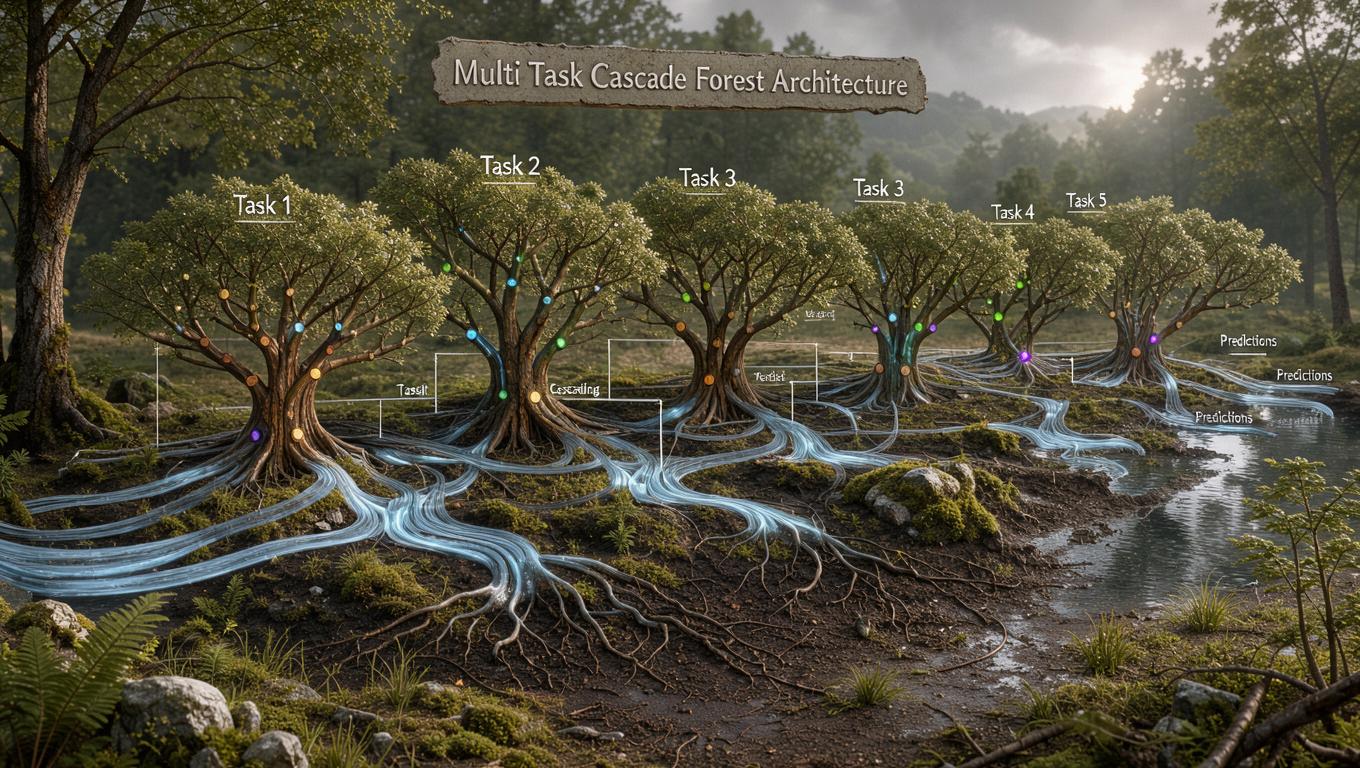
CFF-AT aggregates training data from all 59 toxicity endpoints (122,594 measurements, 80,081 compounds, 15 species, endpoint sizes 102–36,295) into a source-domain cascade forest, then enhances each endpoint's features via layer-1 transfer and greedily selects neighbor endpoints using covariance distance for sample transfer .
The authors note CFF-AT uses only Avalon single-view data yet beats ConsenB (R² 0.61 vs 0.57), which integrates multiple DNNs with multi-view inputs; Friedman/Nemenyi tests show significant ranking differences vs all algorithms except ConsenB .
External validation shows transfer gains that scale with species relatedness: rat R² 0.65→0.83 (+0.18), Tetrahymena 0.71→0.74, aquatic multi-species 0.56→0.60 .
Critical assessment
Strengths: honest framing of why DNNs underperform on sparse small-sample tabular data, with supporting citations; ablations isolate each component; adaptive layer count adds no hyperparameters; code and data (TOXRIC, GitHub) are public, supporting reproducibility.
Blind spots and caveats: (1) Greedy neighbor selection risks local optima and may miss distant-but-relevant endpoints, which the authors themselves acknowledge, alongside suggesting Shapley-based or tree-embedding enhancement vectors as improvements . (2) All external validation datasets use Avalon-type 1024D Boolean features, so claimed generalization is tested only within a familiar feature space. (3) The 12% improvement claim refers to the multi-view consensus (R² 0.64 vs 0.57), not the headline single-view result. (4) Human TDLo endpoints have only ~140–163 samples each, so species-association interpretations (e.g., human–bird similarity) rest on very sparse data. (5) Per-endpoint variance and confidence intervals are relegated to supplementary materials rather than the main text.
Falsifiability: the framework would be undermined if feature/sample enhancements were removed without performance loss, or if it failed on non-Avalon feature spaces or entirely new administration modes; the authors' own multi-view table shows ChemBERTa raw features yield R² only 0.06, indicating fragility outside the top fingerprint types.
Verdict: a well-executed, statistically supported methodological contribution for tabular multi-task toxicology, with meaningful but feature-space-dependent generalization claims. Confidence: moderate-high for the reported benchmarks; lower for cross-species interpretive claims.
Feedback:
Updated: October 27, 2026
BGPT Paper Review
Study Novelty
70%
Applying cascade forests with feature-, parameter-, and sample-based transfer to multi-species acute toxicity is a novel combination in this domain, though each component (deep forest, transfer learning, greedy task selection) is established; the synthesis and domain-specific covariance-distance task relation are the new contributions.
Scientific Quality
70%
Strong benchmarking with 7 baselines, Friedman/Nemenyi tests, ablations, and external validation; but gains partly depend on Avalon fingerprint choice, per-endpoint variance reporting is deferred to supplements, and the 12% improvement headline conflates single-view and multi-view results.
Study Generality
70%
The framework is generic for small-to-medium tabular multi-task problems beyond toxicology, though validation is confined to acute toxicity datasets sharing Avalon-like representations.
Study Usefulness
80%
Reduces reliance on animal testing with an interpretable, hyperparameter-light model; public code/data enable practical adoption in computational toxicology and chemical safety screening.
Study Reproducibility
80%
Data on TOXRIC, code on GitHub, default hyperparameters, and described algorithms support reproduction; only supplementary details (full per-endpoint tables, configs) reside outside the main text.
Explanatory Depth
70%
Mechanistic explanation of why tree ensembles beat DNNs on sparse tabular data is well-cited; feature-importance species associations are suggestive but under-quantified statistically.
We'll email you the results when your analysis is finished.
Hypothesis Graveyard
DNN multi-task models are inherently superior for toxicity prediction — falsified here and consistent with broader evidence that tree ensembles dominate small-sample tabular learning.

 Explore by Goal
 Quick Explanation
 Long Explanation
 Top Data Sources
 Ask a Follow-Up
 Key Insight
 Keep Exploring
 Hypothesis Graveyard
 Potential Experiments
 Discussion
