Check a paper's claims against linked experiments, exact results, stated scope, and limitations.Know what falsifiable science actually supports before you trust the answer.
Press Enter ↵ to search evidence
Explore by Goal
"The saddest aspect of life right now is that science gathers knowledge faster than society gathers wisdom."
- Isaac Asimov
Long Explanation
Copied
What the paper claims
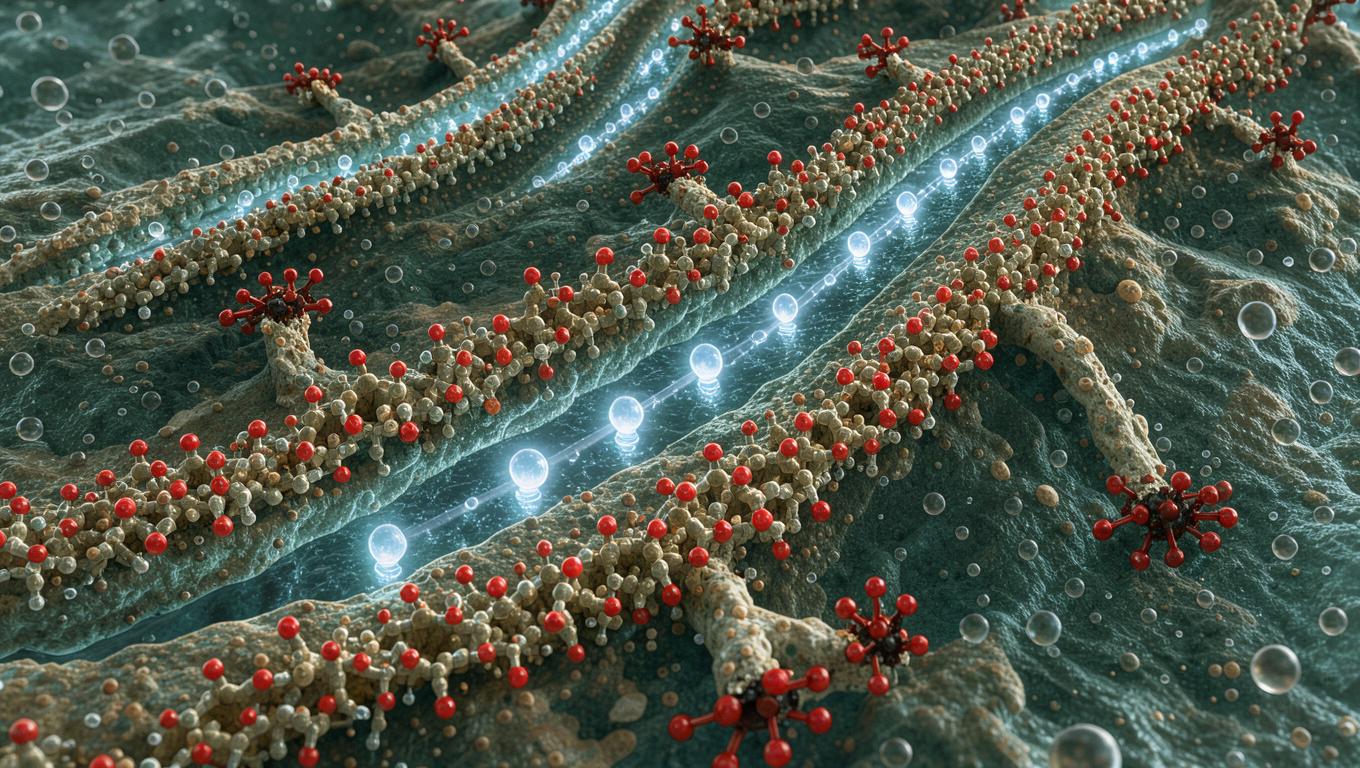
López-Chávez, Solorza-Guzmán and De Landa Castillo-Alvarado built an MD simulation (COMPASS force field, 298 K, 50×50×60 Å cell, ~1,834 atoms: 984 H, 288 C, 48 N, 490 O, 24 S) of two 12-mer protonated chitosan chains, 200 waters, one hydronium, one hydroxide and 12 sulfate ions, and computed conductivity via the Einstein relation over just ~42 ps . They report σ ≈ 2×10⁻² S cm⁻¹, qualitatively matching experimental chitosan conductivities of ~10⁻⁴–1.4×10⁻³ S cm⁻¹ from Wan et al. and PEO-sulfonate simulations reaching 2.6×10⁻² S cm⁻¹ (same source). The mechanistic finding — sulfates anchored on protonated amine groups shepherd hydronium/hydroxide motion — agrees with Wan et al.'s experimental attribution of conduction to free amine groups.
Caution: the simulated value (2×10⁻²) is ~100–200× above the experimental chitosan membrane values the authors themselves cite; they frame the comparison as "of the same order" only versus a different polymer (PEO) simulation. The error bar of 0.02 S cm⁻¹ is comparable to the value itself, and a 42 ps trajectory cannot sample diffusive regimes needed for reliable Einstein-relation conductivity — statistics require far longer runs and multiple ions/trajectories.
Key weaknesses and blind spots
Single hydronium and single hydroxide ion: conductivity from one charge carrier pair is statistically meaningless; no error analysis beyond a stated ~0.02 S cm⁻¹.
System density 0.1520 g/cm³ is drastically below realistic hydrated chitosan (~1+ g/cm³), an unexplained red flag suggesting an under-packed cell.
Fixed-charge COMPASS cannot capture Grotthuss proton hopping, the dominant proton-conduction mechanism in hydrated acidic membranes; modern MD work on chitosan films shows force-field Coulombic artifacts can even invert transport trends with humidity .
No convergence tests, no comparison at multiple hydrations/temperatures, no validation against the same material experimentally.
Limited generality: results reflect one arbitrarily chosen cell; reproducibility is low given deprecated software (MSI Amorphous Builder) and unspecified equilibration details.
Verdict and what would change it
A pioneering but statistically fragile 2006 proof-of-concept. The mechanistic insight (amine-anchored sulfates mediating carrier mobility) is plausible and experimentally corroborated, but the headline conductivity number should be treated as an order-of-magnitude artifact. Longer trajectories, many ions, physically realistic densities, and polarizable/reactive force fields (as the 2016 follow-up literature demonstrates) would be needed to confirm or refute the quantitative claims . Confidence: low-moderate — the qualitative mechanism is defensible; the quantitative conductivity is not.
Feedback:
Updated: November 23, 2026
BGPT Paper Review
Study Novelty
70%
Among the first theoretical MD treatments of chitosan membrane ionic conductivity (2006), when the authors state no prior theoretical work existed; incremental rather than groundbreaking.
Scientific Quality
40%
Single-ion statistics, 42 ps trajectory, unphysical density (0.152 g/cm³), error bar equal to the reported value, and no convergence or validation testing severely undermine the quantitative claims despite a plausible qualitative mechanism.
Study Generality
40%
Authors aspire to a general methodology for polymer electrolytes, but results derive from one small, arbitrary cell of one polymer system; conclusions barely generalize beyond chitosan/sulfate systems.
Study Usefulness
50%
Useful as a historical first step and mechanistic hypothesis (amine-anchored sulfates guide carriers), matching Wan et al.'s experiments; the quantitative conductivity value is not actionable.
Study Reproducibility
30%
Deprecated proprietary software (MSI Amorphous Builder), unspecified equilibration, no data/code availability, and a single-run protocol make independent replication very difficult.
Explanatory Depth
50%
Provides a narrated, snapshot-based mechanistic story (ion-dipole vs ion-ion interactions over picoseconds) but lacks rigorous transport theory, diffusion coefficients, or radial distribution analyses.
We'll email you the results when your analysis is finished.
Hypothesis Graveyard
Conductivity scales simply and linearly with water content in chitosan — later MD (2016 chitosan/chitin films) shows solubility trends can invert with humidity due to Coulombic artifacts, so simple linear hydration scaling is too naive.
OH⁻ is the sole charge carrier as early experiments assumed — the simulation shows hydronium and sulfate also participate, and the authors' own cited derivative-membrane data imply multi-carrier conduction.

 Explore by Goal
 Long Explanation

 Top Data Sources
 Ask a Follow-Up
 Key Insight
 Keep Exploring
 Hypothesis Graveyard
 Potential Experiments
 Discussion
