Analyze how experimental results and claims are presented, scoped, and limited in a paper.Know what the science actually supports before you trust the answer.
Press Enter ↵ to analyze
Explore by Goal
"If you thought that science was certain - well, that is just an error on your part."
- Richard Feynman
Quick Explanation
Copied
This surgical case series (n=8) demonstrates that standing transposition of the equine common carotid artery is technically feasible, with 6/8 horses successfully used for 10 weeks of repeated catheterization, but 25% of horses suffered artery-compromising complications and 2/6 endoscoped horses developed right laryngeal hemiplegia ().
Long Explanation
Study Design and Reported Outcomes
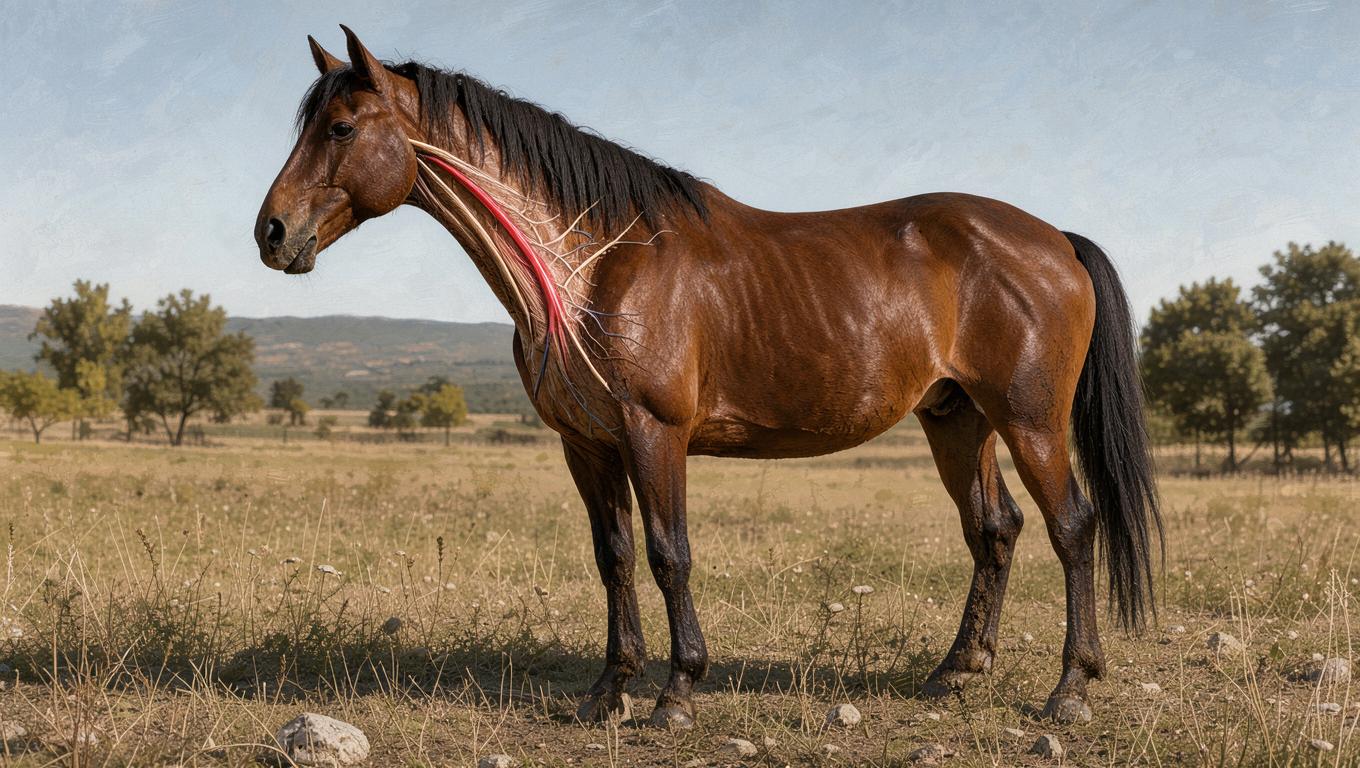
Tapio and colleagues (University of Helsinki) describe a modified technique for permanent subcutaneous relocation of the right common carotid artery (CCA) in eight standing horses, combining a linear skin incision, blunt splitting of the brachiocephalicus and omohyoideus muscles, elevation with Penrose drains, and two-layer muscle closure without polyethylene tubing or suction drains (). All surgeries were completed without intraoperative complications. Six horses were subsequently catheterized weekly (20G cannula, ≤3 h per session) for 10 weeks with no catheterization-related complications; the artery was usable from 3 weeks postoperatively ().
*Denominator is 6, as endoscopy was performed in only 6 horses at 3 months. Data from the Results section of the source paper ().
Novelty and Critical Appraisal
The key advance is performing the procedure standing, avoiding general anesthesia risks and costs; the authors correctly state that permanent translocation had previously only been described in anesthetized horses (). The authors candidly attribute the absence of seromas (vs. 8/14 in Orsini's flap technique) to reduced dead space.
Blindspots and caveats: (1) n=8 with no control group and no preoperative laryngeal endoscopy, so the 2/6 hemiplegia rate cannot be causally attributed to surgery with certainty, though right-sided recurrence is rare; (2) two horses excluded from catheterization means the functional success denominator is really 6/8; (3) follow-up is limited (24 months in only 2 horses), and the acknowledged risk of fatal hemorrhage after neck laceration was never quantified; (4) single-center, healthy, selected research horses limit generalizability; (5) no power calculation or randomization. The paper does acknowledge most of these, which strengthens its credibility ().
What would change this conclusion: a larger cohort showing higher hemiplegia or occlusion rates, or long-term data showing loss of patency, would undermine the technique's utility; conversely, multi-center replication with routine pre/post endoscopy would strengthen it. Confidence: moderate — findings are internally consistent but rest on a small uncontrolled series.
Feedback:
Updated: October 29, 2026
BGPT Paper Review
Study Novelty
80%
First report of permanent CCA transposition in standing (non-anesthetized) horses; prior equine descriptions required general anesthesia, though the modification builds on existing ruminant and equine techniques.
Scientific Quality
60%
Clear surgical description and honest complication reporting, but a small (n=8) uncontrolled case series with no preoperative laryngeal endoscopy, no power analysis, and incomplete follow-up; GROBED extraction also shows minor author-name OCR corruption.
Study Generality
40%
Highly specific to an equine experimental-surgery niche; principles of dead-space closure generalize somewhat but findings do not broadly advance scientific understanding.
Study Usefulness
70%
Practically valuable for researchers needing repeated arterial access in horses; the detailed technique and complication profile (hemiplegia, infection, fibrosis) directly inform protocol design and ethics review.
Study Reproducibility
70%
Detailed step-by-step surgical description, drug doses, suture materials, and monitoring protocols enable replication; no raw data or datasets were deposited.
Explanatory Depth
70%
Mechanistic reasoning on seroma prevention (dead-space reduction), fibrosis-related stenosis, and type I vs II nerve injury classification provides solid pathophysiological depth beyond a mere technique report.
We'll email you the results when your analysis is finished.
Hypothesis Graveyard
Seromas require closed suction drainage to be prevented — falsified here: two-layer muscle closure with reduced dead space produced zero seromas in 8 horses without suction, versus 8/14 with the skin-flap technique.
Polyethylene tubing is needed to keep the artery elevated subcutaneously — already abandoned by this and prior equine modifications; muscle-layer support alone sufficed for at least 24 months.

 Explore by Goal
 Quick Explanation
 Long Explanation
 Top Data Sources
 Ask a Follow-Up
 Key Insight
 Keep Exploring
 Hypothesis Graveyard
 Potential Experiments
 Discussion
